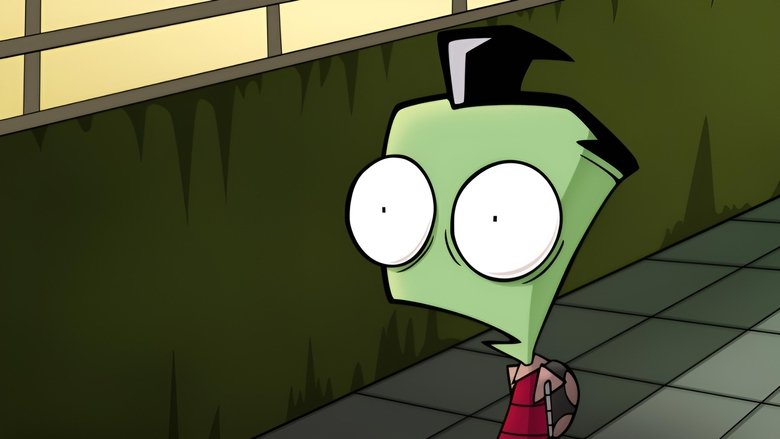
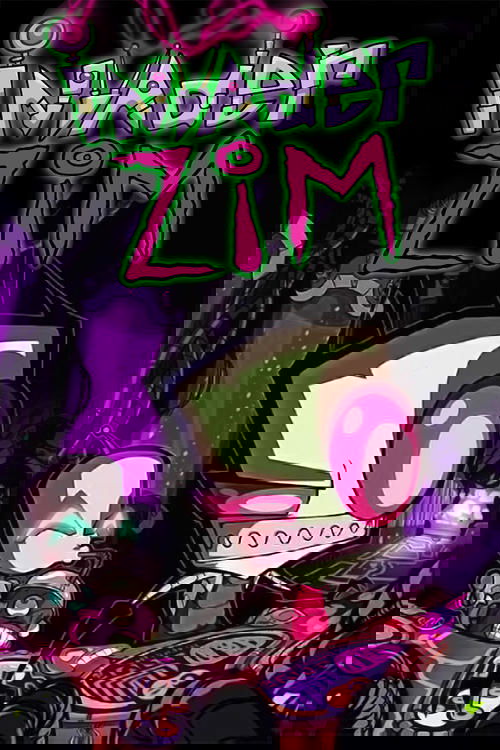
"Bow down and prepare for DOOM!"
Invader ZIM - Symbolism & Philosophy
Symbols & Motifs
Meat and Snack Foods
Meat and various greasy, unhealthy snack foods symbolize the grotesque consumerism and biological foulness of humanity that Zim finds so repulsive. Food in the series is often disgusting and associated with mindless consumption, from the mountains of waffles GIR demands to the meat-based Valentine's tradition.
This motif is present in nearly every episode. Bloaty's Pizza Hog is a recurring location that represents the worst of fast-food culture. In "Tak: The Hideous New Girl," Valentine's Day is celebrated by exchanging sausages. GIR's obsession with tacos and other junk food often derails Zim's plans.
Skool
The elementary school, pointedly spelled "Skool," symbolizes oppressive, spirit-crushing institutions. It is a place of conformity and misery, not learning, run by a terrifying teacher who constantly reminds the children of their impending doom. It represents society's method for enforcing mediocrity and ignorance.
Skool is a primary setting for the series. It's where Zim and Dib's rivalry plays out daily. Episodes like "Career Day" and "The Voting of the Doomed" use the school setting to satirize societal pressures and political systems in microcosm.
Zim's Disguise
Zim's incredibly thin disguise symbolizes humanity's profound lack of awareness and critical thought. The fact that only Dib can see through it illustrates how people will accept any absurdity as normal if it fits their preconceived notions, highlighting societal blindness and apathy.
Zim's disguise is a constant presence. In the first episode, "The Nightmare Begins," the inadequacy of the disguise is immediately established, as is the world's willingness to accept it. Dib's constant, failed attempts to reveal the disguise are a central running gag.
The Dystopian City
The perpetually dark, rainy, and filthy city in which the series is set symbolizes the moral and physical decay of human civilization. It is a visual representation of the show's cynical worldview, where pollution, urban decay, and societal rot are the norm.
The city's grim aesthetic is the backdrop for all of Zim's Earth-based schemes. Its residents are portrayed as dim-witted and unobservant, perfectly matching their squalid environment. The visuals consistently reinforce the theme that humanity lives in a self-made garbage heap.
Philosophical Questions
What is the nature of purpose in an absurd universe?
The series explores this through Zim's mission. His entire existence is dedicated to a goal that is ultimately revealed to be a lie, a cosmic joke played on him by leaders who despise him. When he learns the truth, he is temporarily shattered. However, he quickly creates a new, smaller purpose: tormenting his rival, Dib. The show suggests that in a universe without inherent meaning, individuals must invent their own reasons to exist, even if they are petty or delusional.
Is willful ignorance a survival mechanism?
The entire human race in "Invader ZIM" survives because of its collective stupidity and refusal to see the obvious alien in its midst. Dib, the only one who sees the truth, is ostracized and miserable. The show cynically asks whether it is better to be happy and ignorant or aware and tormented. Humanity's survival is not due to intelligence or strength, but to a profound, almost blissful, apathy.
Does conformity equal morality?
Both Zim and Dib are punished for being different. Zim is an outcast for being defective and annoying, while Dib is an outcast for being intelligent and observant. Both societies, Irken and Human, prize conformity above all else. The series critiques this by making its two non-conformist protagonists the drivers of the entire narrative, suggesting that individuality, while painful, is the only source of genuine action and change in a stagnant world.
Core Meaning
The core meaning of "Invader ZIM" is a deeply cynical and satirical critique of societal structures and human nature. Through its dystopian lens, the series argues that institutions like school, government, and family are inherently flawed and run by incompetents. It suggests that humanity is largely apathetic, unintelligent, and obsessed with mindless consumerism, making it ironically ripe for conquest yet simultaneously saved by its own obliviousness.
Ultimately, the show is a celebration of the outcast. Both Zim and Dib are pariahs among their own people, driven by a desperate need for validation that they never receive. Their endless, pointless conflict suggests that purpose is often self-created in a meaningless universe, and that the struggle of the individual against an absurd and indifferent world is both tragic and profoundly comical.