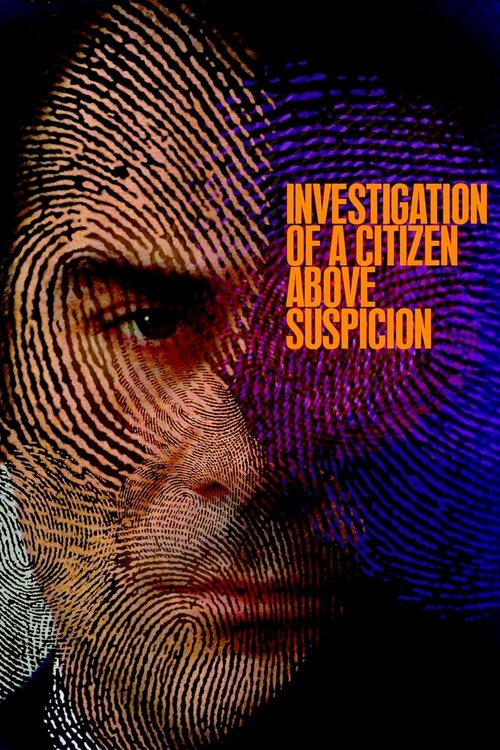
Indagine su un cittadino al di sopra di ogni sospetto
Director: Elio Petri
Cast: Gian Maria Volonté, Florinda Bolkan, Gianni Santuccio, Orazio Orlando, Sergio Tramonti
Investigation of a Citizen Above Suspicion — Characters & Cast
Character Analysis
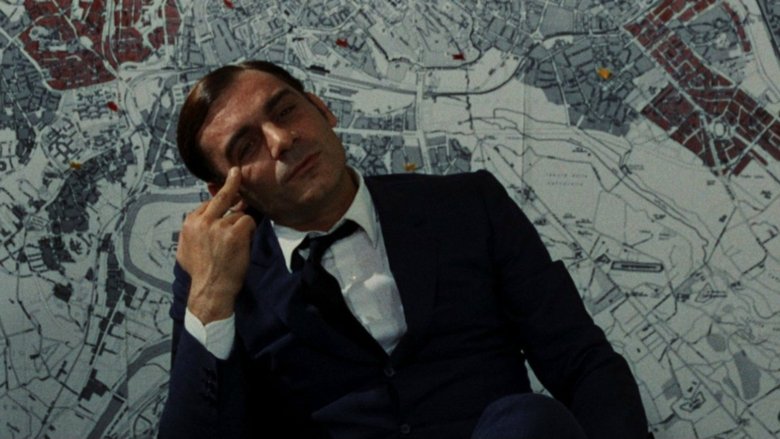
Il Dottore (The Doctor)
Gian Maria Volonté
Motivation
The Doctor's primary motivation is to test the limits of his own power and to prove that he is untouchable. He is driven by a profound sense of arrogance and a belief in his own superiority. His actions are also fueled by a deep-seated insecurity, which is revealed in his relationship with his mistress. He seeks to dominate and control every aspect of his life, and the murder is the ultimate expression of this desire. His motivation is not personal gain in the traditional sense, but the philosophical and psychological affirmation of his place above the moral and legal constraints of society.
Character Arc
The Doctor begins the film as a confident and arrogant police inspector who believes himself to be above the law. His arc is not one of redemption, but of a descent into a specific kind of madness born from his unchecked power. He murders his mistress to prove his immunity, but as the investigation progresses, his need for his guilt to be acknowledged becomes an obsession. By the end of the film, he is a desperate man, not seeking forgiveness, but demanding the validation of his power through the recognition of his crime. His journey is a chilling exploration of how absolute power corrupts absolutely, leading to a complete psychological breakdown.
Augusta Terzi
Florinda Bolkan
Motivation
Augusta is motivated by a desire to explore the boundaries of power and sexuality. She is attracted to the Inspector's authority but also seems to derive pleasure from mocking it. Her motivations are a mixture of masochism, intellectual curiosity, and a self-destructive impulse. She is not simply a passive victim; she actively engages in the psychological games with the Inspector, pushing him to the brink. Her ultimate motivation seems to be a desire to see how far he will go, a curiosity that proves to be fatal.
Character Arc
Augusta's character is revealed primarily through flashbacks. She is a complex woman who is both a victim and a willing participant in the Inspector's power games. Her arc is one of escalating danger as she continuously taunts and challenges his authority. She seems to be drawn to his power, yet she also seeks to undermine it by exposing his vulnerabilities. Ultimately, her provocations lead to her own demise, making her a tragic figure who underestimated the true extent of the Inspector's depravity.
Antonio Pace
Sergio Tramonti
Motivation
Antonio's motivation is rooted in his anarchist beliefs. He sees the Inspector not as an individual criminal, but as a symptom of a corrupt and oppressive system. His refusal to identify the Inspector is a political act, a way of demonstrating the inherent criminality of the state. He believes that a murderer in charge of law enforcement is the perfect embodiment of the system's hypocrisy. His motivation is not to see one man punished, but to expose the rotten core of the entire power structure.
Character Arc
Antonio Pace is a young anarchist who is having an affair with Augusta and witnesses the Inspector leaving her apartment after the murder. His arc is one of a man who holds the key to the Inspector's guilt but chooses not to use it in a conventional way. He represents a different form of opposition to the state, one that is more ideological than legal. He understands that exposing the Inspector would not necessarily change the corrupt system. His arc is one of defiance, as he refuses to play by the rules of a system he despises.
The Police Commissioner
Gianni Santuccio
Motivation
The Commissioner's primary motivation is the preservation of the status quo. He is a career bureaucrat who understands that rocking the boat could be detrimental to his own position. He is motivated by a desire to avoid scandal and to maintain the public's (and his own) faith in the infallibility of the police force. His actions are not necessarily born of personal loyalty to the Inspector, but of a loyalty to the institution he represents. He is motivated by self-preservation and a deep-seated belief in the importance of maintaining the hierarchy of power.
Character Arc
The Police Commissioner represents the institutional inertia and complicity that allows the Inspector to get away with his crime. His arc is essentially static; he remains a symbol of the establishment throughout the film. He is more concerned with maintaining the reputation of the police force than with uncovering the truth. His refusal to even consider the Inspector as a suspect, despite the mounting evidence, demonstrates the deep-seated corruption within the system. He is the embodiment of the power structure that protects its own.
Cast
Explore More About This Movie
Dive deeper into specific aspects of the movie with our detailed analysis pages