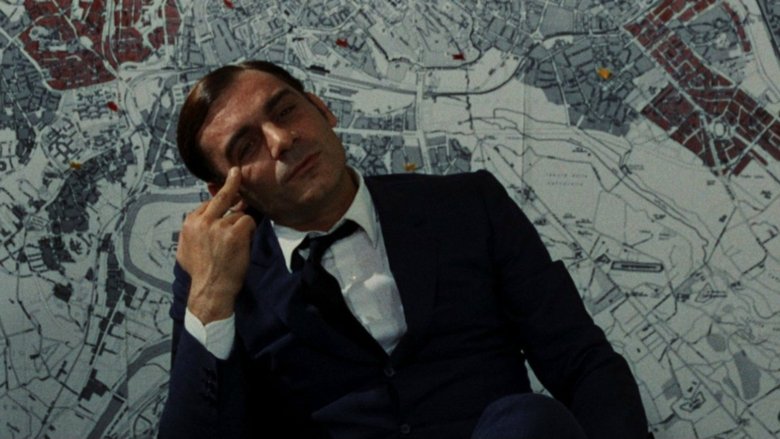
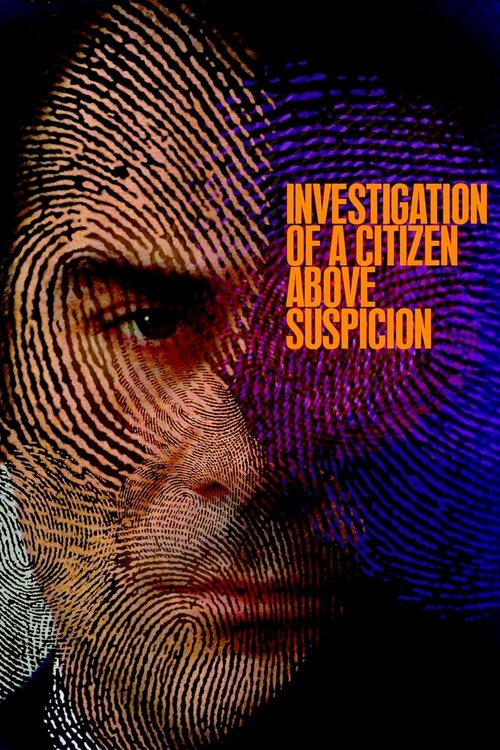
Indagine su un cittadino al di sopra di ogni sospetto
Investigation of a Citizen Above Suspicion - Symbolism & Philosophy
Symbols & Motifs
The Photographs
The photographs that the Inspector takes of Augusta posed as various murder victims symbolize his detached and clinical view of death and violence. They also represent his desire to control and objectify her, reducing her to a series of morbid images. This act blurs the line between his personal and professional life, showing how his obsession with crime has seeped into his intimate relationships. The photos are a chilling premonition of her actual murder and serve as a tangible representation of his psychological decay.
In flashbacks, we see the Inspector arranging Augusta's body in various poses mimicking crime scenes he has investigated. He photographs her in these staged scenarios, turning her into a piece of his macabre collection. This disturbing hobby highlights the power dynamics in their relationship and foreshadows the ultimate act of violence he will commit against her.
The Tie Fiber
The lavender silk tie fiber that the Inspector deliberately leaves under Augusta's fingernail is a symbol of his arrogant challenge to the justice system. It is a direct and undeniable link to him, a clue that he believes his colleagues will be too afraid or too incompetent to properly investigate. The fiber represents his contempt for the investigative process and his absolute certainty that he is untouchable. It is a tangible manifestation of his belief that he is "above suspicion."
After murdering Augusta, the Inspector carefully plants the tie fiber on her body. Throughout the investigation, he repeatedly draws attention to this piece of evidence, almost taunting his subordinates with it. Their failure to connect this clue to him underscores the film's central theme of the impotence of the law in the face of absolute power.
The Wiretapped Conversations
The extensive wiretapping operation that the Inspector oversees in his new position symbolizes the pervasive surveillance and repression of the state. The constant listening in on the private conversations of citizens, particularly political dissidents, highlights the authoritarian nature of the government. It also reflects the Inspector's own paranoia and his obsession with control. The wiretaps create an atmosphere of distrust and fear, where no one is truly free from the prying eyes and ears of the state.
Upon his promotion to the political intelligence division, the Inspector is shown a vast room filled with agents monitoring and recording phone conversations. He embraces this new power with zeal, seeing it as a necessary tool for maintaining order and suppressing dissent. This imagery is a powerful commentary on the erosion of civil liberties in the name of security.
Philosophical Questions
Does absolute power inevitably lead to corruption?
The film explores this question through the character of the Inspector, who begins as a respected and effective police officer but becomes a murderer in his quest to prove his own invincibility. His journey suggests that the constant exercise of power, without any checks or balances, can erode a person's moral compass and lead to a complete detachment from the values they are supposed to uphold. The film presents a deeply pessimistic view on this subject, implying that the very nature of power is to corrupt and that those who wield it are in constant danger of succumbing to its seductive and destructive force.
What is the relationship between law and justice?
"Investigation of a Citizen Above Suspicion" draws a stark distinction between the law as a set of rules and justice as a moral concept. The film argues that the law can be manipulated and subverted by those in power to serve their own interests, rather than to achieve true justice. The Inspector, as a 'servant of the law,' believes he is exempt from its constraints. The film forces the audience to question whether a system that protects the powerful at the expense of the truth can ever be considered just. The closing quote from Kafka reinforces this idea, suggesting that the law is a self-contained system that operates beyond the realm of human morality.
Can an individual ever truly be 'above suspicion'?
The film's title poses this question directly. The Inspector's entire experiment is designed to prove that he is, in fact, above suspicion. While he succeeds in a practical sense, as his colleagues refuse to hold him accountable, the film suggests that he is not above his own psychological torment. His desperate need for his guilt to be recognized shows that, on some level, he is not truly free from the consequences of his actions. The film leaves it to the audience to decide whether being above the law is the same as being above suspicion, and whether a man who is not held accountable by society can ever truly be at peace with himself.
Core Meaning
The core meaning of "Investigation of a Citizen Above Suspicion" is a scathing critique of the corrupting nature of absolute power and the inherent flaws within institutional authority. Director Elio Petri sought to expose how power structures, particularly law enforcement, can become self-serving entities that operate outside the laws they are meant to enforce. The film suggests that those in positions of immense authority can become so detached from moral and legal accountability that they are effectively "above suspicion."
The protagonist's bizarre experiment of framing himself for murder is a powerful allegory for the impunity of the ruling class. He is not a simple psychopath; his actions are a deliberate test of the system, a system he fully expects will protect its own, even at the cost of justice. The film carries a profound message about the psychological effects of power, suggesting it can lead to a form of madness where the only way to feel alive is to push the boundaries of societal norms and laws. Ultimately, Petri's film is a cautionary tale about the dangers of unchecked authority and the ease with which justice can be subverted by those who wield power.