
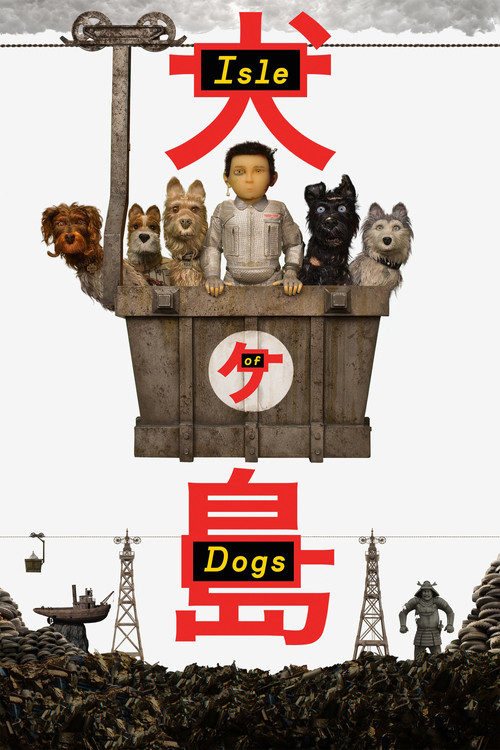
"Loyalty has a scent. And it smells like rebellion."
Isle of Dogs - Symbolism & Philosophy
Symbols & Motifs
Trash Island
Trash Island symbolizes exile, segregation, and the consequences of societal neglect. It is a literal dumping ground for what society deems undesirable—both its garbage and its dogs. It represents a ghetto or concentration camp, a place where a marginalized population is sent to be forgotten and left to perish.
The island is the primary setting for the dogs' story. Its landscape, composed of compressed garbage, toxic sludge, and abandoned structures, visually underscores the dogs' miserable existence and the cruelty of their banishment.
Untranslated Japanese Dialogue
The decision to leave most of the Japanese dialogue unsubtitled serves multiple purposes. For non-Japanese speaking audiences, it immerses them in the dogs' perspective, as they too cannot understand the humans. It also highlights the theme of communication and miscommunication, forcing the viewer to rely on context, tone, and visual cues, just as the characters do. This artistic choice became a central point in discussions about cultural appropriation.
Throughout the film, Atari speaks in Japanese without subtitles. His meaning is conveyed through his actions, the dogs' reactions, or occasional translations from an interpreter character, emphasizing the communication barrier and the emotional connection that transcends it.
Haiku
The haiku Atari recites near the film's climax—"Whatever happened to man's best friend? / Falling spring blossom"—symbolizes a return to empathy and tradition. It is a concise, powerful expression of loss and love that ultimately moves Mayor Kobayashi to have a change of heart, representing the idea that art and emotion can triumph over cold, calculated cruelty.
At the climax, Atari presents this poem to his uncle, Mayor Kobayashi, reminding him of the bond that once existed between humans and dogs. This emotional appeal succeeds where scientific proof and activist protests failed, triggering the story's resolution.
Philosophical Questions
What defines 'personhood' and do non-human animals qualify?
The film deeply explores this question by giving the dogs complex inner lives, emotions, political structures (they vote on decisions), and distinct personalities. They are arguably more 'human' than the actual human villains. By blurring the lines between human and animal, the film challenges the anthropocentric view that personhood is exclusive to humans. It suggests that qualities like loyalty, grief, courage, and the capacity for friendship are the true markers of being a person, regardless of species.
How does language shape our perception of 'the other'?
By having the dogs speak English and the human Japanese characters speak their native language (often untranslated for the English-speaking audience), the film forces the viewer to identify with the non-human characters. It raises questions about empathy and perspective. Can we truly understand someone if we don't speak their language? The film suggests that emotional connection and shared experience can transcend linguistic barriers, as seen between Atari and Chief. At the same time, the controversial choice highlights how language can be used, intentionally or not, to marginalize and create distance.
What is the nature of loyalty in the face of tyranny?
The film presents loyalty as the highest virtue. Atari's loyalty to Spots is the catalyst for the entire plot. This personal loyalty becomes a form of political resistance. In a state that demands conformity and demonizes a segment of the population, Atari's simple, unwavering dedication to his friend is a radical act. The film questions whether loyalty should be to the state or to one's own moral compass and personal bonds.
Core Meaning
At its heart, Isle of Dogs is a powerful allegory about political corruption, propaganda, and the marginalization of entire populations. The film explores how fear can be manipulated by authoritarian leaders to scapegoat a specific group—in this case, dogs—for societal problems. Director Wes Anderson uses the story of a boy's unwavering loyalty to his pet to champion themes of resistance against tyranny, the importance of truth (as pursued by the student activists), and the unbreakable bond between humans and animals. The film ultimately posits that compassion, solidarity, and courage can overcome state-sponsored prejudice and injustice, leading to the restoration of a just and humane society.