The core meaning of "It's a Wonderful Life" is an affirmation of the immense value of every individual's life, regardless of how ordinary or unfulfilled it may seem. Director Frank Capra wanted to celebrate the lives of ordinary American citizens, emphasizing that a person's worth is not measured by wealth or personal achievement, but by the positive impact they have on others. The film carries a powerful message that no person is a failure who has friends and that each life, through a ripple effect of kindness and sacrifice, touches countless others in profound ways. It suggests that true wealth lies in relationships, community, and selfless acts, and that even in moments of deep despair, faith and the love of others can lead to redemption and a renewed appreciation for the simple gift of life.

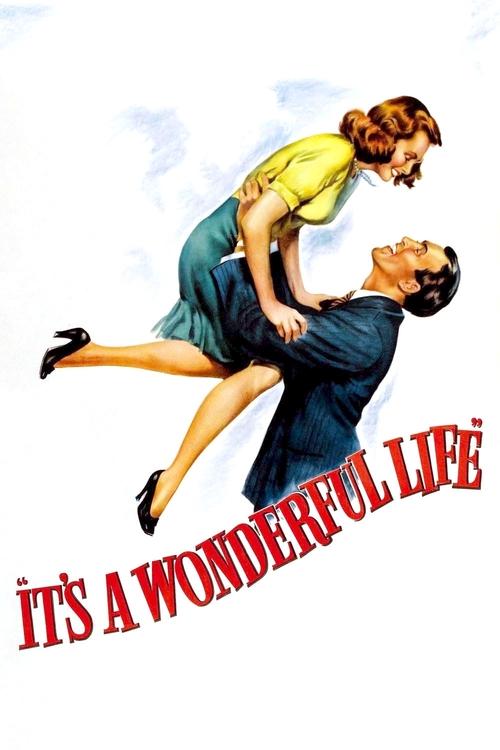
"It's a wonderful laugh! It's a wonderful love!"
Director: Frank Capra
Cast: James Stewart, Donna Reed, Lionel Barrymore, Thomas Mitchell, Henry Travers
It's a Wonderful Life — Symbolism & Philosophy
Symbols & Motifs
Bells
Bells symbolize heavenly intervention and the presence of grace. The most famous line, "Every time a bell rings, an angel gets his wings," directly links the sound to a celestial event.
This motif appears at the end of the film. As the townspeople pour in to help George, a small bell on the Christmas tree rings. His daughter Zuzu reminds him of the saying, and George looks upward and says, "Atta boy, Clarence," acknowledging the angel's success and his own redemption.
The Moon
The moon represents George's youthful, romantic dreams and aspirations. Offering to "lasso the moon" for Mary is a grand, poetic gesture that symbolizes his desire to achieve the impossible for her.
During a romantic walk home from a dance, George tells Mary he will give her the moon. Later, after they are married and have fixed up the dilapidated Granville house, Mary has a drawing of George lassoing the moon, a tender reminder of his promises and their shared dreams.
Broken Bannister Knob
The loose knob on the staircase bannister symbolizes George's frustrations, his feeling of being stuck, and the imperfections of his life in the drafty old house he never wanted.
Throughout the film, George angrily jiggles the loose bannister knob. However, after his transformative experience, he returns home and kisses the knob with joy. It no longer represents his failed dreams but has become a cherished part of the wonderful life he almost threw away.
Zuzu's Petals
Zuzu's petals are a tangible symbol of George's existence and his connection to his family. They are a physical anchor to the life he has, proving that it is real.
Before his despair, George puts his daughter Zuzu's fallen flower petals in his pocket. In the alternate reality where he was never born, the petals disappear. When he begs for his life back and is returned to the bridge, the first thing he checks for is the petals. Finding them in his pocket is the first concrete proof that his precious life has been restored.
The Bridge
The bridge represents a point of transition, a crossing between life and death, hope and despair. It is the physical and emotional precipice of George's journey.
It is on the town bridge that a desperate George Bailey decides to end his life by jumping into the icy water. It is also where Clarence intervenes, jumping in first to be saved by George. The bridge is the setting for George's ultimate crisis and the beginning of his salvation.
Philosophical Questions
What constitutes a 'wonderful' or meaningful life?
The film directly confronts this question through George Bailey's existential crisis. Initially, George believes a wonderful life involves adventure, wealth, and grand achievements—all the things he is denied. The film, through Clarence's intervention, proposes an alternative definition: a life's value is measured by its positive impact on others. It explores objective list theories of worth, suggesting that certain things like love, friendship, and integrity make a life good, regardless of an individual's personal satisfaction or fulfilled desires. George's final, joyous acceptance of his 'ordinary' existence suggests that meaning is found not in personal ambition, but in communal connection and self-sacrifice.
Is self-sacrifice a virtue or a tragedy?
The film can be interpreted through two different lenses on this question. On one hand, it is presented as the ultimate virtue. George's constant sacrifices are what make him a hero and are directly responsible for the well-being of his entire community. His story champions selflessness. On the other hand, a more critical interpretation sees George's life as a tragedy of deferred dreams. It raises the question of whether sacrificing one's own happiness for the sake of others is truly a noble path or a recipe for despair and resentment, a conflict that nearly drives George to suicide.
Does one person's life truly matter in the grand scheme of things?
This is the central existential question the film seeks to answer. George's despair stems from his belief that his life has been insignificant. The entire Pottersville sequence is a powerful cinematic argument for the 'ripple effect,' demonstrating how one person's existence is intricately woven into the fabric of a community. The film unequivocally answers 'yes,' arguing that every life has immense, often unknowable, significance and that removing one person creates an "awful hole."
Core Meaning
Explore More About This Movie
Dive deeper into specific aspects of the movie with our detailed analysis pages