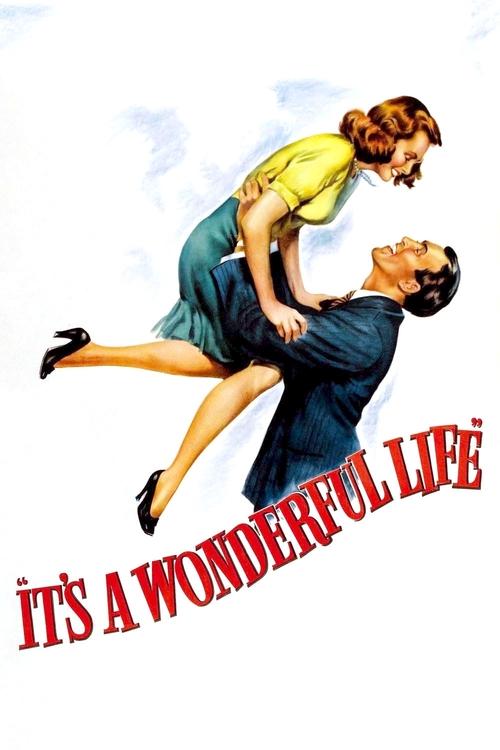
It's a Wonderful Life
A heart-wrenching yet ultimately uplifting fantasy drama that explores the profound impact of a single life, painting a poignant cinematic portrait of despair and redemption.
It's a Wonderful Life

It's a Wonderful Life

"It's a wonderful laugh! It's a wonderful love!"

20 December 1946 United States of America 130 min ⭐ 8.3 (4,607)
Director: Frank Capra
Cast: James Stewart, Donna Reed, Lionel Barrymore, Thomas Mitchell, Henry Travers
Drama Family Fantasy
The Value of the Individual Sacrifice vs. Personal Ambition Community vs. Greed Faith and Despair
Budget: $3,180,000
Box Office: $9,644,124

Overview

"It's a Wonderful Life" tells the story of George Bailey, a man who has consistently sacrificed his own dreams and ambitions for the well-being of his family and the small town of Bedford Falls. From a young age, George has aspirations of traveling the world and building great things, but circumstances always seem to conspire to keep him at home, running his family's modest building and loan company.

The Bailey Building and Loan is the only thing preventing the ruthless and miserly Mr. Potter from gaining complete financial control over the town. On Christmas Eve, a devastating financial crisis pushes George to the brink of despair. Believing he is a failure and that his life has been meaningless, he contemplates suicide.

It is at this lowest point that a gentle, second-class angel named Clarence Odbody is sent to Earth to intervene. To show George the true value of his existence, Clarence grants his wish that he had never been born, revealing a bleak and harsh alternate reality where his absence has had a catastrophic impact on everyone he knows and loves.
Core Meaning

The core meaning of "It's a Wonderful Life" is an affirmation of the immense value of every individual's life, regardless of how ordinary or unfulfilled it may seem. Director Frank Capra wanted to celebrate the lives of ordinary American citizens, emphasizing that a person's worth is not measured by wealth or personal achievement, but by the positive impact they have on others. The film carries a powerful message that no person is a failure who has friends and that each life, through a ripple effect of kindness and sacrifice, touches countless others in profound ways. It suggests that true wealth lies in relationships, community, and selfless acts, and that even in moments of deep despair, faith and the love of others can lead to redemption and a renewed appreciation for the simple gift of life.

Thematic DNA

The Value of the Individual 35%
Sacrifice vs. Personal Ambition 30%
Community vs. Greed 25%
Faith and Despair 10%

The Value of the Individual

The central theme is the profound importance and impact of a single individual's life. George Bailey feels like a failure because he never achieved his grand dreams of travel and fortune. However, Clarence the angel shows him that his seemingly small life of service in Bedford Falls created countless positive ripples. Without him, the town becomes the cynical and corrupt Pottersville, his brother would have died as a child, and the lives of his friends and family would be tragically diminished. The film argues that a person's true worth is measured by the love they share and the positive influence they have on their community, a message encapsulated in Clarence's note: "Remember no man is a failure who has friends."

Sacrifice vs. Personal Ambition

George's life is a continuous series of sacrifices, putting the needs of his family and community before his own ambitions. He gives up his world travels, his college education, and a lucrative job offer to keep the Building & Loan afloat and protect the townspeople from Mr. Potter's greed. This internal conflict between his personal dreams and his sense of duty drives much of the film's drama and George's eventual despair. The film ultimately posits that these sacrifices, while painful, are what give his life meaning and lead to his salvation, suggesting that a life lived for others is the most 'wonderful' life of all.

Community vs. Greed

The film presents a stark contrast between two competing ideologies: the communal spirit of the Bailey Building & Loan and the predatory capitalism of Mr. Potter. Potter represents unchecked greed and a belief that wealth is the only measure of success; he seeks to own and control everything in Bedford Falls. George, on the other hand, champions the idea of community, providing affordable housing and support for the working class, believing that everyone deserves a decent life. The film's climax, where the community rallies to save George, is a powerful endorsement of collective goodwill triumphing over individual avarice.

Faith and Despair

George Bailey's journey is one of faith tested to its absolute limit. He starts with youthful optimism, but life's repeated disappointments slowly erode his spirit, culminating in a moment of utter despair where he questions the value of his own existence and even God. His desperate prayer at the bar is a turning point, leading to divine intervention. The film suggests that it is often in our darkest moments, when all hope seems lost, that faith can be reborn. George's journey through the nightmarish Pottersville restores his faith not just in a higher power, but in the goodness of his own life and the people around him.

Character Analysis

George Bailey

James Stewart

Archetype: The Everyman Hero
Key Trait: Self-sacrificing

Motivation

George's primary motivation is a deep-seated sense of duty and compassion for his family and community. Despite his personal desires for adventure and success, he is fundamentally driven to protect the people of Bedford Falls from the greed of Mr. Potter and to uphold his father's legacy of providing dignified, affordable housing for the working class.

Character Arc

George Bailey begins as a young man with grand dreams of escaping his small town to see the world and build modern wonders. However, a series of familial and communal obligations forces him to repeatedly sacrifice his ambitions. Over the years, this sacrifice wears on him, leading to frustration and a sense of failure. This culminates in a moment of profound despair on Christmas Eve, where he believes his life has been worthless and contemplates suicide. Through the intervention of his guardian angel, Clarence, George is shown an alternate reality where he never existed. This experience forces him to see the immense positive impact he has had, leading to a profound epiphany. He returns to his life with overwhelming gratitude and joy, finally understanding that his seemingly ordinary life was, in fact, truly wonderful.

Mary Hatch Bailey

Donna Reed

Archetype: The Supportive Partner
Key Trait: Steadfast

Motivation

Mary is motivated by her deep and abiding love for George and her unwavering belief in family and community. She shares his values of generosity and compassion and helps him build a life rooted in those principles, even when he himself loses sight of their importance. Her goal is to create a happy, stable home and to support George through all his trials.

Character Arc

Mary has loved George since childhood and remains a steadfast, grounding force in his life. Her arc is less about transformation and more about quiet strength and perseverance. She confidently knows what she wants—a life with George in Bedford Falls—and works to create it. When George's dreams crumble, she provides unwavering support, creating a loving home and even using their honeymoon money to save the Building & Loan. In the film's final crisis, it is Mary who takes decisive action, rallying the townspeople to come to George's aid. She represents the stability, love, and community that George learns to appreciate.

Mr. Potter

Lionel Barrymore

Archetype: The Antagonist / The Tyrant
Key Trait: Miserly

Motivation

Potter is motivated by an insatiable desire for money and power. He despises the Baileys' business model, which empowers the working class and threatens his control. His actions are driven by pure, unapologetic greed and a contempt for what he calls the "rabble."

Character Arc

Mr. Potter is a static character who undergoes no development. He is the richest and most powerful man in town, embodying avarice and misanthropy. Throughout the film, he relentlessly tries to crush the Bailey Building & Loan to establish a complete monopoly over Bedford Falls. He shows no compassion, famously telling George he is "worth more dead than alive." His arc is flat; he begins as a villain and ends as one, unpunished for his theft of the $8,000, serving as a constant representation of the corrupting influence of greed.

Clarence Odbody

Henry Travers

Archetype: The Mentor / The Guardian
Key Trait: Benevolent

Motivation

Clarence's stated motivation is to earn his wings. However, his deeper purpose is to provide George with a crucial change in perspective. He is a divine messenger sent to restore a desperate man's faith and show him that his life has profound meaning.

Character Arc

Clarence is an Angel Second Class who has been waiting over 200 years to earn his wings. He is introduced as a gentle, somewhat naive celestial being tasked with saving George. His arc involves proving his worth as a guardian angel. By successfully showing George the true value of his life, Clarence not only saves a mortal but also achieves his own long-awaited goal. His final act is leaving George a book with the inscription, "Remember no man is a failure who has friends," summarizing the film's core lesson and signifying the completion of his mission.

Symbols & Motifs

Bells

Meaning:

Bells symbolize heavenly intervention and the presence of grace. The most famous line, "Every time a bell rings, an angel gets his wings," directly links the sound to a celestial event.

Context:

This motif appears at the end of the film. As the townspeople pour in to help George, a small bell on the Christmas tree rings. His daughter Zuzu reminds him of the saying, and George looks upward and says, "Atta boy, Clarence," acknowledging the angel's success and his own redemption.

The Moon

Meaning:

The moon represents George's youthful, romantic dreams and aspirations. Offering to "lasso the moon" for Mary is a grand, poetic gesture that symbolizes his desire to achieve the impossible for her.

Context:

During a romantic walk home from a dance, George tells Mary he will give her the moon. Later, after they are married and have fixed up the dilapidated Granville house, Mary has a drawing of George lassoing the moon, a tender reminder of his promises and their shared dreams.

Broken Bannister Knob

Meaning:

The loose knob on the staircase bannister symbolizes George's frustrations, his feeling of being stuck, and the imperfections of his life in the drafty old house he never wanted.

Context:

Throughout the film, George angrily jiggles the loose bannister knob. However, after his transformative experience, he returns home and kisses the knob with joy. It no longer represents his failed dreams but has become a cherished part of the wonderful life he almost threw away.

Zuzu's Petals

Meaning:

Zuzu's petals are a tangible symbol of George's existence and his connection to his family. They are a physical anchor to the life he has, proving that it is real.

Context:

Before his despair, George puts his daughter Zuzu's fallen flower petals in his pocket. In the alternate reality where he was never born, the petals disappear. When he begs for his life back and is returned to the bridge, the first thing he checks for is the petals. Finding them in his pocket is the first concrete proof that his precious life has been restored.

The Bridge

Meaning:

The bridge represents a point of transition, a crossing between life and death, hope and despair. It is the physical and emotional precipice of George's journey.

Context:

It is on the town bridge that a desperate George Bailey decides to end his life by jumping into the icy water. It is also where Clarence intervenes, jumping in first to be saved by George. The bridge is the setting for George's ultimate crisis and the beginning of his salvation.

Memorable Quotes

What is it you want, Mary? What do you want? You want the moon? Just say the word and I'll throw a lasso around it and pull it down.

— George Bailey

Context:

Spoken during a walk home with Mary after a high school dance. They have just shared a moment throwing rocks at the old Granville house, making wishes. This line is George's passionate, slightly hyperbolic declaration of his feelings for her.

Meaning:

This quote captures George's youthful idealism and romantic nature. It shows his big dreams and the grand promises he makes, symbolizing his desire to achieve the impossible for the woman he loves, long before life forces him into a more pragmatic existence.

Each man's life touches so many other lives. When he isn't around he leaves an awful hole, doesn't he?

— Clarence Odbody

Context:

Clarence says this to George during the alternate reality sequence. They have just visited George's mother, who, without him, is a bitter, cold woman who doesn't recognize him. This is one of the first moments George begins to grasp the devastating consequences of his absence.

Meaning:

This line explicitly states the film's central theme: the interconnectedness of human lives and the idea that every person has a significant, often unseen, impact on the world. It is the core lesson Clarence is trying to teach George.

Remember, no man is a failure who has friends.

— Clarence Odbody

Context:

This is the final message of the film, written by Clarence in a copy of "The Adventures of Tom Sawyer" that he leaves for George. George reads it at the end, surrounded by the friends and townspeople who have come to bail him out of his financial trouble.

Meaning:

This quote serves as the film's ultimate moral, redefining success. It posits that true wealth is not monetary but is found in the love and loyalty of friends and family. It directly refutes George's belief that his financial ruin has made him a failure.

Teacher says, every time a bell rings, an angel gets his wings.

— Zuzu Bailey

Context:

In the final scene, as George celebrates with his family and friends, a bell on the Christmas tree rings. His youngest daughter, Zuzu, says this line. George looks up with a knowing smile and says, "Atta boy, Clarence," affirming his newfound faith and gratitude.

Meaning:

This innocent, heartwarming line provides a moment of magical closure. It confirms for George (and the audience) that Clarence has succeeded in his mission, tying George's earthly redemption to a celestial reward and reinforcing the film's fantasy elements.

In the whole vast configuration of things, I'd say you were nothing but a scurvy little spider!

— George Bailey

Context:

George says this to Mr. Potter in his office after Potter has refused him a loan and insulted him. It's a moment of righteous anger before George's complete descent into despair.

Meaning:

This outburst reveals George's deep-seated contempt for Mr. Potter's greed and soullessness. It's a moment where George, despite his own troubles, stands up to the film's embodiment of evil, asserting a moral framework where Potter's wealth means nothing in the grand scheme of things.

Philosophical Questions

What constitutes a 'wonderful' or meaningful life?

The film directly confronts this question through George Bailey's existential crisis. Initially, George believes a wonderful life involves adventure, wealth, and grand achievements—all the things he is denied. The film, through Clarence's intervention, proposes an alternative definition: a life's value is measured by its positive impact on others. It explores objective list theories of worth, suggesting that certain things like love, friendship, and integrity make a life good, regardless of an individual's personal satisfaction or fulfilled desires. George's final, joyous acceptance of his 'ordinary' existence suggests that meaning is found not in personal ambition, but in communal connection and self-sacrifice.

Is self-sacrifice a virtue or a tragedy?

The film can be interpreted through two different lenses on this question. On one hand, it is presented as the ultimate virtue. George's constant sacrifices are what make him a hero and are directly responsible for the well-being of his entire community. His story champions selflessness. On the other hand, a more critical interpretation sees George's life as a tragedy of deferred dreams. It raises the question of whether sacrificing one's own happiness for the sake of others is truly a noble path or a recipe for despair and resentment, a conflict that nearly drives George to suicide.

Does one person's life truly matter in the grand scheme of things?

This is the central existential question the film seeks to answer. George's despair stems from his belief that his life has been insignificant. The entire Pottersville sequence is a powerful cinematic argument for the 'ripple effect,' demonstrating how one person's existence is intricately woven into the fabric of a community. The film unequivocally answers 'yes,' arguing that every life has immense, often unknowable, significance and that removing one person creates an "awful hole."

Alternative Interpretations

Despite its heartwarming reputation, "It's a Wonderful Life" has been subject to several darker and more cynical interpretations. Some critics view the film not as a celebration of community, but as a profoundly pessimistic tale of a man trapped by circumstance. In this reading, George Bailey never escapes Bedford Falls; his dreams are permanently thwarted, and the happy ending is merely a temporary reprieve, a placation that reinforces his confinement.

Film historian Andrew Sarris called it "one of the most profoundly pessimistic tales of human existence ever to achieve a lasting popularity." This perspective argues that Pottersville, the alternate town, is not a fantasy but a more realistic depiction of the world, and George's return to Bedford Falls is a retreat into a comforting illusion. The fact that Mr. Potter, the villain, faces no consequences for stealing the $8,000 is often cited as evidence of the story's underlying cynicism about justice.

Another theory places a sinister spin on Mary's character. One fan theory suggests that Mary's secret wish to marry George and stay in Bedford Falls is the catalyst for all of George's misfortunes, from his father's stroke to the Great Depression, arguing that fate itself conspired to trap him so her wish could come true.

Cultural Impact

Initially a box office flop upon its 1946 release, "It's a Wonderful Life" is a prime example of a film finding its audience and cultural significance over time. Post-WWII audiences were perhaps not in the mood for its dark, existential themes mixed with sentimentality. However, the film's fortunes changed dramatically in 1974 when its copyright was not renewed, placing it in the public domain. Television stations began broadcasting it frequently during the holiday season without needing to pay royalties, and it was through this repeated exposure that it became a quintessential Christmas classic.

The film's influence on cinema is immense. Its narrative structure—examining a protagonist's life through flashbacks and an alternate reality—has been parodied and paid homage to in countless films and television shows, from "Married... with Children"'s "It's a Bundyful Life" to "Donnie Darko" and the music video for Billy Joel's "You're Only Human (Second Wind)". The characters of George Bailey, Mary Hatch, Mr. Potter, and Clarence have become iconic archetypes in American culture.

Philosophically, the film resonates deeply with themes of existentialism, community, and the definition of a meaningful life. It asks profound questions about individual worth and the struggle between personal dreams and communal responsibility. Today, "It's a Wonderful Life" is considered one of the greatest films ever made, lauded by the American Film Institute as one of the most inspirational American films of all time. Frank Capra himself considered it his favorite among his own films, a powerful fable about the importance of the individual.

Audience Reception

Upon its initial release in 1946, "It's a Wonderful Life" received mixed reviews and was a financial disappointment, failing to make a profit at the box office. While some critics praised it, many found it overly sentimental or too dark for the post-war audience that was craving lighter fare. However, its reputation underwent a massive transformation decades later. After its copyright lapsed in 1974, it became a television staple during the Christmas season. This constant exposure allowed the film to be rediscovered by new generations, and it grew into one of the most beloved and acclaimed films of all time. Today, audiences overwhelmingly praise its heartwarming message, timeless themes, and James Stewart's powerful performance. The primary points of praise are its uplifting message about the value of each individual, the importance of community, and its emotional depth. While some modern viewers still find it slow-paced in its first half, the emotional impact of the film's climax is almost universally celebrated. It is now widely considered an essential holiday classic and a masterpiece of American cinema.

Interesting Facts

  • The film was shot during a heatwave in the summer of 1946, with temperatures often reaching over 90°F. The cast had to wear heavy winter coats in the scorching heat.
  • The expansive town of Bedford Falls was one of the largest American film sets ever built at the time, covering four acres of RKO's Encino Ranch. It included 75 buildings and a 300-yard-long main street.
  • A new type of artificial snow was developed for the film. Previously, painted cornflakes were used, but they were so loud that dialogue had to be dubbed later. The new mixture of foamite (a fire-extinguishing chemical), soap, and water was silent, allowing for live sound recording. The RKO Effects Department won a technical Oscar for this innovation.
  • The scene where Uncle Billy drunkenly stumbles off-screen and crashes into trash cans was an unscripted accident. A crew member dropped a tray of props, and actor Thomas Mitchell improvised the line, "I'm all right! I'm all right!" Director Frank Capra loved the authenticity and kept it in, giving the clumsy crewman a $10 bonus.
  • The retractable gym floor that opens up to reveal a swimming pool was not a set. It was a real feature at Beverly Hills High School, and it still exists.
  • Donna Reed, who played Mary, actually broke the window of the Granville house on the first take. The crew had a stuntman ready to break it for her, but she surprised everyone with her strong throwing arm, which she developed playing baseball in high school.
  • Initially, the film was a box office disappointment, failing to recoup its $3.7 million budget on its first run. It only became a beloved Christmas classic decades later when its copyright lapsed in 1974, allowing television stations to broadcast it royalty-free.
  • James Stewart cited George Bailey as his favorite role of his career. The role was also emotionally taxing; during the scene where George prays in the bar, Stewart was so overcome with emotion that he began to sob uncontrollably.
  • The actor H.B. Warner, who played the druggist Mr. Gower, was reportedly a method actor and got drunk for the scene where he has to slap young George Bailey. The child actor, Robert J. Anderson, said the slaps were real and made his ear bleed.

Easter Eggs

Bert the cop and Ernie the cab driver share names with two famous characters from Sesame Street.

This is a long-standing coincidence that has led to a popular fan theory. Sesame Street writer Jerry Juhl has stated that it's purely coincidental and that the characters were not named after the film's duo. However, the connection remains a fun piece of pop culture trivia for fans of both classics.

In the background of a shot in Gower's drugstore, there is a sign for 'Vaseline Hair Tonic,' a product from the company Chesebrough-Ponds, whose president, Philip Van Doren Stern, wrote 'The Greatest Gift,' the short story on which the film is based.

This appears to be a subtle nod to the story's originator. The film's journey began when Stern sent his privately printed story to friends as a Christmas card, eventually catching the attention of Hollywood producers.

⚠️ Spoiler Analysis

Click to reveal detailed analysis with spoilers

Frequently Asked Questions

Explore More About This Movie

Dive deeper into specific aspects of the movie with our detailed analysis pages

Comments (0)

Leave a comment

No comments yet. Be the first to share your thoughts!