
It's Such a Beautiful Day - Symbolism & Philosophy
Symbols & Motifs
The Hat
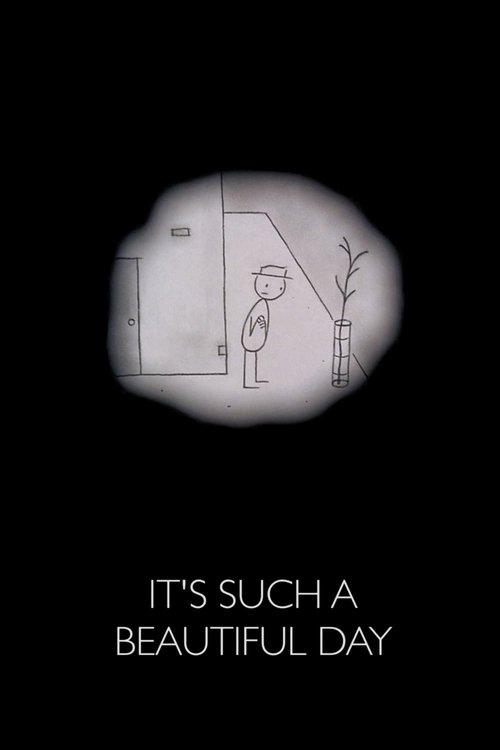
Bill's hat is his defining visual characteristic and can be seen as a symbol of his identity. As his mind deteriorates, the hat remains a constant, a simple signifier of self that persists even as his memories and cognitive abilities fade.
The hat is present on Bill's head throughout the majority of the film, making him identifiable as the protagonist in the minimalist visual landscape.
Live-Action Footage
The interspersed live-action footage often symbolizes moments of clarity or a breakthrough into a more profound, unfiltered reality. As Bill's perception changes, the live-action elements become more frequent and vibrant, suggesting a heightened awareness of the world's beauty.
These clips, often of nature or abstract patterns, are woven into the animated narrative, particularly as Bill's illness progresses and he begins to appreciate the world around him more deeply.
The Monstrous Fish Head
In a recurring hallucination, Bill imagines a monstrous fish head eating his own. This symbolizes his illness and the way it is consuming his mind and identity. It is a graphic and surreal representation of his internal struggle and the feeling of being devoured by his condition.
This image appears during moments of intense psychological distress and hallucinations, visually articulating the destructive nature of Bill's neurological disorder.
Philosophical Questions
Does a finite life have more meaning than an infinite one?
The film explores this question through its ending. While Bill achieves a form of immortality in the narrator's fantasy, this endless existence is portrayed as one where everything eventually loses meaning. By contrasting this with Bill's profound appreciation for life in his final days, the film suggests that it is the very fact of our limited time that imbues our experiences with value and significance.
What is the relationship between memory and identity?
Through Bill's struggle with memory loss, the film questions the stability of identity. As Bill's memories become fragmented and unreliable, his sense of self begins to dissolve. This raises the question of whether we are more than just the sum of our memories and what remains of a person when their past is erased.
Can we find meaning in a seemingly absurd and indifferent universe?
The film delves into absurdist and existentialist philosophy, portraying a universe that is often chaotic and devoid of inherent meaning. However, through Bill's journey, it suggests that meaning is not something to be found, but rather something to be created through our own perception and appreciation of the present moment. Even in the midst of suffering, the film argues for the possibility of finding profound beauty and meaning in the act of existence itself.
Core Meaning
The core meaning of "It's Such a Beautiful Day" is a profound meditation on the human condition, suggesting that the beauty and value of life are intrinsically linked to its impermanence. The film posits that our fear of death often prevents us from truly living, and it is only in confronting our mortality that we can begin to appreciate the small, seemingly insignificant moments that constitute a life. Through Bill's deteriorating mind, Don Hertzfeldt explores the idea that memory is fragile and subjective, and that our identity is a constantly shifting construct. Ultimately, the film argues for an embrace of the present moment and a recognition of the extraordinary beauty that can be found in the mundane, even in the face of suffering and decay.