It's Such a Beautiful Day
Overview
"It's Such a Beautiful Day" is an experimental animated film by Don Hertzfeldt that chronicles the life of Bill, a simple stick figure, as he grapples with a debilitating and unnamed neurological disorder. The film is presented as a trilogy of short films – "Everything Will Be OK," "I Am So Proud of You," and "It's Such a Beautiful Day" – that seamlessly blend to tell Bill's story. Through a non-linear narrative, we witness Bill's mundane life punctuated by increasingly surreal and disturbing hallucinations, memory loss, and seizures.
The story unfolds through the third-person narration of Hertzfeldt himself, offering a glimpse into Bill's disjointed thoughts and anxieties. As his condition worsens, Bill's perception of reality begins to warp, leading to a profound and often darkly humorous exploration of his past, his family's history of mental illness, and his own mortality. The film masterfully juxtaposes the bleakness of Bill's situation with moments of unexpected beauty and clarity, forcing both Bill and the audience to confront deep philosophical questions about life, death, and the nature of consciousness.

Core Meaning
The core meaning of "It's Such a Beautiful Day" is a profound meditation on the human condition, suggesting that the beauty and value of life are intrinsically linked to its impermanence. The film posits that our fear of death often prevents us from truly living, and it is only in confronting our mortality that we can begin to appreciate the small, seemingly insignificant moments that constitute a life. Through Bill's deteriorating mind, Don Hertzfeldt explores the idea that memory is fragile and subjective, and that our identity is a constantly shifting construct. Ultimately, the film argues for an embrace of the present moment and a recognition of the extraordinary beauty that can be found in the mundane, even in the face of suffering and decay.
Thematic DNA
Mortality and the Fear of Death
The film delves deeply into the universal fear of death, showing how it can paralyze and distract from the act of living. Bill's anxieties about his own demise are a constant presence, yet as he gets closer to the end, he realizes the absurdity of this lifelong fear. The film suggests that death is not something to be feared but rather the very thing that gives life its meaning and urgency.
The Beauty in the Mundane
A central theme is the discovery of profound beauty in everyday life. As Bill's cognitive functions decline, his perception shifts, allowing him to see the world with a newfound sense of wonder. The film highlights that ordinary objects and routines hold an inherent beauty that we often overlook in our preoccupation with larger anxieties.
Memory and Identity
"It's Such a Beautiful Day" explores the fragility of memory and its integral role in shaping our identity. Bill's struggle with memory loss and confabulated memories raises questions about who we are without our past. The non-linear narrative and surreal imagery mimic the chaotic nature of a mind coming apart, suggesting that our sense of self is a fluid and often unreliable narrative.
Mental Illness and Isolation
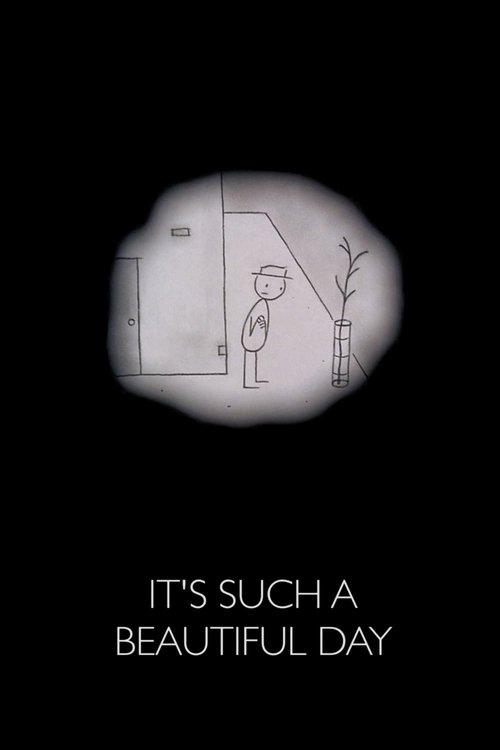
The film provides a poignant and empathetic portrayal of mental illness and the profound sense of isolation it can create. Bill's internal experiences are depicted as a world unto themselves, incomprehensible to those around him. This theme is amplified by the visual style, which often confines Bill to small, isolated sections of the screen.
Character Analysis
Bill
Don Hertzfeldt (narrator)
Motivation
Initially, Bill's motivation is simply to get through his daily routines and manage his anxieties. As his illness progresses, his motivation shifts to a desperate attempt to hold onto his memories and make sense of his fragmenting reality. Ultimately, his motivation becomes a pure, unburdened experience of the present moment.
Character Arc
Bill begins as a detached and anxious individual, living a mundane life filled with repetitive routines and a pervasive fear of death. His neurological illness forces him on an inward journey, and as his mental faculties decline, he paradoxically begins to experience a spiritual awakening. He moves from a state of existential dread to one of profound appreciation for the present moment, finding beauty in the world he had previously ignored. His journey culminates in a form of acceptance, even as his identity dissolves.
The Narrator
Don Hertzfeldt
Motivation
The narrator's primary motivation is to tell Bill's story. However, this evolves into a desire to make sense of Bill's suffering and ultimately, to save him from his fate, even if only through a flight of narrative fancy.
Character Arc
The narrator starts as a seemingly objective storyteller, recounting the events of Bill's life in a deadpan tone. However, as the film progresses, the narrator's emotional investment in Bill becomes apparent. The line between objective narration and Bill's inner monologue blurs, suggesting the narrator may be a manifestation of Bill's consciousness. In the end, the narrator actively rebels against Bill's impending death, choosing to imagine an eternal existence for him.
Sara Cushman (voice)
Sara Cushman
Motivation
Her motivation is to diagnose and treat Bill's condition according to medical protocols. She represents the external world's attempt to understand and categorize Bill's experiences.
Character Arc
Sara Cushman's character, primarily the voice of Bill's doctor, represents the clinical and often detached perspective of the medical world. Her role is to deliver diagnoses and prognoses, grounding Bill's surreal experiences in a medical reality. Her presence highlights the limitations of science in the face of the profound mysteries of the mind and existence.
Symbols & Motifs
The Hat
Bill's hat is his defining visual characteristic and can be seen as a symbol of his identity. As his mind deteriorates, the hat remains a constant, a simple signifier of self that persists even as his memories and cognitive abilities fade.
The hat is present on Bill's head throughout the majority of the film, making him identifiable as the protagonist in the minimalist visual landscape.
Live-Action Footage
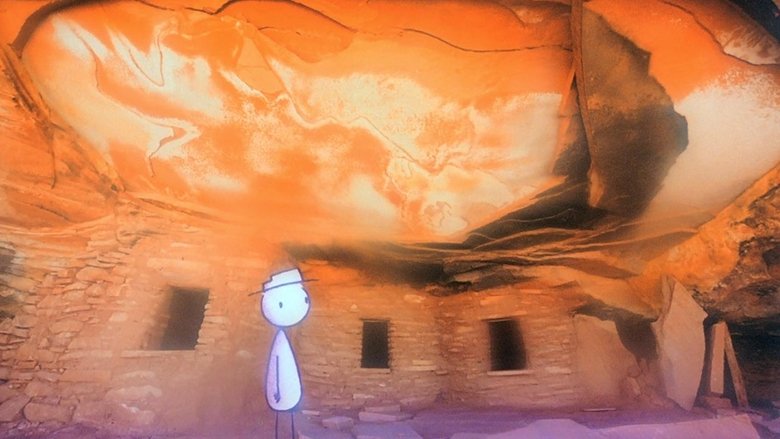
The interspersed live-action footage often symbolizes moments of clarity or a breakthrough into a more profound, unfiltered reality. As Bill's perception changes, the live-action elements become more frequent and vibrant, suggesting a heightened awareness of the world's beauty.
These clips, often of nature or abstract patterns, are woven into the animated narrative, particularly as Bill's illness progresses and he begins to appreciate the world around him more deeply.
The Monstrous Fish Head
In a recurring hallucination, Bill imagines a monstrous fish head eating his own. This symbolizes his illness and the way it is consuming his mind and identity. It is a graphic and surreal representation of his internal struggle and the feeling of being devoured by his condition.
This image appears during moments of intense psychological distress and hallucinations, visually articulating the destructive nature of Bill's neurological disorder.
Memorable Quotes
And as the sun continues to set, he finally comes to realize the dumb irony in how he'd been waiting for this moment his entire life, this stupid, awkward moment of death that had invaded and distracted so many days with stress and wasted time.
— Narrator
Context:
This line is narrated as Bill is confronting the finality of his illness, reflecting on a life spent in apprehension of its end.
Meaning:
This quote encapsulates one of the film's central themes: the foolishness of fearing death to the point of not living. It highlights the anticlimactic nature of what Bill had built up in his mind as a monumental event.
His bathmats...are gorgeous. The grain pattern in his cheap wood cabinets vibrates something deep within him..
— Narrator
Context:
This is narrated after Bill has been told he doesn't have long to live, and his senses are heightened to the beauty of his everyday surroundings.
Meaning:
This quote illustrates Bill's profound shift in perception. As his mind unravels, he begins to see the intense beauty in the most mundane objects, things he had previously overlooked.
Isn't everything amazing?
— Narrator (reflecting Bill's thoughts)
Context:
This thought occurs to Bill as he is driving, desperately trying to absorb as much of the world as he can before he dies.
Meaning:
This question marks the pinnacle of Bill's epiphany. It is a moment of pure, unadulterated wonder at the sheer fact of existence, a feeling that transcends his personal suffering.
Philosophical Questions
Does a finite life have more meaning than an infinite one?
The film explores this question through its ending. While Bill achieves a form of immortality in the narrator's fantasy, this endless existence is portrayed as one where everything eventually loses meaning. By contrasting this with Bill's profound appreciation for life in his final days, the film suggests that it is the very fact of our limited time that imbues our experiences with value and significance.
What is the relationship between memory and identity?
Through Bill's struggle with memory loss, the film questions the stability of identity. As Bill's memories become fragmented and unreliable, his sense of self begins to dissolve. This raises the question of whether we are more than just the sum of our memories and what remains of a person when their past is erased.
Can we find meaning in a seemingly absurd and indifferent universe?
The film delves into absurdist and existentialist philosophy, portraying a universe that is often chaotic and devoid of inherent meaning. However, through Bill's journey, it suggests that meaning is not something to be found, but rather something to be created through our own perception and appreciation of the present moment. Even in the midst of suffering, the film argues for the possibility of finding profound beauty and meaning in the act of existence itself.
Alternative Interpretations
One of the most debated aspects of the film is its ending. The primary interpretation is that Bill does indeed die, and the final sequence of him living an immortal life is a fantasy created by the narrator (or Bill's own dying consciousness) as a way to cope with the finality of death. This reading emphasizes the film's message about the value of a finite existence.
An alternative interpretation is that the ending is a literal depiction of Bill's transcendence. In this view, Bill's consciousness breaks free from the limitations of his physical body and experiences a timeless, eternal existence. This interpretation leans into the more metaphysical and spiritual elements of the film, suggesting a more optimistic, albeit abstract, conclusion to Bill's journey.
A third perspective suggests that the entire film is a metaphor for the process of creating art. Bill's deteriorating mind and his subsequent re-engagement with the world can be seen as a representation of the artist's struggle to deconstruct and then reassemble reality in a meaningful way. The final act of the narrator continuing Bill's story could be seen as the artwork taking on a life of its own, independent of its creator.
Cultural Impact
"It's Such a Beautiful Day" has had a significant cultural impact, particularly within the realm of independent animation. Upon its release, it received widespread critical acclaim and has since been regarded as one of the greatest animated films of all time. The film's unique visual style, which combines simple stick-figure animation with complex in-camera effects and live-action footage, has been influential to a new generation of animators. Hertzfeldt's deeply personal and philosophical approach to storytelling, blending dark humor with profound existential themes, has expanded the perceived boundaries of what animated films can achieve. The film has also found a dedicated cult following, resonating with audiences for its honest and unflinching portrayal of mental illness, mortality, and the search for meaning. Its success as a feature-length compilation of short films has also provided a viable model for other independent animators looking to create long-form narratives. The film's influence can be seen in the increased appreciation for more experimental and adult-oriented animation in the years since its release.
Audience Reception
"It's Such a Beautiful Day" was met with overwhelmingly positive reviews from both critics and audiences, achieving universal acclaim. Audiences have praised the film for its emotional depth, its unique blend of dark humor and profound sadness, and its ability to tackle complex philosophical themes in an accessible and deeply moving way. Many viewers have described the film as a life-changing experience that prompted them to reflect on their own lives and mortality. The minimalist animation style is often cited as a strength, as it allows viewers to project themselves onto the everyman character of Bill. Points of criticism are rare, but some viewers have found the film's experimental nature and non-linear narrative to be challenging or disorienting. The film's bleak subject matter can also be emotionally overwhelming for some. However, the general consensus among audiences is that it is a masterpiece of independent animation and a deeply rewarding cinematic experience.
Interesting Facts
- The film is a compilation of three of Don Hertzfeldt's earlier short films: "Everything Will Be OK" (2006), "I Am So Proud of You" (2008), and "It's Such a Beautiful Day" (2011).
- All the visuals for the film were created without the use of computers. The split-screen effects were achieved in-camera with multiple exposures and by cutting holes in paper to block parts of the lens.
- The DVD for "Everything Will Be OK" contains an easter egg: an alternate, narration-free version of the film that highlights the intricate sound design.
- Don Hertzfeldt created the film largely by himself, serving as writer, director, animator, cinematographer, producer, and narrator.
Easter Eggs
On the DVD release of the first chapter, "Everything Will Be OK," there is a hidden alternate version of the short film that plays without narration.
This narration-free version allows the viewer to experience the film in a completely different way, with a heightened focus on the sound design and the emotional impact of the visuals alone. It emphasizes the meticulous craftsmanship of the film's auditory landscape.
⚠️ Spoiler Analysis
Click to reveal detailed analysis with spoilers
Frequently Asked Questions
Explore More About This Movie
Dive deeper into specific aspects of the movie with our detailed analysis pages
Comments (0)
No comments yet. Be the first to share your thoughts!