공동경비구역 JSA
"Eight shots! The truth is there."
Joint Security Area - Symbolism & Philosophy
Symbols & Motifs
The Choco Pie
A symbol of South Korean capitalism and shared cultural desire.
When Sergeant Oh (North) eats the Choco Pie with relish, it humanizes him as someone with simple tastes and desires, while his refusal to defect for 'more pies' underscores his complex dignity and the difficulty of simple ideological conversion.
The Lighter
A token of brotherhood and an object that crosses the line.
The lighter is gifted from South to North, serving as a physical piece of contraband that binds the men together. Its return at the end of the film serves as a final, painful bridge between the survivors.
The Line (The Border)
The literal and metaphorical division between 'us' and 'them'.
The camera frequently emphasizes the white line at the JSA. In one iconic scene, a character's shadow crosses the line, leading to the warning, 'Your shadow is over the line,' emphasizing how even light and shadow are policed in this environment.
Kim Kwang-seok's Music
Common cultural heritage and the melancholy of the common man.
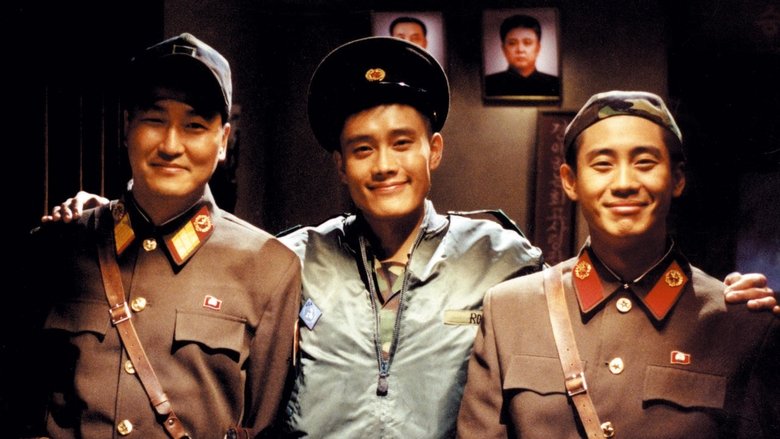
The soldiers listen to the South Korean folk singer together. The music transcends the political divide, evoking a sense of nostalgia for a home that neither side truly feels at peace with.
Philosophical Questions
Can a person be truly 'neutral' in a conflict that defines their identity?
The film explores this through Sophie Jean, whose Swiss neutrality is compromised by her family's hidden North Korean ties, suggesting that heritage is an inescapable gravity.
Does the 'Reflex of the Enemy' override human instinct?
The tragic ending shows that despite months of friendship, the first instinct during the crisis was to draw weapons, suggesting that military conditioning is a deeper layer of the psyche than personal affection.
Core Meaning
Director Park Chan-wook uses the sterile, hyper-tense environment of the JSA to argue that ideological divisions are artificial constructs that crumble when individuals are allowed to see each other as human beings. The core message is one of profound tragedy and irony: the soldiers are identical in language, culture, and desire, yet they are forced to participate in a cycle of mutual destruction dictated by a war that ended before they were born. The film suggests that while personal reconciliation is possible, it is ultimately unsustainable and even dangerous within a system that demands dehumanization to maintain its own existence.