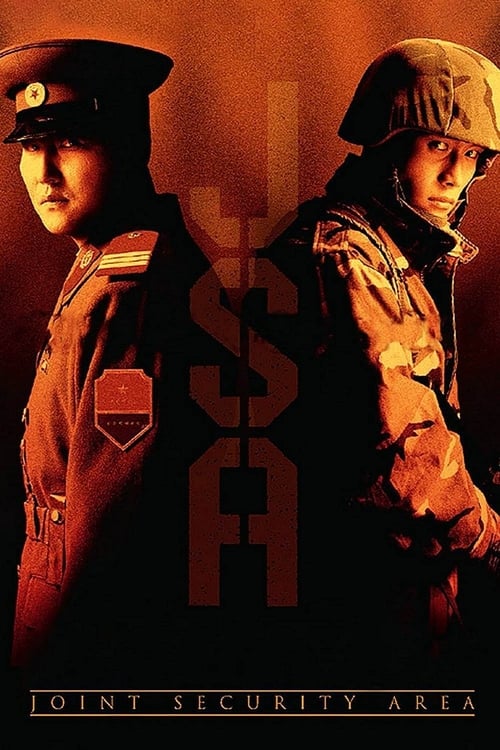
Joint Security Area
공동경비구역 JSA
"Eight shots! The truth is there."
Overview
Set within the tense confines of the Korean Demilitarized Zone, Joint Security Area begins as a cold-blooded investigation into a deadly shootout at a North Korean guard post. Two North Korean soldiers are found dead, and a wounded South Korean sergeant, Lee Soo-hyeok, is rescued from the scene. As both nations trade accusations of kidnapping and unprovoked assault, Major Sophie E. Jean, a Swiss-Korean investigator from the Neutral Nations Supervisory Commission, is brought in to uncover the truth before the incident escalates into all-out war.
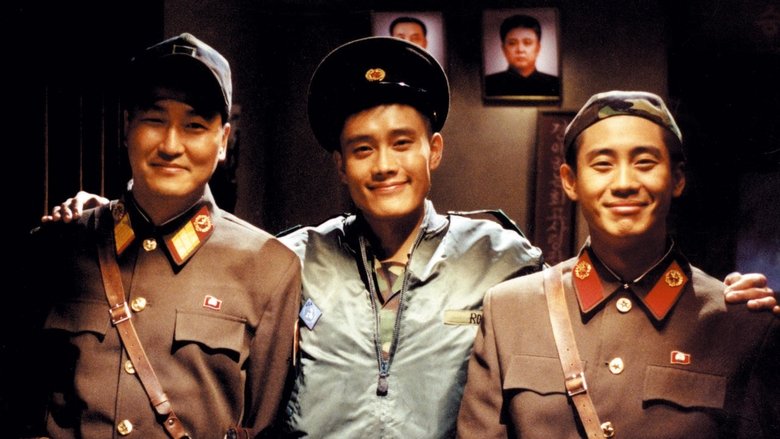
The narrative unfolds through a non-linear structure, peeling back layers of deception to reveal a clandestine reality far more complex than a simple border skirmish. Through flashbacks, the film explores the secret friendship that developed between Sergeant Lee and the very men he was meant to view as mortal enemies. What starts as a series of accidental encounters transforms into a quiet rebellion of shared humanity, involving late-night gatherings, snacks, and music inside the North Korean bunker.
As Sophie navigates the political minefield of the investigation, she finds that neither side is interested in the human truth, only in the official narrative that supports their respective ideologies. The film masterfully transitions from a clinical procedural into a deeply emotional tragedy, questioning the validity of a border that can be crossed by a simple handshake but remains impassable for two nations trapped in a state of perpetual conflict.
Core Meaning
Director Park Chan-wook uses the sterile, hyper-tense environment of the JSA to argue that ideological divisions are artificial constructs that crumble when individuals are allowed to see each other as human beings. The core message is one of profound tragedy and irony: the soldiers are identical in language, culture, and desire, yet they are forced to participate in a cycle of mutual destruction dictated by a war that ended before they were born. The film suggests that while personal reconciliation is possible, it is ultimately unsustainable and even dangerous within a system that demands dehumanization to maintain its own existence.
Thematic DNA
The Tragedy of National Division
The film portrays the 38th Parallel not just as a physical border, but as a psychic wound. The proximity of the soldiers—close enough to see each other's faces but forbidden from speaking—symbolizes the absurdity of the Korean conflict. Their friendship is a microcosm of a unified Korea that is systematically destroyed by the macro-political structures of the North and South.
Humanity vs. Ideology
The clandestine meetings involve mundane acts like eating Choco Pies or listening to Kim Kwang-seok's folk songs. These acts of 'soft' rebellion prioritize shared culture and brotherhood over the rigid military doctrines of their respective regimes, proving that human connection precedes political allegiance.
The Subjectivity of Truth
Drawing comparisons to Rashomon, the film presents multiple accounts of the central shooting. The truth is obscured by trauma, guilt, and the necessity of political survival. Major Sophie Jean’s quest for a 'neutral' truth reveals that in a landscape defined by conflict, truth is often the first casualty of peace.
Guilt and Redemption
The arc of Sergeant Lee is defined by the crushing weight of his own actions. His eventual realization that he was the one who fired the first fatal shot out of a reflexive, conditioned fear highlights how deeply ingrained the 'enemy' narrative is, leading to a guilt that no official pardon can cleanse.
Character Analysis
Sgt. Oh Kyeong-pil
Song Kang-ho
Motivation
To protect his 'younger brothers' (the other soldiers) and maintain his dignity despite the precariousness of his situation.
Character Arc
As a seasoned North Korean soldier, he remains the most pragmatic and composed. His arc is one of showing that even under a repressive regime, a man can retain a sharp intellect and a warm heart.
Sgt. Lee Soo-hyeok
Lee Byung-hun
Motivation
Friendship and a longing for connection that transcends his military training.
Character Arc
Transitions from a fearful soldier who accidentally trips a mine into a man who finds genuine love for his North Korean counterparts, only to be destroyed by the guilt of his own reflexive violence.
Major Sophie E. Jean
Lee Young-ae
Motivation
To uncover the truth of the incident and, subconsciously, to reconcile with her own heritage.
Character Arc
Enters as a clinical, objective investigator but becomes personally entangled when she discovers her own father's history as a North Korean POW, mirroring the division she is studying.
Pvt. Jeong Woo-jin
Shin Ha-kyun
Motivation
To draw, enjoy music, and find joy in the company of his new friends.
Character Arc
A young, artistic North Korean soldier whose death serves as the catalyst for the tragedy. He represents the youth of Korea sacrificed to the ideologies of the past.
Symbols & Motifs
The Choco Pie
A symbol of South Korean capitalism and shared cultural desire.
When Sergeant Oh (North) eats the Choco Pie with relish, it humanizes him as someone with simple tastes and desires, while his refusal to defect for 'more pies' underscores his complex dignity and the difficulty of simple ideological conversion.
The Lighter
A token of brotherhood and an object that crosses the line.
The lighter is gifted from South to North, serving as a physical piece of contraband that binds the men together. Its return at the end of the film serves as a final, painful bridge between the survivors.
The Line (The Border)
The literal and metaphorical division between 'us' and 'them'.
The camera frequently emphasizes the white line at the JSA. In one iconic scene, a character's shadow crosses the line, leading to the warning, 'Your shadow is over the line,' emphasizing how even light and shadow are policed in this environment.
Kim Kwang-seok's Music
Common cultural heritage and the melancholy of the common man.
The soldiers listen to the South Korean folk singer together. The music transcends the political divide, evoking a sense of nostalgia for a home that neither side truly feels at peace with.
Memorable Quotes
Your shadow is over the line. Watch it!
— North Korean Soldier (to South Korean Soldier)
Context:
During a tense standoff early in the film, before the friendship is established.
Meaning:
It highlights the absurdity of the hyper-vigilance at the border, where even a shadow is treated as an illegal incursion.
Why are you so good at deactivating mines? / In the North, everyone learns that.
— Sgt. Lee Soo-hyeok and Sgt. Oh Kyeong-pil
Context:
When Oh saves Lee from a landmine, initiating their contact.
Meaning:
It underscores the constant state of war-readiness the North lives in, while simultaneously being a moment of bonding.
Philosophical Questions
Can a person be truly 'neutral' in a conflict that defines their identity?
The film explores this through Sophie Jean, whose Swiss neutrality is compromised by her family's hidden North Korean ties, suggesting that heritage is an inescapable gravity.
Does the 'Reflex of the Enemy' override human instinct?
The tragic ending shows that despite months of friendship, the first instinct during the crisis was to draw weapons, suggesting that military conditioning is a deeper layer of the psyche than personal affection.
Alternative Interpretations
Some critics interpret the film as a political allegory for the failure of the Sunshine Policy, suggesting that individual goodwill is ultimately powerless against the institutionalized hatred of the two states. Another reading focuses on Major Sophie Jean as a surrogate for the audience; her mixed heritage and 'neutral' status reflect the modern Korean diaspora's disconnect from the raw trauma of the war, trying to piece together a history that is being actively suppressed by both governments.
Cultural Impact
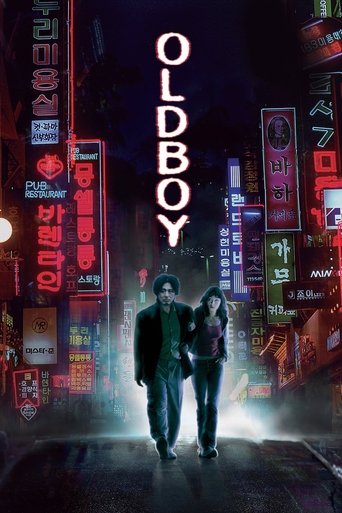
Joint Security Area is credited with revolutionizing the South Korean film industry by proving that a local production could out-earn Hollywood blockbusters like Mission: Impossible 2. Beyond its commercial success, it fundamentally altered the South Korean public's perception of North Koreans. By depicting the 'enemy' as brothers with similar tastes and emotions, it aligned with the political optimism of the Kim Dae-jung administration's Sunshine Policy. It also catapulted Park Chan-wook to international fame, setting the stage for the Korean New Wave and his later masterpieces like Oldboy.
Audience Reception
The film was overwhelmingly praised for its humanism and emotional depth, with Song Kang-ho's performance frequently cited as the emotional anchor. Western critics lauded its slick, high-stakes thriller pacing and its unique take on the 'buddy' genre. The primary point of criticism has consistently been the wooden English-language dialogue and performances of the non-Korean cast members, which some felt detracted from the realism of the investigation scenes. Overall, it is considered a cornerstone of modern Korean cinema.
Interesting Facts
- JSA was the first South Korean film to humanize North Korean soldiers on such a massive scale, moving away from the 'monster' tropes of the past.
- The film was a massive box office hit, becoming the highest-grossing South Korean film ever at the time of its release.
- Since filming at the actual Panmunjom was forbidden, the production built an $800,000 replica of the Joint Security Area at the Namyangju Studio.
- Director Park Chan-wook considers this his first 'real' film, largely disowning his previous two works due to a lack of creative control.
- The film was released during the era of South Korea's 'Sunshine Policy,' which sought peaceful cooperation with the North.
- Song Kang-ho, who plays the North Korean sergeant, later became the first Korean actor to win Best Actor at Cannes for 'Broker'.
Easter Eggs
Song Kang-ho's role reversal
In the 1999 hit Shiri, Song Kang-ho played a South Korean agent hunting North Koreans. In JSA, he plays the North Korean, a choice that subverted audience expectations and signaled a shift in cinema's portrayal of the North.
The final photograph
The black-and-white photo shown at the very end of the film is actually a real photograph taken by an American tourist, in which all four main characters happened to be in the frame by accident. It serves as the ultimate visual metaphor for a unity that existed but was never officially recognized.
⚠️ Spoiler Analysis
Click to reveal detailed analysis with spoilers
Frequently Asked Questions
Explore More About This Movie
Dive deeper into specific aspects of the movie with our detailed analysis pages
Comments (0)
No comments yet. Be the first to share your thoughts!