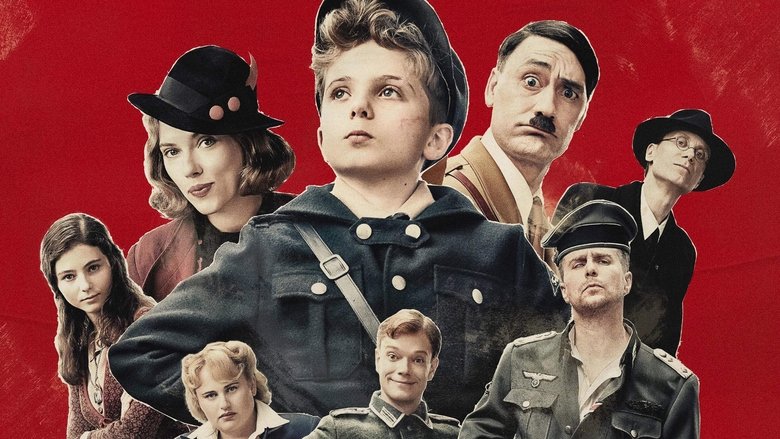
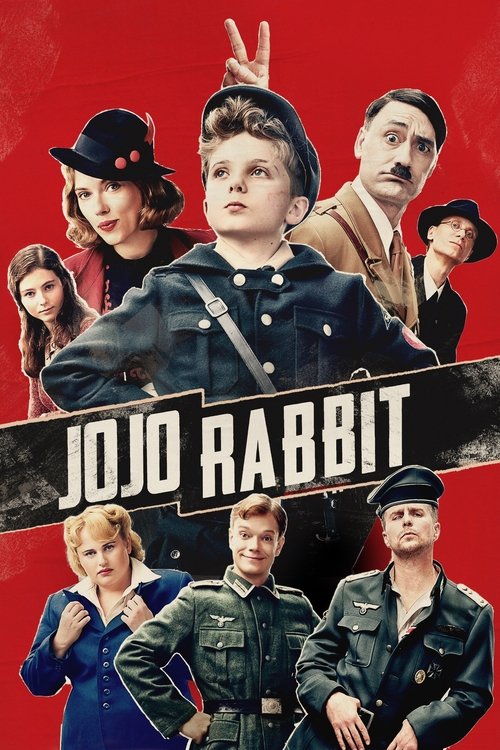
"An anti-hate satire."
Jojo Rabbit - Symbolism & Philosophy
Symbols & Motifs
Dancing
Dancing symbolizes freedom, joy, and the defiant celebration of life in the face of oppression and despair. It represents hope for the future and the expression of humanity that fascism seeks to crush.
Rosie frequently dances and encourages Jojo to do the same, telling him it's a way to "show God we are grateful to be alive." Elsa tells Jojo the first thing she will do when she is free is dance. The film's final, poignant scene shows Jojo and Elsa dancing in the street after the war ends, a powerful affirmation of their newfound freedom and the endurance of the human spirit.
Rosie's Shoes
Rosie's stylish, often red-and-white shoes represent her vibrant, life-affirming spirit, her playfulness, and her quiet rebellion against the drab conformity of the regime. They are a motif for her love of dance and zest for life.
The camera often focuses on Rosie's shoes as she walks or dances. The motif culminates in one of the film's most heartbreaking scenes: Jojo, chasing a butterfly, looks up to see his mother has been hanged in the public square. The audience, like Jojo, first identifies her only by her distinctive shoes, making the discovery profoundly personal and devastating.
The Rabbit
The rabbit initially symbolizes Jojo's perceived weakness and his inability to conform to the cruel expectations of Nazi masculinity. He earns the mocking nickname "Jojo Rabbit" when he can't bring himself to kill one.
After being shamed at the Hitler Youth camp, Jojo's imaginary Hitler encourages him to reframe the rabbit as a clever, tricky, and resilient creature. This reinterpretation mirrors Jojo's own journey, where he learns that strength is not about brutality, but about empathy, cleverness, and survival.
The Dagger
The dagger, given to Jojo as part of his Hitler Youth uniform, symbolizes the toxic masculinity and violent ideology of the Nazi regime. It represents a childish conception of power rooted in destruction and hate.
Jojo proudly carries the dagger, viewing it as a toy and a symbol of his belonging. When he first discovers Elsa, he threatens her with it, but she easily disarms him, symbolically stripping him of his indoctrinated power. Later, after his mother's death, he attempts to stab Elsa in grief and anger but breaks down, choosing connection over violence.
Philosophical Questions
Can innocence and hate coexist within a person?
The film explores this question through its protagonist, Jojo. He is presented as a sweet, caring, and fundamentally innocent child who is also a fervent, swastika-loving Nazi. "Jojo Rabbit" argues that hate is not an inherent trait but a learned behavior, an ideology that can be imprinted upon a blank slate. The film shows how Jojo's 'hate' is superficial, a parroting of propaganda he doesn't fully comprehend. His journey demonstrates that when this indoctrinated hate is confronted with direct human experience (his friendship with Elsa), his innate innocence and capacity for love ultimately win out, suggesting that true innocence is incompatible with sustained, genuine hatred.
Is satire an effective tool for confronting historical atrocities?
By making Nazis, including an imaginary Hitler, into buffoons, the film uses humor to strip them of their power and mystique. The satire is not aimed at the victims but at the perpetrators and the absurdity of their ideology. The film's critical reception was divided on this point: some argued that humor risks trivializing the horror, while others contended that it's a powerful weapon to expose the illogical and banal nature of evil, making its anti-hate message more accessible and potent for a modern audience.
What is the nature of courage in an oppressive society?
The film presents multiple forms of bravery. There is Rosie's active, dangerous resistance work; Elsa's quiet, enduring courage of survival; and Captain Klenzendorf's last-minute, sacrificial courage. Jojo's own journey is one of developing moral courage—the bravery to question everything he has been taught, to reject a powerful ideology, and to choose love and empathy in a world saturated with hate. The film proposes that the greatest courage lies not in conforming to a violent ideal but in daring to be humane against all odds.
Core Meaning
"Jojo Rabbit" is a powerful satire that explores the absurdity of hatred and the corrupting influence of ideological indoctrination, particularly on the innocent. Director Taika Waititi uses comedy not to diminish the horrors of Nazism, but to expose its nonsensical and manufactured nature. The core message is a celebration of love, empathy, and critical thinking as the ultimate antidotes to blind fanaticism. It posits that human connection can dismantle the most deeply ingrained prejudice. The film is also framed as a "love letter to all mothers," highlighting the fierce, protective, and life-affirming love that Rosie embodies in the face of overwhelming darkness.