The core meaning of "Joker" serves as a dark cautionary tale about the consequences of societal neglect, lack of empathy, and the systemic failure to care for the mentally ill. Director Todd Phillips has stated that a central theme is the "power of kindness" and what happens in its absence. The film explores how a person, repeatedly beaten down, marginalized, and stripped of support systems like therapy and medication, can descend into violence. It's a character study examining the symbiotic relationship between a deteriorating individual and a decaying society, suggesting that monsters are not born, but created by the very communities that ostracize them. The film doesn't necessarily justify Arthur's actions but rather provides a disturbing and empathetic look at the circumstances that could forge such a figure, questioning who the real "clowns" are in a world rife with cruelty and inequality.
"Put on a happy face."
Director: Todd Phillips
Cast: Joaquin Phoenix, Robert De Niro, Zazie Beetz, Frances Conroy, Brett Cullen
Joker — Symbolism & Philosophy
Symbols & Motifs
Stairs
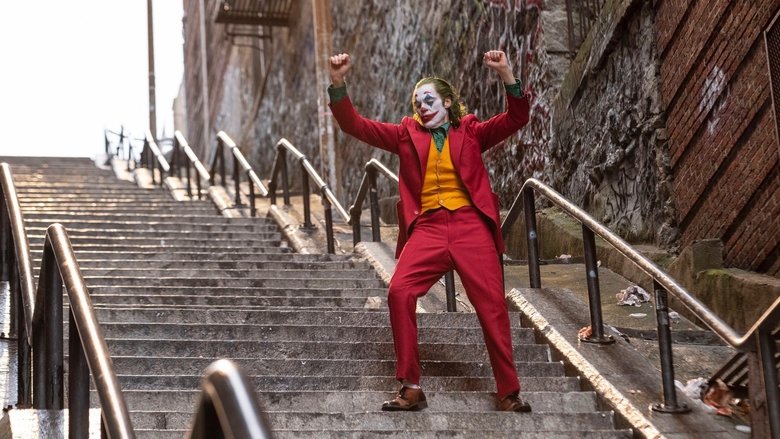
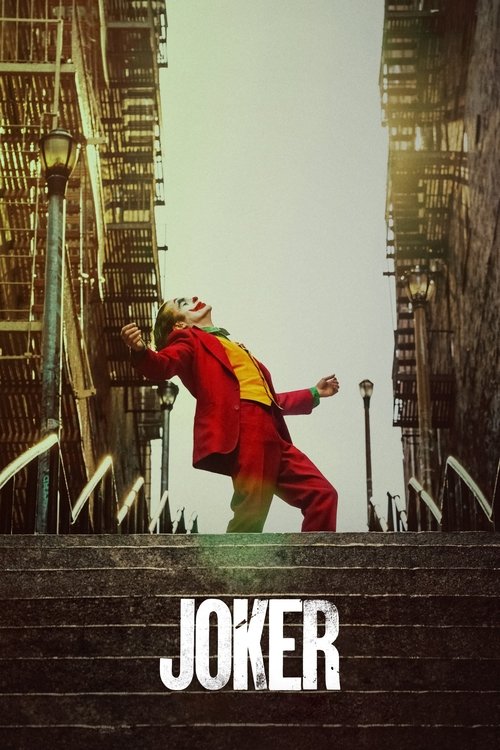
The long, steep flight of stairs represents Arthur's arduous and oppressive daily struggle. Going up is a tiring, joyless climb, symbolizing his attempt to function within a society that pushes him down. Conversely, dancing down the stairs as the fully-formed Joker represents his liberation, his descent into madness, and his gleeful embrace of chaos. It's no longer a struggle; it's an effortless, triumphant fall.
Arthur is frequently shown trudging wearily up the stairs to his apartment, each step a visual metaphor for his difficult life. The film's most iconic scene features him, in full Joker costume, dancing triumphantly down the same set of stairs to the song "Rock and Roll Part 2," marking his complete transformation and rejection of his former struggles.
The Clown Persona / Masks
The clown symbolizes Arthur's forced smile and his failed attempt to bring joy to a cruel world. It represents the mask of happiness people are expected to wear, hiding their inner turmoil. After his first murders, the clown mask is co-opted by a protest movement, becoming a symbol of the anonymous, disenfranchised underclass rising up against the elite. For Arthur, fully embracing the clown makeup as Joker is an act of empowerment, turning a symbol of his humiliation into one of terror and rebellion.
Arthur works as a clown-for-hire, a job that brings him more pain than joy. He is in full clown makeup when he commits his first murders on the subway. Later, protestors throughout Gotham adopt clown masks as a symbol of their anti-rich movement. The climax sees Arthur apply his makeup and fully become the Joker before his appearance on the Murray Franklin show.
Uncontrollable Laughter
Arthur's laughter is not a sign of joy but of a neurological disorder, likely Pseudobulbar Affect (PBA), stemming from past trauma. It symbolizes his pain and his inability to control his own emotional expression. It's a physical manifestation of his internal suffering, often appearing at the most inappropriate and stressful moments, further isolating him from others. When he fully becomes the Joker, his laughter changes, becoming a tool of menace and a genuine expression of his nihilistic amusement.
Arthur's condition is established early on, with him carrying a card to explain it to strangers. He laughs uncontrollably on a bus when trying to entertain a child, on the subway while being beaten, and during his stand-up routine, all of which lead to negative consequences. Director Todd Phillips instructed Joaquin Phoenix to make the laugh sound painful.
Philosophical Questions
Are monsters born, or are they created by society?
The film squarely positions itself on the side of nurture over nature. Arthur is not depicted as being born evil; rather, he is a product of his environment. He is a mentally ill man subjected to relentless bullying, systemic neglect, and profound trauma. The film asks the audience to consider if his horrific transformation into the Joker would have occurred had he received proper mental healthcare, been shown a shred of human kindness, or lived in a more equitable society. It challenges the viewer to see the humanity within the 'monster' and to question society's complicity in creating its own villains.
What is the relationship between mental illness and violence?
"Joker" controversially wades into the complex and often stigmatized connection between mental illness and violence. While it shows a mentally ill character committing heinous acts, the film takes pains to illustrate that the violence is not a direct symptom of his illness itself, but rather a result of his illness going untreated and being exacerbated by societal cruelty and alienation. It explores how the pain, isolation, and desperation stemming from his condition, combined with easy access to a gun, create a perfect storm for violence. This raises difficult questions about social responsibility and the potential consequences of failing to provide adequate mental health support.
Where is the line between reality and subjective perception?
Through its use of an unreliable narrator, the film constantly forces the audience to question the nature of reality. Arthur's entire relationship with Sophie is a delusion, making viewers re-evaluate everything they've seen. This raises the philosophical question of whether an objective reality truly matters more than one's subjective experience. For Arthur, his delusions provided him with comfort and connection that the real world denied him. The film suggests that when reality becomes unbearable, the human mind is capable of constructing its own, and it leaves the audience uncertain as to how much of Arthur's story is 'real' versus a fantasy constructed to cope with his miserable existence.
Core Meaning
Explore More About This Movie
Dive deeper into specific aspects of the movie with our detailed analysis pages