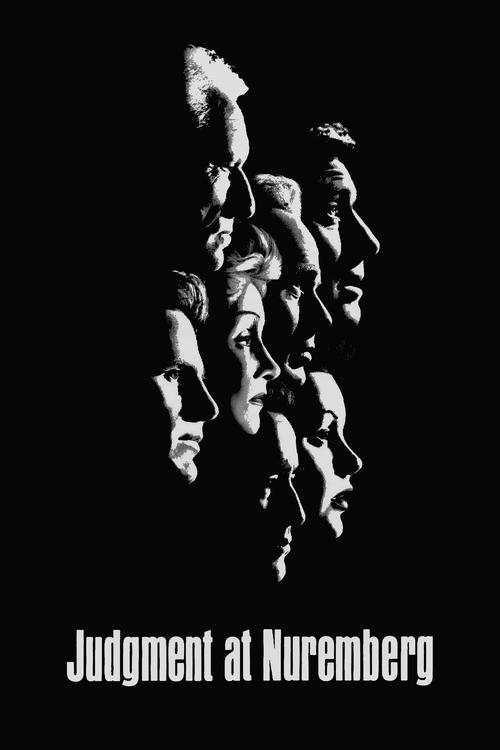
"The event the world will never forget."
Judgment at Nuremberg - Symbolism & Philosophy
Symbols & Motifs
The Ruined City of Nuremberg
The bombed-out, rubble-strewn cityscape symbolizes the complete moral and physical collapse of Germany under the Nazi regime. It is a constant visual reminder of the devastating consequences of the ideology being tried in the courtroom.
The film opens with Judge Haywood's car driving through the ruins, immediately establishing the grim aftermath of the war. The visual contrast between the stately, intact courtroom and the destruction outside highlights the attempt to reconstruct not just buildings, but justice and order itself from the ashes.
The Courtroom
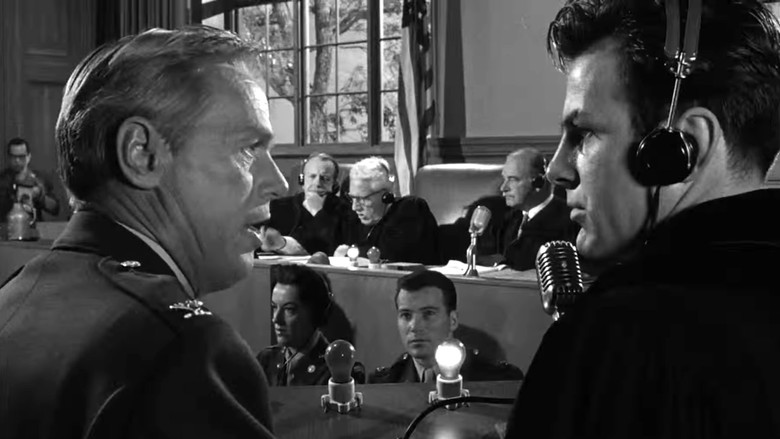
The courtroom itself symbolizes a fragile bastion of reason and justice in a world recovering from chaos and barbarism. It represents the effort to impose moral order on horrific events through civilized, logical process. It is a space where truth, however painful, is meant to be confronted.
Nearly the entire film is set within the confines of the courtroom. Director Stanley Kramer uses the space to create a sense of claustrophobia and intensity, forcing the characters and the audience to confront the difficult testimony and arguments head-on. The structured proceedings stand in stark contrast to the lawlessness of the Nazi era being discussed.
Actual Concentration Camp Footage
The inclusion of real documentary footage of liberated concentration camps serves as an undeniable, horrifying symbol of the ultimate truth of the Nazi regime's crimes. It moves the discussion from legal arguments and rhetoric to the brutal reality of the Holocaust, stripping away any attempts at denial or minimization.
During the prosecution's case, Colonel Lawson presents a film to the court. The movie screen within the film shows graphic, real-life footage of the atrocities. This moment silences the courtroom and serves as the film's most powerful and irrefutable piece of evidence, confronting both the characters and the audience with the absolute evil that is on trial.
Philosophical Questions
Can an individual be held responsible for actions committed while following the laws of their country?
This is the central conflict of the film. The defense argues that the judges were not making the law, but merely carrying it out, a duty expected of any citizen or official. The film explores this through the character of Ernst Janning, a brilliant legal mind who chose to serve a corrupt state. The ultimate verdict and Haywood's final words to Janning provide the film's answer: there is a higher moral law that supersedes national law. When state law commands one to commit crimes against humanity, the individual has a moral obligation to refuse and resist, and failing to do so incurs personal guilt.
What is the relationship between collective guilt and individual responsibility?
The film grapples with whether to blame the entire German population or specific individuals. Hans Rolfe repeatedly argues that you cannot try four men without trying the whole nation. The film explores the pervasiveness of denial among ordinary Germans, like Mrs. Bertholt and the Haywood's servants, who claim they "didn't know." However, the narrative ultimately rejects the notion of a vague, indefinable 'collective guilt' and instead insists on pinpointing responsibility on individuals, particularly those in positions of power and influence, who made conscious choices to participate in and legitimize the regime's evil.
Does justice have a statute of limitations, or can it be compromised for future political gain?
The film presents a stark conflict between the need for justice for past atrocities and the perceived need for political stability in the present. The American authorities pressure Haywood to deliver lenient sentences to help secure West Germany as an ally in the Cold War. The film, through Haywood's steadfastness, argues that true justice cannot be swayed by political convenience. However, the epilogue, noting the early release of all convicted Nazis, serves as a cynical real-world counterpoint, suggesting that in the long run, politics often does trump moral imperatives.
Core Meaning
The core meaning of "Judgment at Nuremberg" is an exploration of personal and national responsibility in the face of systemic evil. Director Stanley Kramer poses the critical question: Where does the guilt lie when a nation commits monstrous acts? The film argues that simply following orders or adhering to unjust laws does not absolve an individual of their moral responsibility. This is powerfully encapsulated in the final confrontation between Judge Haywood and the convicted Judge Janning. When Janning claims he never knew the atrocities would reach such a scale, Haywood retorts, "Herr Janning, it came to that the first time you sentenced a man to death you knew to be innocent." This final indictment asserts that the path to genocide begins with small, individual compromises of justice, making the film a timeless warning about the necessity of upholding moral principles, even—and especially—when it is most difficult.