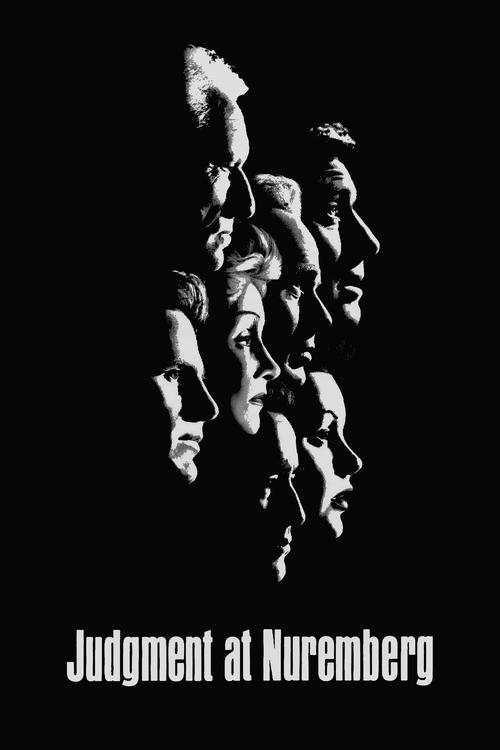
Judgment at Nuremberg
A somber historical drama that relentlessly dissects the conscience of a nation, presented as a stark, black-and-white courtroom battle for the very soul of justice.
Judgment at Nuremberg

Judgment at Nuremberg

"The event the world will never forget."

18 December 1961 United States of America 191 min ⭐ 8.0 (871)
Director: Stanley Kramer
Cast: Spencer Tracy, Richard Widmark, Maximilian Schell, Burt Lancaster, Marlene Dietrich
Drama History
Individual vs. Collective Guilt Justice vs. Political Expediency The Nature of Law and Morality The Burden of Truth and Memory
Budget: $3,000,000
Box Office: $10,000,000

Overview

Set in 1948, three years after the end of World War II, "Judgment at Nuremberg" depicts a fictionalized version of the Judges' Trial, one of the subsequent Nuremberg trials. American Judge Dan Haywood (Spencer Tracy) arrives in the war-torn city of Nuremberg to preside over the trial of four German judges accused of crimes against humanity for their role in enforcing and legitimizing Nazi laws.

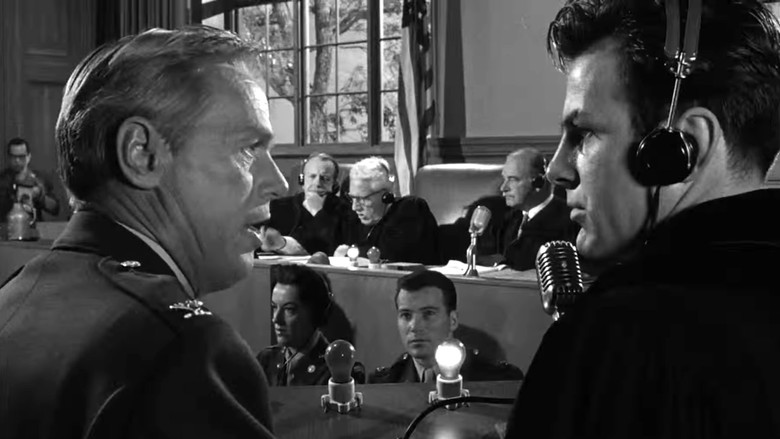
The prosecution, led by the fervent Colonel Tad Lawson (Richard Widmark), argues that these men twisted the law to support horrific acts, including forced sterilizations and wrongful executions, making them complicit in the Holocaust. The defense is mounted by the sharp and patriotic German lawyer Hans Rolfe (Maximilian Schell), who contends that the judges were merely following the established laws of their country during a time of national crisis and that other nations share a portion of the blame for not stopping Hitler sooner. As the trial unfolds, featuring harrowing testimony from victims, Judge Haywood grapples with immense political pressure to be lenient in the interest of Cold War alliances, forcing him to confront the profound questions of individual versus collective guilt and the true meaning of justice.


Core Meaning

The core meaning of "Judgment at Nuremberg" is an exploration of personal and national responsibility in the face of systemic evil. Director Stanley Kramer poses the critical question: Where does the guilt lie when a nation commits monstrous acts? The film argues that simply following orders or adhering to unjust laws does not absolve an individual of their moral responsibility. This is powerfully encapsulated in the final confrontation between Judge Haywood and the convicted Judge Janning. When Janning claims he never knew the atrocities would reach such a scale, Haywood retorts, "Herr Janning, it came to that the first time you sentenced a man to death you knew to be innocent." This final indictment asserts that the path to genocide begins with small, individual compromises of justice, making the film a timeless warning about the necessity of upholding moral principles, even—and especially—when it is most difficult.

Thematic DNA

Individual vs. Collective Guilt 35%
Justice vs. Political Expediency 30%
The Nature of Law and Morality 25%
The Burden of Truth and Memory 10%

Individual vs. Collective Guilt

The film relentlessly probes the line between the responsibility of individuals and the guilt of an entire nation. While defense attorney Hans Rolfe argues that if the judges are guilty, then all of Germany is, the narrative ultimately focuses on personal accountability. The character of Ernst Janning, a respected jurist, embodies this conflict. His final confession admits that educated men like him, who knew better but went along out of patriotism or fear, bear a heavy burden of guilt, suggesting that a nation's crimes are the sum of its citizens' individual moral failures.

Justice vs. Political Expediency

Set against the backdrop of the emerging Cold War and the Berlin Blockade, the trial is fraught with political pressure. American officials subtly and overtly push Judge Haywood toward leniency, arguing that a harsh verdict against German leaders would alienate a populace needed as an ally against the Soviet Union. Haywood's struggle and final verdict, which sentences the defendants to life in prison, represent a stand for absolute justice over geopolitical convenience, even though a postscript reveals that these sentences were not fully served in reality.

The Nature of Law and Morality

The central legal and philosophical question is whether law is merely a set of rules to be followed or if it must be grounded in fundamental human morality. The defendants claim they were simply upholding the laws of the Third Reich. The prosecution, and ultimately the film's verdict, argues that there is a higher moral law. Judge Haywood's final judgment asserts that when a law becomes an instrument for persecution and murder, it is the duty of a just person to resist it, not enforce it.

The Burden of Truth and Memory

The film explores the German people's struggle to confront their recent past. Characters like Mrs. Bertholt plead with Haywood to understand that Germans must forget in order to move on. However, the film, through the inclusion of actual footage from concentration camps and the raw testimony of victims, argues for the necessity of remembering. Janning's confession is a pivotal moment where a German character finally accepts the truth, stating that salvation for Germany can only come from admitting its guilt.

Character Analysis

Chief Judge Dan Haywood

Spencer Tracy

Archetype: The Moral Compass / The Wise Mentor
Key Trait: Methodical Integrity

Motivation

His primary motivation is to understand the truth and deliver a just and righteous verdict. He is driven by a deep-seated belief in the sanctity of law and the value of a single human life, principles he feels compelled to uphold against the forces of political expediency and historical revisionism.

Character Arc

Judge Haywood begins as a thoughtful, somewhat provincial American judge, seemingly unprepared for the immense weight of the trial. He initially tries to understand the German perspective through his interactions with people like Mrs. Bertholt. Throughout the trial, as he listens to the horrifying evidence, his initial empathy for the German people's plight hardens into a firm, unwavering conviction that justice must be served, regardless of political pressures. His journey is one from observer to the ultimate arbiter of moral responsibility.

Dr. Ernst Janning

Burt Lancaster

Archetype: The Fallen Idol / The Penitent
Key Trait: Tortured Conscience

Motivation

Initially, his motivation is a stoic, prideful refusal to recognize the legitimacy of the court. However, his conscience is slowly awakened. His ultimate motivation becomes a desperate need to tell the truth, not for acquittal, but for the potential salvation of Germany and to reclaim a shred of his own lost integrity, admitting that he and others should have known and acted sooner.

Character Arc

Janning starts the trial as a silent, defiant, and respected legal scholar who refuses to participate. He is the embodiment of how a sophisticated, intellectual man could become complicit in evil. His arc is a powerful journey from denial to confession. Moved by the prosecution's evidence and disgusted by his own defense attorney's tactics, he ultimately breaks his silence to condemn himself and the regime he served, providing the film's moral climax.

Hans Rolfe

Maximilian Schell

Archetype: The Zealous Advocate
Key Trait: Patriotic Intellect

Motivation

Rolfe is motivated by a complex mix of professional duty and patriotism. He aims to defend not just the four men in the dock, but the honor of Germany itself. He argues that the judges were patriots following the law of their land and uses a "tu quoque" (you also) defense, pointing to moral failings of the Allied nations to challenge the court's authority.

Character Arc

Hans Rolfe does not have a significant arc of change; he remains a brilliant and passionate defense attorney throughout. He begins and ends as a fierce German patriot, dedicated to defending his clients by using any logical or legal argument available. While he is not a Nazi sympathizer, he believes his country is being unfairly singled out for judgment by the victors. His skill and fervor force the prosecution—and the audience—to confront uncomfortable truths about the world's complicity.

Colonel Tad Lawson

Richard Widmark

Archetype: The Crusader
Key Trait: Righteous Indignation

Motivation

His motivation is deeply personal and emotional. Haunted by the atrocities he has witnessed, he is driven by a burning need to hold the perpetrators accountable and to ensure the world does not forget the victims of the Holocaust. For him, the trial is not a political exercise but a moral necessity.

Character Arc

Colonel Lawson is a character defined by his righteous fury, having been present at the liberation of the concentration camps. He remains unwavering in his mission to see the defendants convicted. His arc is less about personal change and more about the struggle to maintain his fervor for justice against the tide of political maneuvering and the German populace's desire to forget. He represents the raw, uncompromising anger of those who witnessed the horrors firsthand.

Symbols & Motifs

The Ruined City of Nuremberg

Meaning:

The bombed-out, rubble-strewn cityscape symbolizes the complete moral and physical collapse of Germany under the Nazi regime. It is a constant visual reminder of the devastating consequences of the ideology being tried in the courtroom.

Context:

The film opens with Judge Haywood's car driving through the ruins, immediately establishing the grim aftermath of the war. The visual contrast between the stately, intact courtroom and the destruction outside highlights the attempt to reconstruct not just buildings, but justice and order itself from the ashes.

The Courtroom

Meaning:

The courtroom itself symbolizes a fragile bastion of reason and justice in a world recovering from chaos and barbarism. It represents the effort to impose moral order on horrific events through civilized, logical process. It is a space where truth, however painful, is meant to be confronted.

Context:

Nearly the entire film is set within the confines of the courtroom. Director Stanley Kramer uses the space to create a sense of claustrophobia and intensity, forcing the characters and the audience to confront the difficult testimony and arguments head-on. The structured proceedings stand in stark contrast to the lawlessness of the Nazi era being discussed.

Actual Concentration Camp Footage

Meaning:

The inclusion of real documentary footage of liberated concentration camps serves as an undeniable, horrifying symbol of the ultimate truth of the Nazi regime's crimes. It moves the discussion from legal arguments and rhetoric to the brutal reality of the Holocaust, stripping away any attempts at denial or minimization.

Context:

During the prosecution's case, Colonel Lawson presents a film to the court. The movie screen within the film shows graphic, real-life footage of the atrocities. This moment silences the courtroom and serves as the film's most powerful and irrefutable piece of evidence, confronting both the characters and the audience with the absolute evil that is on trial.

Memorable Quotes

A country isn't a rock. It's not an extension of one's self. It's what it stands for. It's what it stands for when standing for something is the most difficult!

— Judge Dan Haywood

Context:

This is part of the powerful monologue delivered by Judge Haywood as he sentences the four defendants to life in prison, directly refuting the defense's argument that the judges were simply being patriotic.

Meaning:

This line, from Haywood's closing verdict, encapsulates the film's core message. It rejects blind patriotism ('my country, right or wrong') and argues that a nation's true worth is defined by its commitment to moral principles like justice and truth, especially under pressure.

Herr Janning, it came to that the first time you sentenced a man to death you knew to be innocent.

— Judge Dan Haywood

Context:

In the final scene, Janning asks Haywood to visit him in his cell and pleads for Haywood to believe that he never knew the full extent of the Nazi atrocities. Haywood delivers this line calmly and unequivocally before walking away, ending the film on a stark note of individual accountability.

Meaning:

This is the film's final, devastating moral judgment. It dismisses the excuse of ignorance ('I didn't know it would go that far') and pinpoints the origin of genocide in the first small, deliberate compromise of individual conscience and justice. It argues that great evil grows from seemingly small acts of moral cowardice.

But to be logical is not to be right. And nothing on God's earth could ever make it right!

— Judge Dan Haywood

Context:

This line is spoken during Haywood's deliberation with the other judges. One of his colleagues is swayed by Hans Rolfe's logical arguments, prompting Haywood to passionately declare that some actions are inherently wrong, regardless of any legal or logical justification.

Meaning:

This quote is a powerful rebuttal to the defense's purely logical and legalistic arguments, which attempt to justify the defendants' actions within the framework of Nazi law. Haywood asserts that there is a higher, universal morality that transcends flawed human logic and unjust laws.

We must forget if we want to go on living.

— Mrs. Bertholt

Context:

Marlene Dietrich's character, the widow of an executed Nazi general, says this to Judge Haywood during one of their conversations outside the courtroom. She is trying to make him understand the German mindset and encourage a more lenient, forward-looking approach to justice.

Meaning:

This line represents the perspective of many ordinary Germans who, overwhelmed by guilt and the trauma of war, believe that moving forward requires a willful amnesia about the past. The film presents this view but ultimately argues against it.

Philosophical Questions

Can an individual be held responsible for actions committed while following the laws of their country?

This is the central conflict of the film. The defense argues that the judges were not making the law, but merely carrying it out, a duty expected of any citizen or official. The film explores this through the character of Ernst Janning, a brilliant legal mind who chose to serve a corrupt state. The ultimate verdict and Haywood's final words to Janning provide the film's answer: there is a higher moral law that supersedes national law. When state law commands one to commit crimes against humanity, the individual has a moral obligation to refuse and resist, and failing to do so incurs personal guilt.

What is the relationship between collective guilt and individual responsibility?

The film grapples with whether to blame the entire German population or specific individuals. Hans Rolfe repeatedly argues that you cannot try four men without trying the whole nation. The film explores the pervasiveness of denial among ordinary Germans, like Mrs. Bertholt and the Haywood's servants, who claim they "didn't know." However, the narrative ultimately rejects the notion of a vague, indefinable 'collective guilt' and instead insists on pinpointing responsibility on individuals, particularly those in positions of power and influence, who made conscious choices to participate in and legitimize the regime's evil.

Does justice have a statute of limitations, or can it be compromised for future political gain?

The film presents a stark conflict between the need for justice for past atrocities and the perceived need for political stability in the present. The American authorities pressure Haywood to deliver lenient sentences to help secure West Germany as an ally in the Cold War. The film, through Haywood's steadfastness, argues that true justice cannot be swayed by political convenience. However, the epilogue, noting the early release of all convicted Nazis, serves as a cynical real-world counterpoint, suggesting that in the long run, politics often does trump moral imperatives.

Alternative Interpretations

While the film's primary message is a clear condemnation of individual moral failure, some interpretations focus on the more ambiguous elements. One perspective, championed by the character of Hans Rolfe, is that the trial represents 'victor's justice,' where the winning side of a war imposes its moral standards on the defeated, ignoring its own transgressions (such as the atomic bombings). This reading challenges the moral authority of the American-led tribunal and suggests a more complex, universal capacity for atrocity.

Another interpretation centers on the film's bleak postscript, which states that by 1961, none of the 99 defendants sentenced in the American-zone trials were still in prison. This fact can be seen as an overriding cynical statement, suggesting that despite Judge Haywood's noble stand, political expediency ultimately triumphed over justice. From this viewpoint, the film is less a celebration of justice being served and more a tragic acknowledgment of its fragility and ultimate failure in the face of real-world politics.

Cultural Impact

Released in 1961, "Judgment at Nuremberg" entered the cultural landscape at a pivotal time. The world was grappling with the memory of World War II while simultaneously navigating the tense geopolitics of the Cold War. The film directly addresses the shifting American attitude towards Germany, from defeated enemy to crucial ally against the Soviet Union, and the political pressure this created to downplay past crimes.

Its influence on cinema was significant. It solidified the courtroom drama as a powerful vehicle for exploring complex social and ethical issues. The film's daring use of actual Holocaust footage broke cinematic ground and confronted audiences with a level of reality rarely seen in Hollywood productions. It received widespread critical acclaim in the U.S. and won two Academy Awards, though its reception in Germany was more controversial, as many were uncomfortable with this direct dissection of their recent history. The film has had an enduring legacy, contributing to the ongoing dialogue about war crimes, international law, and the dangers of nationalism. In 2013, it was selected for preservation in the United States National Film Registry by the Library of Congress as being "culturally, historically, or aesthetically significant".

Audience Reception

Audiences have overwhelmingly praised "Judgment at Nuremberg" for its powerful performances, particularly those of Spencer Tracy, Maximilian Schell (who won an Oscar), Burt Lancaster, Montgomery Clift, and Judy Garland. The film's intelligent, thought-provoking script by Abby Mann is frequently cited as its greatest strength, lauded for its courage in tackling profound and uncomfortable questions without offering easy answers. The inclusion of actual footage from the concentration camps was, and remains, a deeply impactful and praised decision, grounding the legal drama in horrifying reality. The main points of criticism, both at the time of its release and since, tend to focus on its lengthy runtime (over three hours) and its theatrical, sometimes melodramatic, courtroom scenes. Some viewers and critics found the film's philosophical debates to be heavy-handed. Despite these critiques, the overall verdict from audiences is that it is a monumental and essential film that bravely confronts one of history's darkest chapters.

Interesting Facts

  • Many of the big-name actors, including Burt Lancaster and Marlene Dietrich, worked for significantly reduced salaries because they believed in the importance of the film's subject matter.
  • Maximilian Schell, who won the Best Actor Oscar for his role as defense attorney Hans Rolfe, had previously played the same role in the 1959 television version of the story on "Playhouse 90".
  • Spencer Tracy's powerful 11-minute closing speech was reportedly filmed in a single, uninterrupted take.
  • Marlene Dietrich, who was fiercely anti-Nazi, had extreme difficulty with her scene where she had to defend the German people's ignorance of the atrocities, finding the sentiment personally repulsive.
  • The film incorporates actual footage of liberated Nazi concentration camps, a bold and shocking move for a mainstream Hollywood film in 1961.
  • Laurence Olivier was Stanley Kramer's first choice for the role of Ernst Janning, but he turned it down.
  • Montgomery Clift, who played a victim of Nazi sterilization, had so much trouble remembering his lines that director Stanley Kramer told him to ad-lib to better convey his character's confused mental state.
  • The film received 11 Academy Award nominations, including two for Best Actor (Spencer Tracy and Maximilian Schell), with Schell winning.

⚠️ Spoiler Analysis

Click to reveal detailed analysis with spoilers

Frequently Asked Questions

Explore More About This Movie

Dive deeper into specific aspects of the movie with our detailed analysis pages

Comments (0)

Leave a comment

No comments yet. Be the first to share your thoughts!