
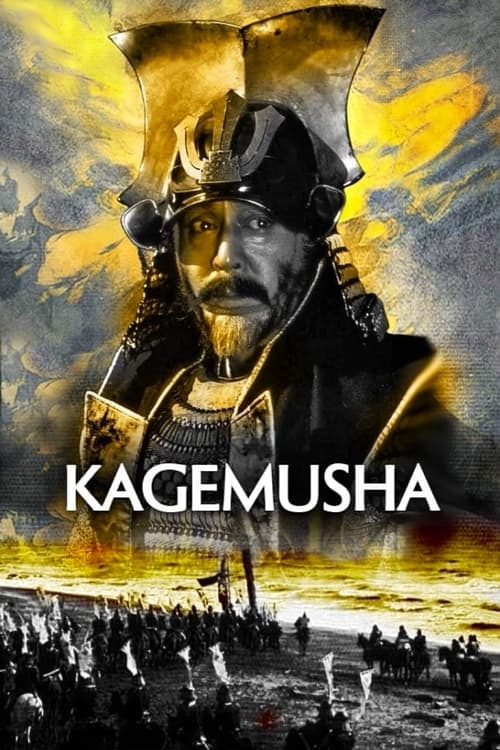
影武者
"The Shadow of a man can never stand up and walk on its own."
Kagemusha - Symbolism & Philosophy
Symbols & Motifs
The Shadow (Kage)
The shadow represents the intangible essence of power and identity. The Kagemusha is literally a 'shadow warrior'. The film visually explores this concept, showing how the shadow (the illusion) can take on a life of its own, becoming as substantial as the real thing. It symbolizes the idea that a leader's influence and image persist even after their physical death.
From the opening scene, where the three main figures are arranged with distinct shadows, to scenes where the Kagemusha's shadow seems to merge with Shingen's, the motif is constant. After Shingen's death, his brother Nobukado states, "The shadow of a man can never stand up and walk on its own," a phrase that the film both proves and disproves.
The Fūrinkazan Banner
The banner, bearing the words "Swift as the wind, silent as a forest, fierce as a fire, immovable as a mountain," represents the spirit and philosophy of the Takeda clan and Shingen himself. It is the physical embodiment of their strength and identity. Shingen's famous creed was to remain "immovable as a mountain."
The banner is a constant presence in clan meetings and on the battlefield. The film's final, tragic shot shows the mortally wounded Kagemusha trying to retrieve the banner from a river, symbolizing his complete identification with the clan and its spirit. His body floats past it, signifying the final fall of the Takeda clan.
The Mountain
The mountain symbolizes Lord Shingen's strategic philosophy: to be immovable, patient, and unshakable. His generals constantly reference his dictum, "Do not move the mountain," as a warning against rash action.
This is quoted repeatedly by the generals as they try to restrain the impatient Katsuyori. When Katsuyori finally decides to "move the mountain" by launching the attack at Nagashino, he defies his father's core principle and leads the clan to its doom, proving the wisdom behind the symbol.
The Empty Armor
Lord Shingen's armor, displayed in his throne room after his death, symbolizes the hollow nature of power without the person to fill it. It is a powerful, revered object that represents authority, yet it is empty.
The Kagemusha sits before the empty armor, a potent visual of a substitute trying to live up to a powerful, but absent, reality. It underscores the theme that the clan is now following a symbol rather than a man.
Philosophical Questions
What constitutes an individual's identity?
The film forces the audience to question whether identity is an innate, internal quality or a performance defined by external perception. The thief is nobody, but when he wears the robes, speaks the words, and sits on the throne of Shingen, he becomes Shingen in the eyes of the world. The film suggests that identity can be fluid and that the roles we play can fundamentally change who we are. The Kagemusha's tragedy is that he so successfully adopts a new identity that he is left without one of his own.
Is a powerful illusion more valuable than a flawed reality?
The Takeda clan thrives for three years under the illusion of Shingen's leadership. The deception maintains stability and deters enemies. When this powerful illusion is shattered and replaced by the flawed reality of Katsuyori's leadership, the clan is swiftly destroyed. Kurosawa seems to suggest that a collective belief in a symbol, even a false one, can be a more potent unifying force than a dysfunctional and unpopular truth, exploring the essential role of myths and shared fictions in holding societies together.
What is the true nature of power?
"Kagemusha" dissects the concept of power, showing it not as an inherent trait but as a symbolic construct. Power resides where people believe it resides. The thief wields immense authority not because he possesses any special qualities, but because others believe he is Shingen. The film demonstrates that the elaborate rituals, armor, banners, and expectations surrounding a leader are what grant him power. Once the Kagemusha is revealed to be an ordinary man, the power vanishes instantly, even though he had successfully guided the clan.
Core Meaning
At its core, "Kagemusha" is a profound meditation on the nature of identity, illusion, and power. Director Akira Kurosawa explores the idea that the symbol of a leader can be more powerful than the individual himself. The film questions what constitutes a person's identity—is it their innate self, or the role they are perceived to play? Kurosawa suggests that shared beliefs and illusions are the glue that holds society and power structures together. When that illusion shatters, the result is chaos and tragedy. The film serves as a powerful anti-war statement, illustrating the folly and catastrophic human cost of conflicts driven by pride and ambition, culminating in a devastating portrayal of the Battle of Nagashino.