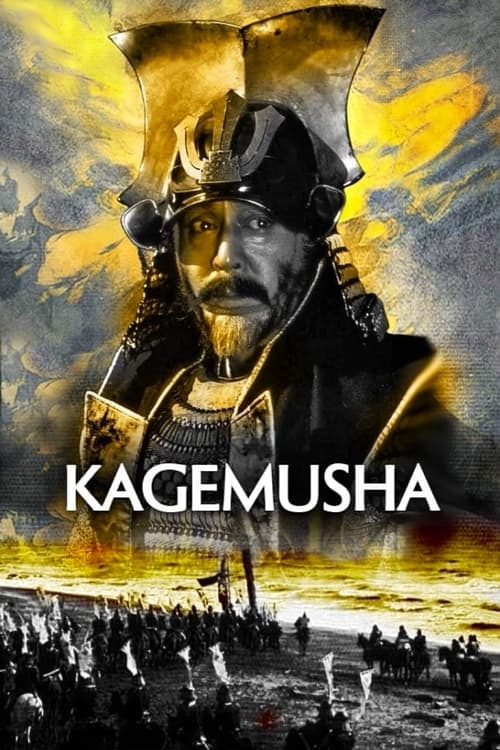
Kagemusha
An epic historical drama where the shadow of a fallen warlord breathes life into a common thief, painting a tragic portrait of identity, illusion, and the crushing weight of a symbol.
Kagemusha

Kagemusha

影武者

"The Shadow of a man can never stand up and walk on its own."

26 April 1980 Japan 180 min ⭐ 7.8 (702)
Director: Akira Kurosawa
Cast: Tatsuya Nakadai, Tsutomu Yamazaki, Kenichi Hagiwara, Jinpachi Nezu, Hideji Ōtaki
Drama War History Action
Illusion vs. Reality Identity and The Self The Futility of War Duty and Honor
Budget: $6,000,000
Box Office: $4,000,000

Overview

Set in the turbulent Sengoku period of 16th-century Japan, "Kagemusha" tells the story of a petty thief saved from crucifixion because of his uncanny resemblance to the powerful and respected warlord, Takeda Shingen. When Shingen is mortally wounded by a sniper, his dying wish is for his death to be kept secret for three years to protect his clan from opportunistic rivals.

The thief is recruited to become Shingen's 'kagemusha' (shadow warrior), a political decoy to maintain the illusion of the great leader's presence. Thrust into a world of power, politics, and ceremony, the once-worthless criminal must suppress his own identity and fully embody the spirit and authority of the man he impersonates. He struggles with the immense pressure, constantly under the scrutiny of Shingen's inner circle, his mistresses, and his young grandson, all while rival warlords Oda Nobunaga and Tokugawa Ieyasu watch for any sign of weakness.

Core Meaning

At its core, "Kagemusha" is a profound meditation on the nature of identity, illusion, and power. Director Akira Kurosawa explores the idea that the symbol of a leader can be more powerful than the individual himself. The film questions what constitutes a person's identity—is it their innate self, or the role they are perceived to play? Kurosawa suggests that shared beliefs and illusions are the glue that holds society and power structures together. When that illusion shatters, the result is chaos and tragedy. The film serves as a powerful anti-war statement, illustrating the folly and catastrophic human cost of conflicts driven by pride and ambition, culminating in a devastating portrayal of the Battle of Nagashino.

Thematic DNA

Illusion vs. Reality 35%
Identity and The Self 30%
The Futility of War 20%
Duty and Honor 15%

Illusion vs. Reality

This is the central theme of the film. The entire premise rests on the successful maintenance of an illusion: that a petty thief is a great warlord. Kurosawa masterfully blurs the lines between the two, showing how the 'kagemusha' gradually sheds his own identity and adopts Shingen's. The film argues that in the realm of power, perception is reality. The Takeda clan's survival depends not on the real Shingen, but on the idea of Shingen remaining alive. This theme is also explored in the dream sequences and the theatrical, highly stylized presentation of battles.

Identity and The Self

The film poses deep questions about what defines an individual. The thief, whose real name is never revealed, is stripped of his own identity to become a 'shadow'. Initially, it's a torturous act of suppression, but over time, he finds a purpose and a form of nobility in his role that his own life lacked. The film explores the tragedy of a man who becomes the perfect copy, only to be left with no identity of his own when the illusion is no longer needed. His journey is a powerful exploration of how roles can consume and redefine the self.

The Futility of War

While an epic samurai film, "Kagemusha" is profoundly anti-war. Kurosawa depicts warfare not through glorified combat, but through ceremony, strategy, and its horrific aftermath. The final battle sequence is a masterpiece of this theme. Instead of showing the clash, Kurosawa focuses on the reactions of the generals as their army is systematically annihilated by gunfire, followed by painterly, haunting images of the dead and dying. It highlights the tragedy of sending men to die for a symbol, especially when that symbol has been replaced by an arrogant and foolish leader, Katsuyori.

Duty and Honor

The film contrasts different forms of duty. The generals and bodyguards exhibit unwavering loyalty to their late lord, dutifully upholding his final wish even at great personal and strategic cost. The Kagemusha, a man with no initial sense of honor, develops a profound loyalty to the clan and the man he impersonates. This contrasts sharply with Shingen's son, Katsuyori, whose actions are driven by personal ambition and resentment rather than a sense of duty to his clan's well-being, ultimately leading to their destruction.

Character Analysis

Kagemusha / The Thief

Tatsuya Nakadai

Archetype: The Everyman / The Impostor
Key Trait: Adaptable

Motivation

Initially, his motivation is survival—impersonating the lord is his only alternative to crucifixion. As the film progresses, his motivation shifts to a genuine sense of duty and a desire to live up to the great man he is impersonating, protecting the clan as Shingen would have.

Character Arc

The Kagemusha begins as a cynical, defiant thief condemned to death. Forced into the role of Shingen, he is initially resistant and fearful. Over three years, he slowly internalizes the lord's persona, developing a sense of responsibility, wisdom, and even love for Shingen's grandson. After being exposed and cast out, his developed loyalty is so strong that he willingly follows the Takeda army to their doom, dying in a futile attempt to uphold the clan's honor. He transforms from a man with no identity to one who fully embodies a stolen one.

Takeda Shingen

Tatsuya Nakadai

Archetype: The Wise Ruler / The Patriarch
Key Trait: Strategic

Motivation

His overarching motivation is to conquer and unify Japan under his rule, believing it is the only way to end the constant bloodshed of the civil wars. His final wish is to preserve his clan's power by hiding his death.

Character Arc

Shingen is a formidable and revered warlord, whose presence is felt long after his early death. He is portrayed as a brilliant strategist but also a ruthless man who admits to banishing his father and killing his son for the sake of unifying the country. His character exists mostly through the memories and reverence of his followers and the Kagemusha's struggle to emulate him. His arc is completed posthumously, as his wisdom is proven by the catastrophic failure of his son who defies his final orders.

Takeda Katsuyori

Kenichi Hagiwara

Archetype: The Impetuous Son / The Usurper
Key Trait: Arrogant

Motivation

Driven by a deep-seated inferiority complex and a lust for glory, Katsuyori's main motivation is to step out of his father's shadow and prove his own strength as a leader, no matter the cost.

Character Arc

Katsuyori is Shingen's son, who was passed over as heir. He is defined by his resentment and desperate need to prove himself superior to his father's 'shadow'. He is openly defiant of the Kagemusha ruse. Once he assumes power, his arrogance and rashness lead him to ignore the advice of the veteran generals. His arc is a tragic one of hubris, leading the mighty Takeda clan into a catastrophic and final defeat at the Battle of Nagashino.

Takeda Nobukado

Tsutomu Yamazaki

Archetype: The Loyal Brother / The Mentor
Key Trait: Loyal

Motivation

His motivation is absolute loyalty to his brother and the preservation of the Takeda clan. He believes wholly in the necessity of the 'kagemusha' strategy to fulfill Shingen's final wishes.

Character Arc

Nobukado is Shingen's younger brother and was once a 'kagemusha' himself. He is the architect of the deception and acts as the Kagemusha's primary mentor, guiding him on how to embody Shingen. He is loyal, wise, and understands the immense burden of suppressing one's own identity for a greater cause. He serves as the film's moral conscience, trying to uphold his brother's legacy against Katsuyori's recklessness.

Symbols & Motifs

The Shadow (Kage)

Meaning:

The shadow represents the intangible essence of power and identity. The Kagemusha is literally a 'shadow warrior'. The film visually explores this concept, showing how the shadow (the illusion) can take on a life of its own, becoming as substantial as the real thing. It symbolizes the idea that a leader's influence and image persist even after their physical death.

Context:

From the opening scene, where the three main figures are arranged with distinct shadows, to scenes where the Kagemusha's shadow seems to merge with Shingen's, the motif is constant. After Shingen's death, his brother Nobukado states, "The shadow of a man can never stand up and walk on its own," a phrase that the film both proves and disproves.

The Fūrinkazan Banner

Meaning:

The banner, bearing the words "Swift as the wind, silent as a forest, fierce as a fire, immovable as a mountain," represents the spirit and philosophy of the Takeda clan and Shingen himself. It is the physical embodiment of their strength and identity. Shingen's famous creed was to remain "immovable as a mountain."

Context:

The banner is a constant presence in clan meetings and on the battlefield. The film's final, tragic shot shows the mortally wounded Kagemusha trying to retrieve the banner from a river, symbolizing his complete identification with the clan and its spirit. His body floats past it, signifying the final fall of the Takeda clan.

The Mountain

Meaning:

The mountain symbolizes Lord Shingen's strategic philosophy: to be immovable, patient, and unshakable. His generals constantly reference his dictum, "Do not move the mountain," as a warning against rash action.

Context:

This is quoted repeatedly by the generals as they try to restrain the impatient Katsuyori. When Katsuyori finally decides to "move the mountain" by launching the attack at Nagashino, he defies his father's core principle and leads the clan to its doom, proving the wisdom behind the symbol.

The Empty Armor

Meaning:

Lord Shingen's armor, displayed in his throne room after his death, symbolizes the hollow nature of power without the person to fill it. It is a powerful, revered object that represents authority, yet it is empty.

Context:

The Kagemusha sits before the empty armor, a potent visual of a substitute trying to live up to a powerful, but absent, reality. It underscores the theme that the clan is now following a symbol rather than a man.

Memorable Quotes

The shadow of a man can never stand up and walk on its own.

— Takeda Nobukado

Context:

Nobukado says this while mentoring the Kagemusha, reflecting on his own past as a double and the psychological toll it takes. It serves as both a warning and a statement of fact about the nature of a substitute.

Meaning:

This quote encapsulates the central philosophical conflict of the film. Nobukado initially says this to express the difficulty and seeming impossibility of the Kagemusha truly becoming Shingen. The film, however, both supports and refutes this idea, as the thief's 'shadow' identity gains its own substance and purpose.

I will do anything to rule this country. War is everywhere. Unless somebody unifies the nation and reigns over us, we will see more rivers of blood and more mountains of the dead.

— Takeda Shingen

Context:

Shingen says this in the opening scene, responding to the thief's accusation that Shingen is a greater villain than he is for killing hundreds. Shingen agrees, laying out his ruthless philosophy.

Meaning:

This line reveals Shingen's self-awareness and the brutal justification for his actions. He acknowledges his own wickedness but frames it as a necessary evil to achieve a greater good: ending the devastating civil wars that plague Japan. It complicates his character, showing him as more than a simple hero.

Do not move! If you ignore my order and set out to attack, our Takeda clan will be no more.

— Takeda Shingen

Context:

Shingen utters these words on his deathbed to his most trusted generals, stressing the importance of remaining defensive and preserving the clan's strength for three years after his death.

Meaning:

This is Shingen's dying command, a final strategic order based on his philosophy of being "immovable as a mountain." It is a crucial piece of foreshadowing, as the violation of this order by his son, Katsuyori, is what directly leads to the clan's annihilation.

Philosophical Questions

What constitutes an individual's identity?

The film forces the audience to question whether identity is an innate, internal quality or a performance defined by external perception. The thief is nobody, but when he wears the robes, speaks the words, and sits on the throne of Shingen, he becomes Shingen in the eyes of the world. The film suggests that identity can be fluid and that the roles we play can fundamentally change who we are. The Kagemusha's tragedy is that he so successfully adopts a new identity that he is left without one of his own.

Is a powerful illusion more valuable than a flawed reality?

The Takeda clan thrives for three years under the illusion of Shingen's leadership. The deception maintains stability and deters enemies. When this powerful illusion is shattered and replaced by the flawed reality of Katsuyori's leadership, the clan is swiftly destroyed. Kurosawa seems to suggest that a collective belief in a symbol, even a false one, can be a more potent unifying force than a dysfunctional and unpopular truth, exploring the essential role of myths and shared fictions in holding societies together.

What is the true nature of power?

"Kagemusha" dissects the concept of power, showing it not as an inherent trait but as a symbolic construct. Power resides where people believe it resides. The thief wields immense authority not because he possesses any special qualities, but because others believe he is Shingen. The film demonstrates that the elaborate rituals, armor, banners, and expectations surrounding a leader are what grant him power. Once the Kagemusha is revealed to be an ordinary man, the power vanishes instantly, even though he had successfully guided the clan.

Alternative Interpretations

One interpretation of "Kagemusha" views it as Kurosawa's commentary on his own role as a film director. The Kagemusha, like a director, must create a convincing reality for others (the audience/the clan). He manipulates appearances and orchestrates events to elicit a specific belief, and his success is dependent on how well he can sustain this illusion. The generals and advisors could be seen as the producers and crew who help maintain the 'cinematic' reality.

Another reading suggests the film is a critique of rigid hierarchical structures. The Takeda clan is so dependent on the singular symbol of its leader that it becomes brittle and unable to adapt after his death. The generals' slavish devotion to the dead lord's wishes and their inability to accept a new form of leadership under Katsuyori (however flawed he may be) contributes to their downfall. The film shows that when a system values the symbol over substance and loyalty over pragmatism, it is doomed to collapse.

Finally, the ending can be interpreted not just as the tragedy of one man, but as a metaphor for the end of an era. The Kagemusha's death, along with the destruction of the Takeda cavalry, represents the death of the old samurai code of honor and traditional warfare, swept away by the 'modern' and impersonal force of firearms. The final shot of his body floating away symbolizes the fading of a historical period into memory.

Cultural Impact

"Kagemusha" marked a major comeback for Akira Kurosawa after a difficult decade that included funding struggles and personal turmoil. Its critical and commercial success, bolstered by the support of Lucas and Coppola, reaffirmed his status as a master filmmaker on the global stage and enabled him to make his subsequent epic, "Ran".

Set during the Sengoku Jidai (Warring States Period), the film meticulously recreates the era's aesthetics, from armor and castles to military formations. It specifically dramatizes the events leading to the historic Battle of Nagashino in 1575, a turning point in Japanese history where Oda Nobunaga's use of massed arquebusiers (matchlock firearms) defeated the famed Takeda cavalry, signaling a shift in Japanese warfare.

The film was widely praised by critics for its stunning visual beauty, epic scale, and profound themes, with many calling it a masterpiece of filmmaking prowess. Kurosawa's painterly approach to color and composition was particularly noted. However, some critics found it emotionally distant and slow-paced compared to his earlier works. The film's influence can be seen in its thoughtful, de-glamorized depiction of war and its complex exploration of identity, resonating in later historical epics.

Audience Reception

Audiences have generally praised "Kagemusha" for its breathtaking visuals, epic scale, and masterful direction. Many viewers consider it one of Kurosawa's great later works, citing the stunning use of color, the meticulous production design, and the haunting beauty of the battle sequences. The performance of Tatsuya Nakadai in the dual role is frequently singled out for acclaim. The film's complex themes of identity and illusion resonate strongly with many viewers, who appreciate its philosophical depth. However, a common point of criticism among some audience members is the film's deliberate and slow pace, which can feel tedious to those expecting a more action-oriented samurai film. Some viewers also find the film emotionally cold or detached, arguing that it focuses more on spectacle and ideas than on creating a deep connection with the characters.

Interesting Facts

  • The film's production was initially troubled, and original production company Toho could not afford to complete it. American directors George Lucas and Francis Ford Coppola, who were great admirers of Kurosawa, persuaded 20th Century-Fox to provide the remaining funds in exchange for international distribution rights.
  • The lead role was originally cast with actor Shintaro Katsu. However, Katsu clashed with Kurosawa on the first day of shooting, reportedly after arriving with his own film crew to document the director's methods. He was fired (or quit) and replaced by Tatsuya Nakadai, who ended up playing both Shingen and the Kagemusha.
  • Akira Kurosawa was a talented painter. Unable to secure funding for the film for years, he painted hundreds of detailed storyboards for every scene. These paintings not only guided the production but are considered works of art in their own right.
  • For the final battle sequence, Kurosawa reportedly used 5,000 extras.
  • The film won the prestigious Palme d'Or at the 1980 Cannes Film Festival, sharing the prize with Bob Fosse's "All That Jazz".
  • A scene featuring longtime Kurosawa collaborator Takashi Shimura was cut from the international release but later restored for the Criterion Collection DVD. It was Shimura's final appearance in a Kurosawa film.
  • To help raise money for the production, Akira Kurosawa and Francis Ford Coppola appeared together in a series of Japanese commercials for Suntory whisky.

⚠️ Spoiler Analysis

Click to reveal detailed analysis with spoilers

Frequently Asked Questions

Explore More About This Movie

Dive deeper into specific aspects of the movie with our detailed analysis pages

Comments (0)

Leave a comment

No comments yet. Be the first to share your thoughts!