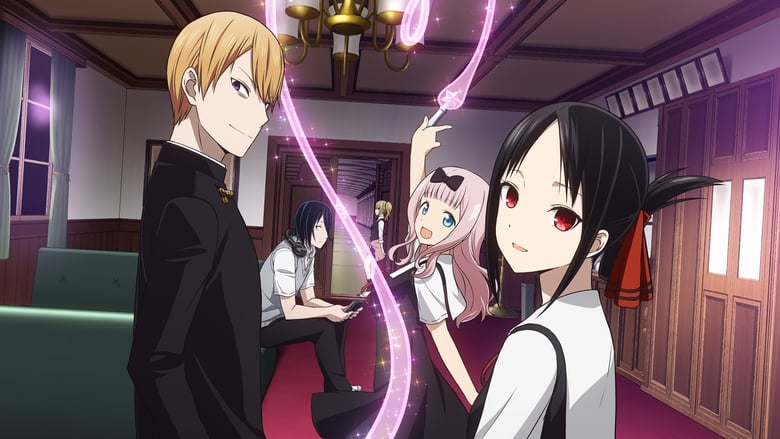

Kaguya-sama: Love Is War
A high-stakes romantic comedy where intellectual warfare masks profound vulnerability, like two fencers dueling with razor-sharp wits under a fragile cherry blossom tree.
Kaguya-sama: Love Is War

かぐや様は告らせたい~天才たちの恋愛頭脳戦~

12 January 2019 — 25 June 2022 Japan 3 season 37 episode Ended ⭐ 8.6 (778)
Cast: Makoto Furukawa, Aoi Koga, Konomi Kohara, Ryota Suzuki, Yumiri Hanamori
Animation Comedy
Pride and Vulnerability Communication and Misunderstanding Social Status and Personal Worth Friendship and Found Family

Kaguya-sama: Love Is War - Ending Explained

⚠️ Spoiler Analysis

"Kaguya-sama: Love Is War" follows a clear evolutionary path from comedic battles to sincere romance and external conflict. In Season 1, the plot is driven by the episodic 'battles' of wits, culminating in the Fireworks Festival, the first major crack in their prideful facade where Kaguya admits her loneliness and desire for connection.

Season 2 deepens the character backstories significantly. The focus expands to Yu Ishigami, revealing his past trauma from middle school where he was ostracized for defending a classmate from her cheating boyfriend. Miyuki is revealed to have been the one who saved him, cementing Ishigami's loyalty. The season ends with Miyuki accidentally seeing Kaguya's vulnerable side after she falls asleep, a key moment that humanizes her in his eyes.

Season 3, "Ultra Romantic," is the turning point. The entire season builds towards the Hoshin Culture Festival. Knowing he will be leaving for Stanford University soon, Miyuki decides to confess. He creates an incredibly elaborate plan, framing his confession as a grand 'theft' of Kaguya's kiss. In the finale, he succeeds, leading them to share a passionate kiss atop the school's clock tower. This event effectively ends the 'love is war' premise, as they have mutually confessed.

The movie, "The First Kiss That Never Ends," explores the immediate, awkward aftermath. Their lack of a formal verbal confession throws them into confusion. Kaguya's psyche fractures into different personas—her cold 'Ice' self and a childlike 'Little' self—representing her fear of commitment and her desire for a perfect romance. Miyuki, in turn, must confront his own insecurities, realizing he doesn't need to be perfect to be loved. The film concludes with them achieving a more stable understanding and truly beginning their relationship, marked by a second, more intimate kiss. The overarching narrative reveals that their initial 'war' was a necessary, if immature, way for two emotionally stunted geniuses to navigate their feelings until they were mature enough to embrace vulnerability.

Alternative Interpretations

One alternative interpretation of the series focuses on it as a critique of class and societal expectations in modern Japan. Kaguya's coldness and manipulative tendencies can be seen not just as a personality quirk, but as a direct result of the dehumanizing pressures placed upon the children of the corporate elite. Her 'war' is a desperate attempt to exert control in a life where she has none. Similarly, Miyuki's obsession with perfection can be read as a commentary on the intense pressure on students in Japan's meritocratic but rigid education system. From this perspective, their romance is less about pride and more about two individuals from different, but equally oppressive, systems trying to find a genuine human connection that transcends the roles society has assigned them.

Another reading views Chika Fujiwara not as an oblivious agent of chaos, but as a subtly brilliant manipulator herself. This interpretation suggests that her interruptions and seemingly random actions are not accidental but are intentional, albeit subconscious, efforts to maintain the status quo of the student council. She enjoys the dynamic of the group and instinctively understands that a resolution to Kaguya and Miyuki's conflict would change things forever. Her actions, therefore, serve to prolong the 'fun' phase of their relationships, making her a gatekeeper of the series' central conflict rather than a mere obstacle.