
Kaguya-sama: Love Is War
かぐや様は告らせたい~天才たちの恋愛頭脳戦~
Overview
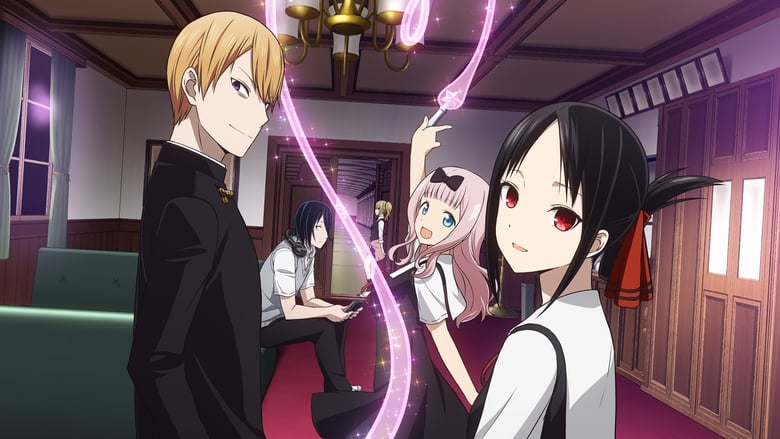
"Kaguya-sama: Love Is War" chronicles the elaborate schemes of Miyuki Shirogane and Kaguya Shinomiya, the brilliant President and Vice President of the elite Shuchiin Academy's student council. Both harbor deep romantic feelings for each other but are crippled by immense pride, believing that confessing would be a sign of weakness and subordination. This conviction sparks a daily "war" where they use their formidable intellects to manipulate situations, trying to force the other to confess their love first. Each episode typically presents several comedic battles of wit, narrated like a high-stakes psychological thriller, often with a declared winner and loser.
As the series progresses through its seasons, the initial premise evolves significantly. The focus expands beyond the central duo to include the other members of the student council: the chaotic and unpredictable secretary Chika Fujiwara, the gloomy but kind-hearted treasurer Yu Ishigami, and the rigidly moral Miko Iino. Their personal stories and character arcs become increasingly prominent, adding emotional depth and new dynamics to the central romance. The series masterfully transitions from a purely episodic comedy to a compelling overarching narrative about overcoming personal trauma, societal expectations, and the fear of vulnerability, exploring how Kaguya and Miyuki's relationship gradually deepens as they begin to lower their guards and support each other through genuine challenges.

Core Meaning
The core meaning of "Kaguya-sama: Love Is War" is that genuine connection and emotional honesty are triumphs, not weaknesses. The series deconstructs the idea that love is a battle to be won through pride and manipulation. Initially, Kaguya and Miyuki view vulnerability as a loss, but their entire journey is about realizing the opposite. The creators, led by mangaka Aka Akasaka, convey that true strength lies in the courage to be open with one's feelings, to accept imperfections in oneself and others, and to build relationships based on mutual support rather than power dynamics. The evolution from a "war" to a genuine partnership illustrates the message that the real victory in love is not in making the other person submit, but in finding the security to be your true self with them.
Thematic DNA
Pride and Vulnerability
This is the central theme driving the entire series. Kaguya and Miyuki's pride is the primary obstacle to their happiness. They construct elaborate psychological games to protect their egos, fearing that confessing love would make them the 'loser' in the relationship. Throughout the series, their character development is measured by their growing ability to shed this pride and embrace vulnerability. Moments of genuine emotional connection, often accidental at first, slowly chip away at their defenses, revealing that their fear of being vulnerable is the true enemy, not each other.
Communication and Misunderstanding
The series is a masterclass in the comedy and tragedy of miscommunication. Nearly every conflict stems from Kaguya and Miyuki over-analyzing each other's words and actions, leading to absurdly incorrect conclusions. Their internal monologues showcase the vast gap between their intentions and their outward behavior. The evolution of their relationship is marked by a gradual shift towards more direct and honest communication, as they learn that their mind games are less effective than simply speaking from the heart.
Social Status and Personal Worth
The setting of the elite Shuchiin Academy places a heavy emphasis on social standing. Kaguya comes from an incredibly wealthy and powerful family, while Miyuki is a meritocratic genius who has studied his way to the top. This disparity is a source of insecurity for both; Kaguya feels emotionally stunted by her restrictive upbringing, and Miyuki feels he must be 'perfect' to stand beside her. The series explores how they learn to value each other for who they are, not for their status, and how characters like Yu Ishigami overcome social ostracization to find their own sense of worth.
Friendship and Found Family
While the romance is central, the platonic relationships within the student council are the heart of the show. The council room becomes a sanctuary where Kaguya, Miyuki, Chika, Ishigami, and Miko can be themselves. They form a 'found family' that provides the support and acceptance they lack elsewhere. Kaguya's interactions with Ishigami, for instance, reveal a nurturing side, while Chika's chaotic energy, though disruptive, often forces the others out of their comfort zones and closer together.
Character Analysis
Kaguya Shinomiya
Aoi Koga
Motivation
Initially, her motivation is purely to 'win' the war of love by making Miyuki confess. This is driven by a deep-seated fear of vulnerability ingrained by her upbringing. As the series progresses, her motivation shifts from winning a game to a genuine desire to be with Miyuki and experience a normal, happy life filled with authentic relationships, free from the golden cage of her family name.
Character Arc
Kaguya begins as a cold, calculating, and prideful vice president, raised in a wealthy family that taught her to trust no one and view relationships as power struggles. Her initial interactions with Miyuki are purely tactical battles. Her arc is a journey of profound emotional thawing. Through her friendships in the student council, particularly with Ishigami whom she mentors, and her escalating feelings for Miyuki, she learns to embrace vulnerability. By the end of Season 3, she moves from trying to force a confession to orchestrating a grand romantic gesture herself, showing she has learned that expressing love is a victory, not a defeat. Her journey continues as she fights to free herself from her family's oppressive control to choose her own future with Miyuki.
Miyuki Shirogane
Makoto Furukawa
Motivation
His primary motivation is to prove that he is Kaguya's equal, despite their vast difference in social standing. He believes he must be perfect in every conceivable way to earn the right to stand by her side. This pressure to maintain his #1 student status and flawless image drives him to exhaustion. Over time, his motivation evolves into a simpler, more powerful desire: to make Kaguya happy and build a future with her, even if it means revealing his own flaws.
Character Arc
Miyuki starts as the brilliant, hard-working student council president who rose to the top through sheer effort, in stark contrast to the privileged elite around him. His perfectionism is a mask for his numerous insecurities, from his fear of insects to his complete lack of talent in arts and sports. His arc involves learning to accept his imperfections and realizing that Kaguya's affection is not contingent on his flawless facade. He trains relentlessly to overcome his weaknesses (volleyball, singing, dancing) not just to win, but because he genuinely wants to be a man worthy of Kaguya. His journey culminates in him being the first to truly risk everything, planning an elaborate 'theft' of Kaguya's first kiss during the culture festival, signifying his growth from a cautious strategist to a confident romantic lead.
Chika Fujiwara
Konomi Kohara
Motivation
Chika's motivation is simple: to have fun. She is driven by a desire for entertainment, novelty, and amusement. Whether it's introducing a new board game, starting a rap battle, or proclaiming herself a 'love detective', her actions are almost always aimed at creating an enjoyable, albeit chaotic, atmosphere. She thrives on being the center of attention and bringing energy into the room.
Character Arc
Chika is largely a static character, but her role is crucial to the development of others. She is the unpredictable 'wild card' whose bizarre schemes and cheerful obliviousness constantly derail Kaguya and Miyuki's plans. She serves as a catalyst for comedy and growth. Her arc is less about personal change and more about her consistent impact on the student council. She acts as Miyuki's long-suffering 'mother' figure, teaching him skills he lacks, and her friendship with Kaguya provides a link to a normal girl's life that Kaguya desperately craves. While she remains chaotic and self-serving, her genuine affection for her friends becomes more apparent over time.
Yu Ishigami
Ryota Suzuki
Motivation
His initial motivation is simply to survive the school day without drawing attention. After Miyuki and the council accept him, his motivation shifts towards wanting to protect the peace and happiness of the group he has come to cherish. Later, his arc is driven by a desire for self-improvement and to prove his worth, particularly as he develops a crush on his senpai, Tsubame Koyasu, which pushes him far out of his comfort zone.
Character Arc
Ishigami is introduced as a gloomy, game-obsessed treasurer who fears Kaguya and wants to die. His arc is one of the most significant in the series, focusing on overcoming past trauma and social anxiety. Initially isolated due to a middle school incident where his attempt to do the right thing led to him being ostracized, he learns to trust others again through the student council's acceptance. Encouraged by Miyuki, he confronts his past, joins the cheer squad, and makes an effort to connect with his peers. His journey is about learning to value himself, stepping out of his self-imposed darkness, and realizing that he deserves happiness and friendship.
Miko Iino
Miyu Tomita
Motivation
Miko is driven by a powerful, almost obsessive sense of justice and a desire to make the school a morally upright place. This stems from a lonely childhood where she clung to rules for stability. She is motivated by a genuine, albeit naive, desire to help others and correct what she perceives as wrong. As she integrates into the council, her motivation evolves to include protecting her newfound friends and learning to see the nuances in their behavior.
Character Arc
Miko joins the story as a rigid and uncompromisingly moralistic first-year student who runs against Miyuki for president. After her loss, she joins the council and her arc becomes about tempering her idealism with real-world understanding. She slowly learns that her black-and-white view of justice doesn't always apply and that the other council members, whom she initially sees as delinquents, are good people. She struggles with anxiety and a need for validation, but grows more confident and flexible through her interactions, particularly with the initially antagonistic but ultimately supportive Ishigami.
Symbols & Motifs
The Student Council Room
The Student Council Room symbolizes a safe haven or a sanctuary. It is the primary setting for the series and the 'battlefield' for Kaguya and Miyuki's schemes. More importantly, it represents a space where the main characters can shed the masks they wear in the outside world and form genuine, if chaotic, bonds. It's where they confront their issues and grow as individuals.
Nearly every major character interaction and development happens within the walls of this room. It is where Kaguya experiences a 'normal' high school life, Miyuki receives absurd life advice, Ishigami finds acceptance, and Miko learns to relax her rigid worldview. Its consistency as a setting highlights its importance as the crucible for their relationships.
The Moon
The moon is a classic symbol of romance and unattainable beauty, directly referencing the folkloric Tale of the Bamboo Cutter, where Princess Kaguya comes from the moon. In the series, it often symbolizes Kaguya's own feelings of isolation and her deep-seated desire for a genuine connection that feels as distant as the moon itself. It also represents the romantic ideal that both she and Miyuki are striving for.
The moon is featured prominently during key romantic moments, most notably during the Fireworks arc at the end of Season 1. Kaguya's internal monologue connects the beauty of the fireworks and the moon to her feelings for Miyuki, signifying a major turning point where her romantic feelings start to overpower her pride.
Masks
Masks, both literal and metaphorical, symbolize the facades and multiple personas the characters adopt to hide their true feelings and insecurities. Kaguya has her 'Ice Kaguya' persona, a cold and calculating mask to hide her vulnerability, while Miyuki maintains a 'perfect president' image to mask his humble background and various ineptitudes.
This is most explicitly explored in the movie, "The First Kiss That Never Ends," where Kaguya's internal conflict manifests as different personalities. Throughout the series, characters metaphorically 'put on a mask' during their strategic battles. The removal of these masks, such as when Ai Hayasaka reveals her true self or Kaguya allows her gentler side to show, signifies major character growth.
Memorable Quotes
お可愛いこと。
— Kaguya Shinomiya
Context:
Used frequently throughout all seasons, often as the punchline to one of their schemes. A classic example is in Season 1, Episode 1, after she masterfully manipulates Miyuki into asking her to see a movie, she thinks this to herself as her declaration of victory.
Meaning:
"How cute." This is Kaguya's iconic catchphrase, typically uttered with a condescending tone when she believes she has won a psychological battle against Miyuki. It symbolizes her pride and the emotional mask she wears. While it sounds dismissive, it's often a defense mechanism to hide her own flustered feelings.
恋愛は戦―――好きになった方が負けなのである!
— Narrator
Context:
This line is stated at the beginning of nearly every episode in the first season and frequently repeated by the narrator throughout the series to frame the comedic battles that are about to unfold.
Meaning:
"Love is war. Whoever falls in love first, loses!" This line is the series' thesis statement, establishing the core premise and the internal belief system of the two protagonists. It perfectly encapsulates the prideful, high-stakes nature of their romantic conflict.
見て見ぬふりをするのが一番怖いことだと気づいた。 目をそらすから、いろんなものが怖く見えるんだ。
— Yu Ishigami
Context:
This is from Ishigami's backstory arc in Season 2, Episode 11. He reflects on his decision to stand up for his classmate in middle school, understanding that facing a problem is better than ignoring it, even if it leads to personal suffering.
Meaning:
"The important thing is not to avert my eyes. I realized that so many things only seemed scary because I kept averting my eyes." This quote is the cornerstone of Ishigami's character development. It represents his decision to stop running from his past trauma and confront his fears head-on, marking a major turning point in his journey toward self-acceptance.
だから俺は頑張った。今までの人生で一番頑張った。
— Miyuki Shirogane
Context:
Miyuki thinks this during a flashback in Season 1, explaining why he studied so relentlessly to become the top student at Shuchiin. He felt it was the only way to get the seemingly untouchable Kaguya to even notice him.
Meaning:
"So I worked hard. Harder than I ever had before." This line reveals the depth of Miyuki's insecurity and the incredible effort he puts in to feel worthy of Kaguya. It reframes his academic achievements not just as personal ambition, but as a direct result of his feelings for her, highlighting the romantic core beneath his competitive exterior.
Episode Highlights
I Can't Hear the Fireworks, Part 2 / Kaguya Doesn't Want to Avoid Him
The student council gets separated during a summer festival. This episode masterfully cuts between the loud fireworks display and the quiet, internal monologues of Kaguya and Miyuki. Kaguya, stranded and having missed the fireworks, has a moment of profound emotional honesty, revealing her loneliness. The climax, where the entire council finds her, solidifies their bond as a found family.
This is the first major turning point in the series. It marks the moment the 'war' facade truly begins to crack, prioritizing genuine emotional connection over winning. Kaguya's vulnerability and Miyuki's earnest desire to help her signals a fundamental shift in their dynamic, setting the stage for the deeper character studies of later seasons.
Yu Ishigami Closes His Eyes, Part 3 / Miyuki Shirogane and Yu Ishigami / Kyoko Otomo Doesn't Realize
This episode delves into Ishigami's traumatic backstory, revealing why he became a recluse. It shows how Miyuki discovered the truth and defended Ishigami's honor, forming the basis of their deep loyalty. The episode culminates in Ishigami overcoming his fear and confronting his past during the sports festival, cheered on by the student council.
It's a pivotal episode for character depth, transforming Ishigami from a simple gag character into a complex, empathetic figure. It elevates the series' themes by tackling serious issues like bullying, rumors, and depression, and showcases the profound positive impact the student council has on its members' lives.
Dual Confessions, Part 2 / The Shuchiin Afterparty
The climax of the first major phase of the series. During the school's culture festival, Miyuki executes an incredibly elaborate and romantic plan, culminating in him 'stealing' a kiss from Kaguya atop the school's clock tower amidst a shower of heart-shaped balloons. The confession is mutual, heartfelt, and spectacular.
This episode effectively ends the 'war' part of "Love Is War." It's the culmination of three seasons of build-up, finally allowing the protagonists to move past their pride and admit their feelings. It redefines their relationship and sets the stage for the next phase of the story, which deals with the challenges of being a couple and external conflicts.
Chika Fujiwara Wants to Beat a Rhythm / Ai Hayasaka Wants to Talk / Maki Shijo Wants Some Help
A fan-favorite episode known for its incredible comedic timing and character moments. It features a segment where Chika tries to teach Miyuki how to rap, which is a hilarious disaster. The episode also gives a spotlight to Ai Hayasaka, Kaguya's maid, and the perpetually suffering Maki Shijo, deepening the world and its side characters.
While not as plot-heavy as others, this episode is a perfect showcase of the series' strengths: top-tier comedy, stellar voice acting, and creative direction. The rap segment, in particular, became an iconic, widely-shared moment that demonstrates the show's ability to turn a simple premise into comedic gold.
Philosophical Questions
Is vulnerability a strength or a weakness in human relationships?
The series explores this question through its central premise. Kaguya and Miyuki begin with the firm belief that vulnerability is a weakness and that the person who confesses love 'loses' power. However, their entire journey is a process of unlearning this toxic belief. Every time they accidentally show their true, vulnerable selves, their relationship deepens. The series argues that while pride offers a shield, it's a shield that leads to isolation. True strength, and the ultimate 'win,' is found in the courage to be vulnerable and build a connection based on mutual trust and emotional honesty.
To what extent do we perform for others versus being our 'true' selves?
Almost every character in "Kaguya-sama" wears a mask. Miyuki performs the role of the infallible president, Kaguya the role of the untouchable ice queen, and Hayasaka the role of the perfect servant. The series constantly delves into their internal monologues, showing the massive disconnect between their internal selves and their external personas. Their growth is contingent on their ability to let these masks slip and allow others to see their flawed, authentic selves. The story suggests that while performance is a necessary part of social interaction, true happiness is found in relationships where one no longer needs to perform.
Alternative Interpretations
One alternative interpretation of the series focuses on it as a critique of class and societal expectations in modern Japan. Kaguya's coldness and manipulative tendencies can be seen not just as a personality quirk, but as a direct result of the dehumanizing pressures placed upon the children of the corporate elite. Her 'war' is a desperate attempt to exert control in a life where she has none. Similarly, Miyuki's obsession with perfection can be read as a commentary on the intense pressure on students in Japan's meritocratic but rigid education system. From this perspective, their romance is less about pride and more about two individuals from different, but equally oppressive, systems trying to find a genuine human connection that transcends the roles society has assigned them.
Another reading views Chika Fujiwara not as an oblivious agent of chaos, but as a subtly brilliant manipulator herself. This interpretation suggests that her interruptions and seemingly random actions are not accidental but are intentional, albeit subconscious, efforts to maintain the status quo of the student council. She enjoys the dynamic of the group and instinctively understands that a resolution to Kaguya and Miyuki's conflict would change things forever. Her actions, therefore, serve to prolong the 'fun' phase of their relationships, making her a gatekeeper of the series' central conflict rather than a mere obstacle.
Cultural Impact
"Kaguya-sama: Love Is War" arrived as a breath of fresh air in the romantic comedy genre, quickly becoming a cultural phenomenon. Its unique premise, which frames romance as a psychological battle, resonated with a massive audience. The series revitalized the genre by blending slice-of-life comedy with intense, thriller-like narration and surprisingly deep character analysis. Critics and audiences alike praised its witty writing, sharp humor, and the exceptional quality of its anime adaptation by A-1 Pictures, which was lauded for its creative direction, expressive animation, and stellar voice performances. The 'Chika Dance' ending from Season 1 became a viral internet sensation, transcending the anime community and demonstrating the show's wide appeal.
The series has had a significant impact on pop culture, spawning countless memes, fan works, and discussions. It set a new standard for romantic comedies in anime, influencing subsequent shows with its successful formula of deconstructing genre tropes while still delivering heartfelt character moments. The characters, particularly the main duo and the supporting cast like Chika and Ishigami, have become iconic in their own right. The show's legacy is its masterful ability to evolve; it starts as a high-concept gag series and matures into a genuinely moving story about love, friendship, and the courage to be vulnerable, proving that a romantic comedy can be both hilarious and emotionally profound.
Audience Reception
"Kaguya-sama: Love Is War" has received overwhelmingly positive reception from audiences worldwide. It consistently ranks as one of the highest-rated anime series on platforms like MyAnimeList and IMDb, with its third season, "Ultra Romantic," receiving particularly exceptional scores, often placing it among the top-rated anime of all time. Audiences have praised the series for its brilliant comedy, witty dialogue, and surprisingly deep character development. The chemistry between Kaguya and Miyuki is a frequent point of acclaim, as is the strength of the supporting cast, with Yu Ishigami's character arc being a standout favorite for many viewers. The high-quality animation, creative storyboarding, and memorable opening and ending themes by A-1 Pictures are also consistently highlighted as major strengths. While some minor criticism has been directed at the occasional slow pacing of certain subplots, the overall consensus is that the series is a masterclass in the romantic comedy genre, successfully blending humor, romance, and heartfelt drama across its entire run.
Interesting Facts
- The creator of the manga, Aka Akasaka, modeled Kaguya Shinomiya's character on the mythical Princess Kaguya from 'The Tale of the Bamboo Cutter.'
- Aka Akasaka announced his retirement as a manga artist after the conclusion of the Kaguya-sama manga, stating he will focus solely on writing stories for other artists to illustrate.
- The ending sequence of Season 1, Episode 3, featuring Chika Fujiwara's meticulously animated dance (the 'Chikatto Chika Chika'), was a viral sensation online. It was animated by a single animator, Naoya Nakayama, over three months as a passion project.
- The series shares a universe with another of Aka Akasaka's works, "Oshi no Ko," which he writes. There are subtle crossovers and references between the two manga series.
- The narrator, Yutaka Aoyama, plays a significant role in the anime's comedic timing, often breaking the fourth wall and providing dramatic, game-show-like commentary on the characters' inner thoughts.
Easter Eggs
In several episodes, characters can be seen playing a parody of the Nintendo Switch, often called the 'Bentendo Switch.'
This is a common type of parody in anime to avoid trademark issues, but it's used frequently in the student council room, highlighting Ishigami's gaming hobby and the group's slice-of-life moments.
During the rap training episode (S3E5), the background music and Miyuki's attempts to rap contain references to classic Japanese hip-hop.
This adds a layer of cultural humor for viewers familiar with the Japanese music scene and showcases the production team's attention to detail in creating a genuinely funny and authentic parody.
The series contains numerous references to other manga and anime, including parodies of iconic scenes from series like 'JoJo's Bizarre Adventure' and 'Death Note.'
These homages serve as comedic highlights for seasoned anime fans. For example, the intense internal monologues and strategic thinking are a direct parody of the psychological battles in 'Death Note'.
⚠️ Spoiler Analysis
Click to reveal detailed analysis with spoilers
Frequently Asked Questions
Explore More About This Movie
Dive deeper into specific aspects of the movie with our detailed analysis pages
Comments (0)
No comments yet. Be the first to share your thoughts!