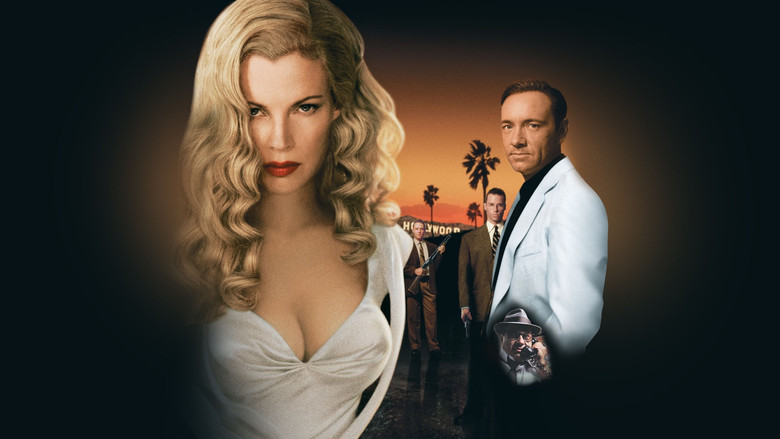
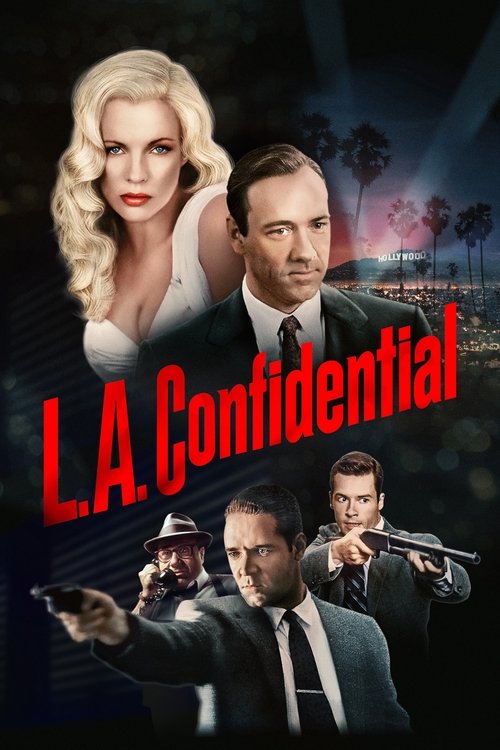
"Everything is suspect... Everyone is for sale... And nothing is what it seems."
L.A. Confidential - Symbolism & Philosophy
Symbols & Motifs
Rollo Tomasi
A symbol for unpunished crime and the elusive nature of absolute justice. It represents the personal ghost that haunts Exley and ultimately becomes the catalyst for exposing the truth.
Exley invents the name to give personality to his father's anonymous killer. It is later used as a code to signal the truth to Jack Vincennes before his death.
The Victory Motel
The physical manifestation of hidden corruption. It is a place of transit and transience where the city's "trash" is handled away from public eyes.
The site of the final, desperate shootout where the protagonists and the antagonist finally drop their pretenses and engage in raw violence.
Eyeglasses
Symbolizes clarity and the burden of seeing too much. It also represents Exley's initial lack of "toughness" in the eyes of his peers.
Dudley Smith repeatedly tells Exley to "lose the glasses" if he wants to get ahead, metaphorically asking him to look away from the truth.
Fleur-de-Lis
A symbol of manufactured desire and the commodification of the Hollywood image.
The name of the service that provides lookalike prostitutes, its tagline "Whatever you desire" mirrors the false promises of the city itself.
Philosophical Questions
Is it possible to remain moral within a fundamentally corrupt system?
The film explores this through Exley's journey from a 'straight arrow' to a man who shoots his unarmed boss in the back. It suggests that survival and 'justice' in such a system require the total abandonment of traditional morality.
Does the motivation for a 'good' act matter if the outcome is justice?
Bud White protects women but does so through illegal violence. Exley solves the case but does so for personal glory. The film asks whether these characters are heroes or simply people whose personal pathologies happen to align with the law occasionally.
Core Meaning
The film is a searing critique of image vs. reality. Director Curtis Hanson explores the idea that in a society obsessed with maintaining a heroic facade—whether it be the LAPD's "Badge of Honor" or Hollywood's manufactured starlets—the truth is often the first casualty. The core message suggests that justice is not a clean, bureaucratic outcome but a messy, often illegal struggle carried out by deeply flawed individuals who must become monsters to fight them.