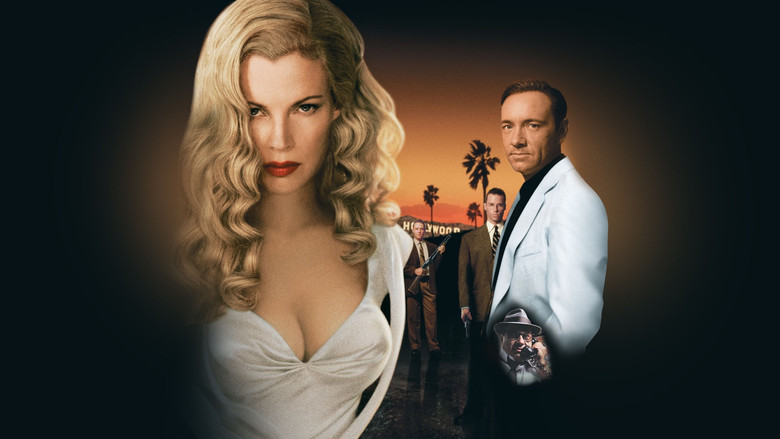
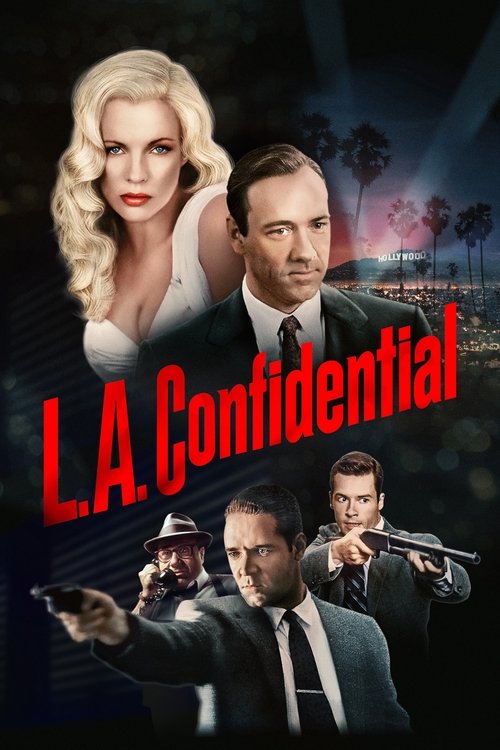
L.A. Confidential
A neon-soaked descent into a labyrinth of shadows where moral compasses shatter against the glitz of Hollywood. Blood-stained badges and tabloid whispers collide in a poetic, visceral autopsy of the American Dream.
L.A. Confidential

L.A. Confidential

"Everything is suspect... Everyone is for sale... And nothing is what it seems."

19 September 1997 United States of America 138 min ⭐ 7.8 (5,311)
Director: Curtis Hanson
Cast: Kevin Spacey, Russell Crowe, Guy Pearce, James Cromwell, Kim Basinger
Drama Crime Thriller Mystery
The Corruption of the American Dream Moral Ambiguity and Compromise Ambition vs. Integrity The Performance of Identity Redemption
Budget: $35,000,000
Box Office: $126,216,940

Overview

Set in the sweltering, post-war landscape of 1953 Los Angeles, L.A. Confidential follows three disparate detectives as they navigate a city trapped between its polished public image and a rotting underbelly of organized crime. Following a brutal multiple homicide at the Nite Owl coffee shop, the officers find their investigations intertwining in a web of police corruption, heroin trafficking, and high-stakes blackmail involving the city's most powerful figures.

The film masterfully contrasts three different approaches to law enforcement: the cold, political ambition of Edmund Exley, the raw, violent justice of Bud White, and the media-savvy charisma of Jack Vincennes. As they peel back the layers of a conspiracy that threatens to dismantle the LAPD, the trio must confront their own compromised ethics and decide what they are willing to sacrifice for a truth that no one else wants to hear.
Core Meaning

The film is a searing critique of image vs. reality. Director Curtis Hanson explores the idea that in a society obsessed with maintaining a heroic facade—whether it be the LAPD's "Badge of Honor" or Hollywood's manufactured starlets—the truth is often the first casualty. The core message suggests that justice is not a clean, bureaucratic outcome but a messy, often illegal struggle carried out by deeply flawed individuals who must become monsters to fight them.

Thematic DNA

The Corruption of the American Dream 30%
Moral Ambiguity and Compromise 25%
Ambition vs. Integrity 20%
The Performance of Identity 15%
Redemption 10%

The Corruption of the American Dream

The film portrays Los Angeles as a "paradise" built on a foundation of lies. This theme is revealed through the Fleur-de-Lis prostitution ring, where women are surgically altered to look like movie stars, symbolizing how the city's beauty is merely a carefully constructed and often violent mask for depravity.

Moral Ambiguity and Compromise

None of the protagonists are traditional heroes. Exley is willing to snitch on colleagues for a promotion; Bud White uses illegal brutality; and Vincennes takes bribes from tabloids. The film suggests that in a truly corrupt system, the only way to achieve a "good" end is through "bad" means.

Ambition vs. Integrity

Primarily explored through Ed Exley, whose desire to surpass his father's legacy drives him to manipulate the system. By the film's end, his "integrity" has morphed into a sophisticated form of political maneuvering that allows him to win while keeping the system's secrets.

The Performance of Identity

Characters are constantly performing roles: Vincennes as a "movie star" cop, the call girls as screen icons, and the LAPD as a holy force. The narrative strip-searches these identities to reveal the hollow, desperate people beneath the costumes.

Redemption

Specifically through Jack Vincennes and Bud White, the film explores the possibility of atoning for a lifetime of compromise. Their decision to pursue the truth despite personal cost represents a hard-won, bloody path to moral reclamation.

Character Analysis

Edmund Exley

Guy Pearce

Archetype: Anti-Hero / Ladder-Climber
Key Trait: Calculating Intellect

Motivation

Driven by a deep-seated need to live up to (and eventually surpass) the legend of his father, a heroic detective.

Character Arc

Begins as a rigid, by-the-book idealist and ends as a pragmatic, politically savvy leader who understands that the system requires a "hero" even if that hero has to shoot a man in the back.

Wendell 'Bud' White

Russell Crowe

Archetype: The Enforcer / Fallen Knight
Key Trait: Volatile Righteousness

Motivation

A personal crusade to protect women from abusers, rooted in the childhood trauma of witnessing his father beat his mother to death.

Character Arc

Starts as a blunt instrument of violence used by his superiors; evolves into a man of conscience who finds his own agency through his love for Lynn Bracken.

Jack Vincennes

Kevin Spacey

Archetype: The Mentor / Moral Centrist
Key Trait: Cynical Charisma

Motivation

Accolades, bribes, and the thrill of the Hollywood lifestyle, until he realizes he can't remember why he became a cop.

Character Arc

Initially a hollow celebrity cop addicted to the spotlight; undergoes a tragic awakening when his vanity leads to an innocent's death, prompting a final act of genuine police work.

Dudley Smith

James Cromwell

Archetype: The Mastermind / False Mentor
Key Trait: Paternal Ruthlessness

Motivation

Absolute power and the cold, Darwinian belief that he is the only one strong enough to "control" the city's chaos.

Character Arc

Maintains a fatherly, authoritative facade while secretly orchestrating the city's criminal takeover from within the police department.

Symbols & Motifs

Rollo Tomasi

Meaning:

A symbol for unpunished crime and the elusive nature of absolute justice. It represents the personal ghost that haunts Exley and ultimately becomes the catalyst for exposing the truth.

Context:

Exley invents the name to give personality to his father's anonymous killer. It is later used as a code to signal the truth to Jack Vincennes before his death.

The Victory Motel

Meaning:

The physical manifestation of hidden corruption. It is a place of transit and transience where the city's "trash" is handled away from public eyes.

Context:

The site of the final, desperate shootout where the protagonists and the antagonist finally drop their pretenses and engage in raw violence.

Eyeglasses

Meaning:

Symbolizes clarity and the burden of seeing too much. It also represents Exley's initial lack of "toughness" in the eyes of his peers.

Context:

Dudley Smith repeatedly tells Exley to "lose the glasses" if he wants to get ahead, metaphorically asking him to look away from the truth.

Fleur-de-Lis

Meaning:

A symbol of manufactured desire and the commodification of the Hollywood image.

Context:

The name of the service that provides lookalike prostitutes, its tagline "Whatever you desire" mirrors the false promises of the city itself.

Memorable Quotes

Rollo Tomasi.

— Ed Exley / Jack Vincennes

Context:

Whispered by Jack with his dying breath to the killer, who then unknowingly repeats it to Exley.

Meaning:

This is the film's most critical plot device. It signifies the idea of the man who gets away with it, and it ultimately exposes the villain through a moment of shared, secret knowledge.

Off the record, on the QT, and very hush-hush.

— Sid Hudgens

Context:

Repeated throughout the film as the opening narration and the slogan of Hush-Hush magazine.

Meaning:

Captures the voyeuristic, tabloid-driven culture of the 1950s where secrets were the most valuable currency.

Some men get the world. Others get an ex-hooker and a trip to Arizona.

— Lynn Bracken

Context:

Said to Exley at the very end, highlighting the contrast between his political ascent and Bud's quiet retirement.

Meaning:

A cynical summary of the film's resolution, acknowledging the different types of "victories" the characters achieve.

Go to work, Bud.

— Dudley Smith

Context:

Used by Dudley to unleash Bud's violence against suspects.

Meaning:

A dehumanizing command that frames Bud White as a tool rather than a person.

Philosophical Questions

Is it possible to remain moral within a fundamentally corrupt system?

The film explores this through Exley's journey from a 'straight arrow' to a man who shoots his unarmed boss in the back. It suggests that survival and 'justice' in such a system require the total abandonment of traditional morality.

Does the motivation for a 'good' act matter if the outcome is justice?

Bud White protects women but does so through illegal violence. Exley solves the case but does so for personal glory. The film asks whether these characters are heroes or simply people whose personal pathologies happen to align with the law occasionally.

Alternative Interpretations

Critics have often debated the ending's cynicism. While it appears to be a 'happy ending' with the villain dead and Bud surviving, many interpret it as deeply dark: Exley only 'wins' by participating in a massive cover-up that paints the villain as a hero, thus perpetuating the cycle of institutional lies. Another reading suggests Exley is the real antagonist of the piece—a man who lacks the soul of Bud or the late-blooming conscience of Jack, and who ends the film having successfully used every tragedy to further his own career. Some audience members also point to the final glances between Lynn and Exley as evidence of a transactional, cold attraction that supersedes Lynn's 'love' for Bud.

Cultural Impact

L.A. Confidential is widely regarded as the pinnacle of the neo-noir genre in the 1990s. It arrived at a time when Hollywood was moving toward bombastic blockbusters (famously losing the Best Picture Oscar to Titanic), yet it stood out for its intricate, literary-depth screenplay and restrained, naturalistic style. It revitalized interest in the works of James Ellroy and set a new standard for period crime dramas. In 2015, the Library of Congress selected it for preservation in the National Film Registry for its aesthetic and historical significance. It also served as a major launching pad for the international careers of Russell Crowe and Guy Pearce.

Audience Reception

The film was a critical darling, sweeping the 'Big Four' critics' awards (NYFCC, LAFCA, NSFC, NBR)—a rare feat shared only by Schindler’s List and The Social Network. Audiences praised its complex, 'adult' storytelling and the visceral performances of the lead trio. While some found the plot's density difficult to follow on a first viewing, it has since gained a reputation as one of the most 'rewatchable' films ever made, with viewers discovering new clues and nuances with each screening. The main point of contention remains the survival of Bud White, which some fans of the darker novel feel was a concession to Hollywood sensibilities.

Interesting Facts

  • The 'Bloody Christmas' riot was based on a real-life event that occurred in the LAPD on Christmas Day, 1951.
  • Warner Bros. was terrified of casting Guy Pearce and Russell Crowe because they were unknown Australian actors at the time.
  • Kim Basinger's performance is one of the shortest ever to win an Oscar; she is on screen for only about 15 minutes.
  • The character of Jack Vincennes was modeled after the real-life detective who consulted on the TV show 'Dragnet'.
  • Director Curtis Hanson had the actors watch 1950s police training videos to learn the 'stiff and wooden' posture of the era.
  • The fictional 'Hush-Hush' magazine is a direct parody of the real-life 1950s scandal rag 'Confidential'.

Easter Eggs

The Bad and the Beautiful (1952) Marquee

When Jack Vincennes is standing outside a theater, the marquee displays this title. It is a direct reference to the film's themes of Hollywood's dual nature and mirrors Jack's own amoral 'star' persona.

The Lana Turner Joke

Exley insults a woman he thinks is a prostitute 'cut' to look like Lana Turner, only for it to actually be the real Lana Turner. This meta-joke highlights the theme of reality vs. imitation.

Robert Mitchum's Arrest Photo

During the opening montage, a photo of Robert Mitchum's 1948 marijuana arrest is shown. This grounds the film in real Hollywood scandals of the era.

⚠️ Spoiler Analysis

Click to reveal detailed analysis with spoilers

Frequently Asked Questions

Explore More About This Movie

Dive deeper into specific aspects of the movie with our detailed analysis pages

Comments (0)

Leave a comment

No comments yet. Be the first to share your thoughts!