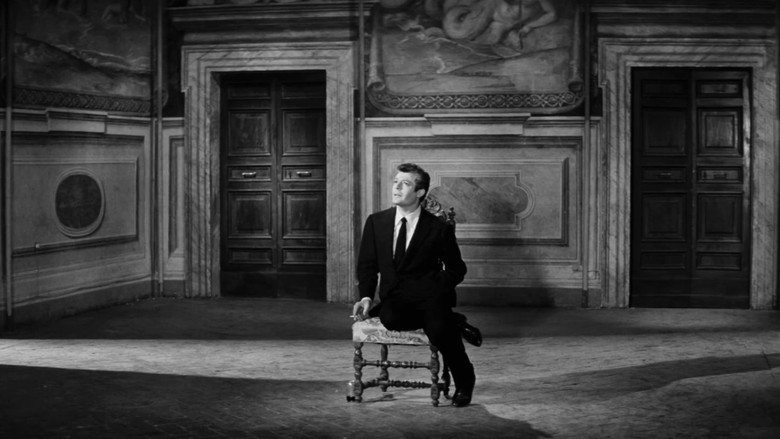

La dolce vita
"The world’s most talked about movie today!"
Director: Federico Fellini
Cast: Marcello Mastroianni, Anita Ekberg, Anouk Aimée, Yvonne Furneaux, Magali Noël
La Dolce Vita — Characters & Cast
Character Analysis
Marcello Rubini
Marcello Mastroianni
Motivation
Marcello is motivated by a conflicted desire for both the fleeting pleasures of Rome's high society and a deeper, more authentic existence. He craves excitement, women, and fame, yet is simultaneously disgusted by the emptiness of this lifestyle and yearns for the intellectual and stable life he believes his friend Steiner possesses.
Character Arc
Marcello begins as a disillusioned journalist with lingering literary ambitions, caught in a world of superficial glamour. He does not experience a traditional redemptive arc; instead, he spirals deeper into a life of hedonism and self-loathing. By the end of the film, after the tragic suicide of his intellectual friend Steiner, Marcello abandons his aspirations and fully embraces the debauchery he once only observed, becoming a publicity agent. His final inability to understand the innocent Paola signifies his complete disconnection from a more meaningful life.
Sylvia
Anita Ekberg
Motivation
Sylvia is motivated by the pursuit of pleasure and sensation. She is a creature of impulse, whether it's dancing wildly in the Baths of Caracalla, climbing the dome of St. Peter's, or wading into the Trevi Fountain. Her motivations are simple and immediate, contrasting with Marcello's complex internal conflicts.
Character Arc
Sylvia is a larger-than-life American movie star who represents the ultimate fantasy of the "sweet life." Her character is more symbolic than developmental. She appears as a force of nature—uninhibited, sensual, and seemingly carefree. She serves as a catalyst for one of Marcello's most significant escapades into pure fantasy, but her presence is fleeting, and she ultimately remains an unattainable ideal for him.
Maddalena
Anouk Aimée
Motivation
Maddalena is motivated by a desperate need to escape her own boredom. She seeks excitement and novelty, whether it's spending the night in a prostitute's apartment or exploring a dilapidated castle. Her wealth provides no fulfillment, leaving her in a constant state of jaded dissatisfaction.
Character Arc
Maddalena is a wealthy, beautiful, and perpetually bored heiress. Like Sylvia, her character does not have a significant arc but rather represents a particular facet of the decadent society Marcello inhabits. She is restless and constantly seeking new sensations to escape her ennui. Her relationship with Marcello is purely physical and thrill-seeking, as shown when she loses interest in him moments after proposing marriage.
Emma
Yvonne Furneaux
Motivation
Emma's primary motivation is to possess Marcello completely. She wants a conventional life with him—a husband, a home, and children. Her love is described as aggressive and maternal, and her actions, from her suicide attempt to her constant arguments, are all driven by her desperate desire to hold on to a man who is emotionally unavailable.
Character Arc
Emma is Marcello's long-suffering fiancée. Her character remains largely static throughout the film, defined by her possessive, all-consuming love for Marcello. She experiences moments of extreme crisis, such as her suicide attempt at the beginning of the film, but her fundamental character and her dysfunctional dynamic with Marcello do not change. She represents a form of domestic life and traditional love that Marcello finds suffocating and ultimately rejects.
Steiner
Alain Cuny
Motivation
Steiner's motivations are complex and ultimately rooted in a profound existential fear. He confesses to Marcello his fear of peace, seeing it as a fragile facade hiding the chaos of life. He seeks a detached, harmonious existence beyond passion but is ultimately consumed by a darkness that leads him to commit an unthinkable act to protect his children from the life he dreads.
Character Arc
Steiner is a wealthy intellectual whom Marcello admires and sees as an ideal. He has a beautiful wife, children, a home filled with art and intelligent friends—everything Marcello thinks he wants. However, Steiner's arc is tragic and shocking. Beneath his serene exterior, he harbors a deep despair about the future, which culminates in him murdering his two children and committing suicide. This act shatters Marcello's idealized view and serves as a major catalyst for his final descent into nihilism.
Cast
Explore More About This Movie
Dive deeper into specific aspects of the movie with our detailed analysis pages