"How far you fall doesn't matter, it's how you land…"
La Haine - Symbolism & Philosophy
Symbols & Motifs
The Falling Man/Society Story
This recurring story, told by Hubert, about a man falling from a skyscraper who tells himself "so far, so good" on the way down, is an allegory for French society. It symbolizes a society in denial, ignoring its deep-seated problems and heading for a catastrophic landing. The final iteration of the story changes "a man" to "a society," making the film's critique explicit.
The story bookends the film, appearing in the opening and closing narration. It serves as a framework for understanding the entire narrative, suggesting that the 24 hours we witness are just a moment in a larger, inevitable descent into chaos.
The Gun
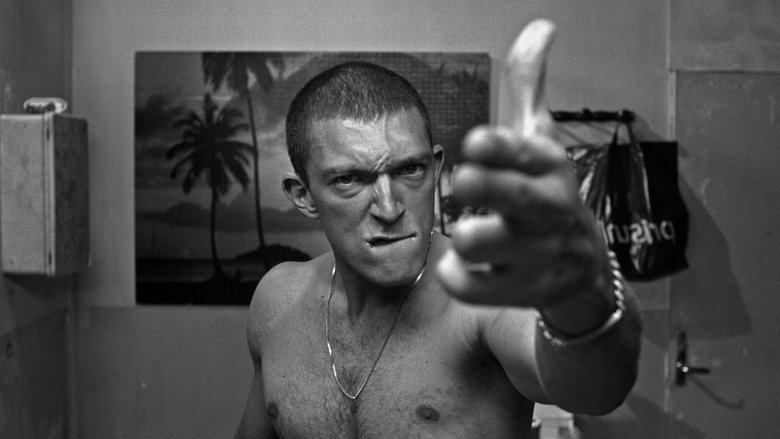
The lost police revolver that Vinz finds symbolizes power, the potential for violence, and the central moral dilemma of the film. For Vinz, it represents a means of gaining respect and enacting revenge in a world that has rendered him powerless. For Hubert, it is a dangerous object that will only perpetuate the cycle of hate. The transfer of the gun from Vinz to Hubert at the end signifies a shift in responsibility and Vinz's ultimate rejection of violence.
The gun is a central plot device, introduced early on after the riots. Vinz carries it throughout the film, creating constant tension. Key scenes involving the gun include Vinz's confrontation with a skinhead and the final, tragic standoff with the police.
The Ticking Clock
The on-screen display of the time throughout the film creates a sense of impending doom and urgency. It functions as a countdown, suggesting that time is running out for the characters and the society they inhabit. This device reinforces the film's structure, which chronicles a specific 24-hour period, and amplifies the tension as the narrative moves towards its inevitable conclusion.
The time is frequently superimposed on the screen, marking the progression of the day and night. This technique gives the film a documentary-like feel of chronicling events as they unfold.
The Cow
The surreal image of a cow appearing in the housing project symbolizes the absurdity and displacement felt by the characters. It represents something out of place, much like the protagonists feel in their own society. For Vinz, who is the only one to see it, it could represent his inner turmoil and the strangeness of his reality. In Jewish culture, seeing a cow in a dream can be an omen of death, foreshadowing Vinz's fate.
The cow appears unexpectedly as the friends are talking on a rooftop. The other characters dismiss Vinz's sighting, adding to the surreal and isolating nature of the vision.
Philosophical Questions
Does violence justify violence?
This is the central philosophical question debated by Vinz and Hubert. Vinz believes in an "eye-for-an-eye" justice, arguing that killing a cop is necessary to "re-establish the balance." Hubert counters with the philosophy that "hatred breeds hatred," arguing that violence is a self-perpetuating cycle that solves nothing. The film explores this question without offering a simple answer, culminating in a tragic climax where violence, both accidental and deliberate, leads only to more death and despair.
Can one escape their environment?
Hubert's character embodies the struggle to escape the 'banlieue'. He dreams of leaving and tries to maintain a moral code separate from the street, but his environment constantly pulls him back. His boxing gym, a potential escape route, is destroyed in the riots. The film questions whether individual will is enough to overcome systemic poverty, prejudice, and violence. The ending suggests a pessimistic view, implying that the forces of one's environment and the cycle of hatred are ultimately inescapable.
What is the nature of identity in a multicultural society?
The film presents a "black-blanc-beur" (black-white-Arab) trio, representing the multicultural makeup of the French suburbs. Despite their different ethnic and religious backgrounds, they are united by a common social identity defined by their exclusion from mainstream French society. The film explores how their identities are forged in opposition to the state and in solidarity with each other, challenging the traditional French model of assimilation.
Core Meaning
The core message of "La Haine" is encapsulated in Hubert's recurring line, "La haine attire la haine" (hatred breeds hatred). Director Mathieu Kassovitz sought to expose the vicious cycle of violence and prejudice that traps marginalized youth in the French 'banlieues' (suburbs). The film is a powerful social commentary on police brutality, systemic inequality, and the disenfranchisement of immigrant communities. It doesn't offer easy answers but rather holds up a mirror to a society in crisis, as symbolized by the story of a man falling from a skyscraper who repeats to himself, "So far, so good..." — it's not the fall that matters, but the landing. Kassovitz intended to put a human face on the statistics of urban violence, making the audience understand the individuals behind the news headlines of riots and arrests.