The entire narrative of "La Notte" builds to its devastating final scene, which reframes all that has come before. After a night of flirtations and emotional drifting at the party, Lidia reveals to Giovanni that their friend Tommaso has died. This news, which she has held onto for hours, acts as the final catalyst. As dawn breaks on a golf course, the artificial landscape mirroring their artificial lives, Lidia tells Giovanni she no longer loves him and feels like dying because of it. To prove how far they have drifted, she reads a beautiful, passionate love letter he wrote her years earlier. The ultimate twist is Giovanni's vacant reaction: he doesn't recognize the words as his own. This moment reveals that his problem is not simply a lack of love, but a profound amnesia of the soul; he has become a stranger to his own feelings. His response is not emotional, but a desperate, almost violent physical attempt to possess her, to force a connection that has long since vanished. Lidia's resistance ("I don't love you anymore. And you don't love me either.") confirms the absolute finality of their emotional death. The film ends on this unresolved, uncomfortable embrace in a bunker on the golf course, offering no hope for reconciliation, only the stark, bleak truth of their emptiness.
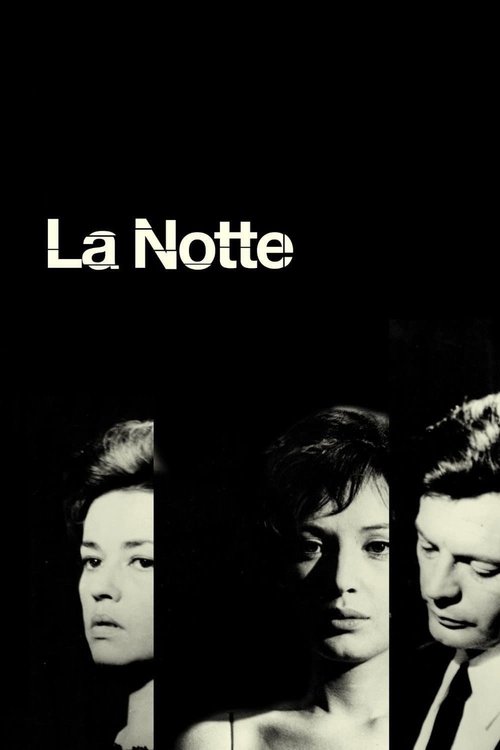
La notte
"A new genre of motion picture... to make you think and feel."
Director: Michelangelo Antonioni
Cast: Marcello Mastroianni, Jeanne Moreau, Monica Vitti, Bernhard Wicki, Rosy Mazzacurati
La Notte — Ending Explained
⚠️ Spoiler Analysis
Alternative Interpretations
While the dominant interpretation of "La Notte" sees the ending as a bleak confirmation of the death of love, some viewers find a glimmer of ambiguity. Giovanni's final, desperate attempt at physical intimacy after Lidia's confession could be seen not just as a pathetic, animalistic gesture, but as a raw, wordless acknowledgment of their shared despair—a clinging to the only form of connection they have left. Is it the final degradation, or the first step toward a new, albeit broken, form of honesty?
Another perspective focuses more on the feminist undertones of the film. Lidia's journey and eventual confrontation can be read as an awakening. She is no longer willing to exist as a passive reflection of her successful husband. Her declaration is not just an admission of defeat but an act of reclaiming her own emotional truth. The quiet solidarity she shares with Valentina, another intelligent woman reduced to a supporting role, suggests a critique of the limited roles available to women in this patriarchal, bourgeois society. In this light, the film is less about a specific failing marriage and more about a woman's struggle for selfhood in a world that seeks to render her invisible.
Explore More About This Movie
Dive deeper into specific aspects of the movie with our detailed analysis pages