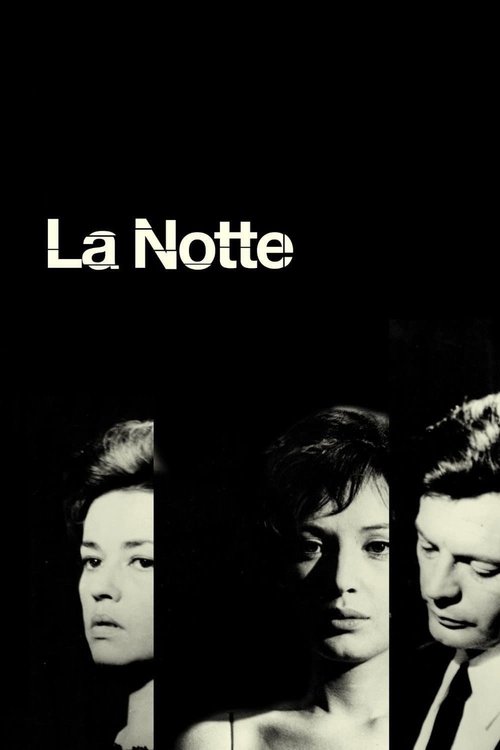
La Notte
La notte
"A new genre of motion picture... to make you think and feel."
Overview
"La Notte" chronicles a day and night in the life of a Milanese couple, Giovanni Pontano (Marcello Mastroianni), a successful but disillusioned novelist, and his wife, Lidia (Jeanne Moreau). The film opens with their visit to a dying friend, Tommaso (Bernhard Wicki), an event that profoundly unsettles Lidia and sets the tone for the ensuing emotional excavation.
Following the hospital visit, the couple drifts apart. Giovanni attends a launch party for his new book, where he is celebrated but feels empty. Lidia, feeling alienated, wanders through the city, revisiting places from their past. Their paths converge again in the evening as they attend a lavish party hosted by a wealthy industrialist. Through the long, decadent night, they interact with other guests, including the host's vibrant and enigmatic daughter, Valentina (Monica Vitti), who attracts Giovanni's attention. As the night wears on, the façade of their marriage cracks, leading to a raw and uncertain dawn.
Core Meaning
"La Notte" is a profound meditation on the erosion of love and the spiritual emptiness of modern bourgeois life. Director Michelangelo Antonioni uses the crumbling marriage of Giovanni and Lidia as a microcosm to explore broader themes of alienation, incommunicability, and existential ennui in a rapidly modernizing society. The film suggests that material success and a sophisticated social life often mask a deep-seated emotional void and an inability to truly connect with others. Antonioni critiques a world where genuine feeling has been replaced by superficiality and intellectualism, leaving individuals adrift in a landscape that is both physically and emotionally sterile. The film doesn't offer easy answers but rather presents a stark, poignant diagnosis of a modern malaise.
Thematic DNA
Alienation and Incommunicability
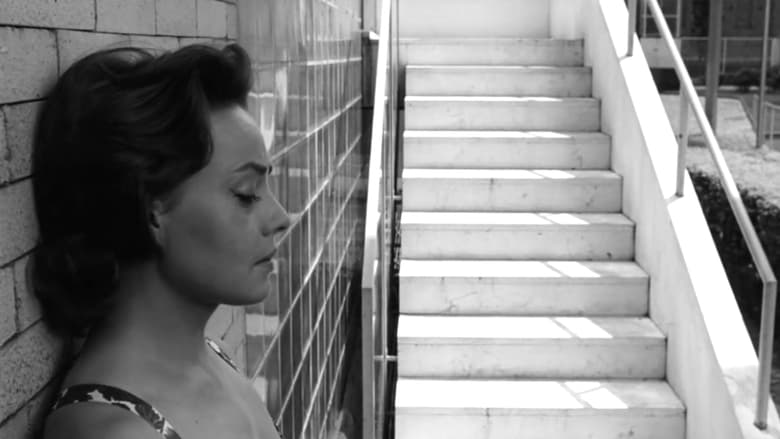
This is the central theme, pervading every interaction. Giovanni and Lidia exist in the same spaces but are emotionally miles apart, their conversations sparse and failing to bridge the chasm between them. Antonioni masterfully uses long takes, silence, and framing to emphasize their isolation, not just from each other but from the world around them. The bustling party, intended for connection, only highlights their profound loneliness. Lidia's solitary walk through Milan is a physical manifestation of her emotional wandering and detachment.
The Decay of Love and Marriage
The film is a forensic examination of a dying relationship. The initial love and passion, recalled only through an old letter at the end, have evaporated, leaving behind habit and resentment. Their dying friend Tommaso can be seen as a symbol of their dead marriage. Both Giovanni and Lidia seek distraction and connection elsewhere—Giovanni with a nymphomaniac at the hospital and later with Valentina, Lidia in a fleeting connection with a man named Roberto—but these attempts are hollow and fail to provide any real solace.
Existential Ennui and Spiritual Emptiness
The characters, particularly Giovanni and Lidia, are affluent and successful, yet they suffer from a profound sense of purposelessness. Giovanni, a writer, admits he has run out of ideas and only has memories, signaling a creative and spiritual crisis. The opulent lifestyle, represented by the industrialist's party, is depicted as decadent and spiritually bankrupt. The characters' pursuits of pleasure are portrayed as desperate attempts to fill an inner void.
Modernity and its Discontents
Antonioni sets the film against the backdrop of a rapidly modernizing Milan, with its new skyscrapers juxtaposed against old, crumbling neighborhoods. This architectural landscape is not merely a setting but a reflection of the characters' internal states: sterile, cold, and dehumanizing. The sleek, modern buildings symbolize a society that has prioritized progress and materialism at the cost of genuine human connection and emotion.
Character Analysis
Giovanni Pontano
Marcello Mastroianni
Motivation
His primary motivation is to escape his existential boredom and creative impotence. He seeks validation and distraction through fleeting flirtations and the prospect of a lucrative but soul-crushing job, all while avoiding direct confrontation with his marital failure.
Character Arc
Giovanni begins the film as a celebrated but spiritually adrift writer. Throughout the night, his detachment and casual infidelity reveal a deep-seated crisis of meaning. He moves from a state of passive dissatisfaction to a desperate, last-ditch attempt to reclaim a love he no longer recognizes, ending in a state of pathetic uncertainty.
Lidia Pontano
Jeanne Moreau
Motivation
Lidia is motivated by a desperate need to feel something real and to understand how her life and marriage have arrived at this empty place. She revisits the past and observes the present, searching for a sign of life or a reason to continue.
Character Arc
Lidia is the film's emotional core. Initially presented as Giovanni's quiet, embittered wife, her long, solitary walk through Milan reveals her inner turmoil and search for meaning. She moves from silent suffering and resignation to a painful, clear-eyed articulation of the death of her love, confronting the truth that Giovanni tries to evade.
Valentina Gherardini
Monica Vitti
Motivation
Valentina is motivated by a desire for authenticity in a world of artifice. She engages in playful games and intellectual conversation but is ultimately searching for genuine connection, which she senses is absent in Giovanni.
Character Arc
Valentina is the intelligent, alluring, and equally disillusioned daughter of the wealthy host. She enters the narrative as a potential object of Giovanni's desire but reveals her own depth and weariness with the superficial world she inhabits. She acts as a mirror to both Giovanni and Lidia, ultimately rejecting the meaningless affair Giovanni proposes and showing solidarity with Lidia.
Tommaso Garani
Bernhard Wicki
Motivation
His motivation in his final moments is to connect honestly with his friends, praising Giovanni's work while being acutely aware of his own mortality. He represents a past where things, including love and friendship, had more meaning.
Character Arc
Tommaso's presence is brief but his arc is central to the film's theme. He is a man of integrity and a dear friend from the couple's past who is now facing death. His physical decline parallels the emotional death of the central relationship, and his passing serves as the final catalyst for Lidia's emotional breakdown.
Symbols & Motifs
Milan's Architecture
The architecture of Milan serves as a visual metaphor for the characters' emotional states. The cold, geometric lines of the modern skyscrapers reflect their alienation, emptiness, and the sterile nature of their lives. In contrast, the older, more dilapidated parts of the city Lidia wanders through evoke a sense of a lost past and decaying emotion.
The film opens with the camera descending a glass skyscraper, immediately establishing a theme of modern alienation. Lidia is often framed against vast, impersonal buildings, emphasizing her solitude and insignificance in this modern world.
The Dying Friend, Tommaso
Tommaso represents the death of love and intellectual honesty. His physical decay mirrors the decay of Giovanni and Lidia's marriage. He was a figure from their past who, unlike Giovanni, seems to have retained his integrity, and his death marks the final, undeniable end of an era for the couple.
The film begins with the couple visiting the terminally ill Tommaso in the hospital. His death is announced to Lidia during the party, which precipitates her final confrontation with Giovanni about the state of their relationship.
The Party
The lavish all-night party symbolizes the superficiality, decadence, and moral emptiness of the upper class. It's a world of frivolous games, intellectual posturing, and fleeting, meaningless encounters designed to distract from deeper existential anxieties. Despite being surrounded by people, the main characters have never felt more alone.
The second half of the film is almost entirely set at the Gherardini villa. It is here that Giovanni's flirtation with Valentina intensifies and Lidia receives the news of Tommaso's death, bringing the couple's crisis to a head amidst the hedonism.
Giovanni's Love Letter
The love letter that Giovanni wrote to Lidia years ago symbolizes the passionate, hopeful love they once shared. It is a tangible relic of a past that feels completely disconnected from their present reality.
In the final scene, as dawn breaks, Lidia reads the letter aloud. Giovanni, moved, doesn't even recognize his own words, highlighting how completely he has become detached from his former self and his feelings for her. The act of reading it is a final, painful acknowledgment of what has been lost.
Memorable Quotes
Se stasera ho voglia di morire, è perché non ti amo più. Sono disperata per questo.
— Lidia Pontano
Context:
Spoken to Giovanni in the final scene, on the golf course at dawn, after the party has ended and she has just informed him of Tommaso's death. It is her final, unambiguous declaration of their marriage's end.
Meaning:
"If tonight I feel like dying, it's because I don't love you anymore. I'm desperate because of it." This line is the raw, devastating climax of Lidia's journey. It's not an angry accusation but a statement of profound sorrow and hopelessness, equating the death of love with a personal death wish.
Chi l'ha scritta?
— Giovanni Pontano
Context:
In the final scene, immediately after Lidia finishes reading his old love letter to him. Her simple, devastating reply is, "You did."
Meaning:
"Who wrote that?" Giovanni's question, after Lidia reads aloud the passionate love letter he wrote years ago, is the ultimate confirmation of his alienation. He is so disconnected from his past emotions that he cannot even recognize his own words, revealing the depth of his spiritual and emotional amnesia.
Non ho più idee, io. Ho solo ricordi.
— Giovanni Pontano
Context:
Giovanni says this to Valentina during the party, confessing the creative 'crisis' that he feels is affecting his entire life.
Meaning:
"I no longer have ideas. I only have memories." This statement encapsulates Giovanni's creative and existential crisis. As a writer, his inability to generate new ideas signifies a kind of spiritual death. He is trapped in the past, unable to create or feel anything new, which explains his constant search for external stimuli.
Philosophical Questions
Can love survive in a world of profound spiritual emptiness and materialism?
The film relentlessly explores this question through Giovanni and Lidia. Their initial love, born in a simpler past, cannot withstand the pressures of success, societal expectations, and the internal void that has grown within them. The opulent but soulless environment they inhabit offers no nourishment for genuine emotion, suggesting that modern life itself, with its focus on surfaces and distractions, is toxic to deep, lasting connection.
What is the role of art and the artist in a society that seems to have lost its way?
Giovanni, a successful writer, embodies this dilemma. His art has brought him fame and fortune but has left him creatively and morally bankrupt. He is offered a position by an industrialist who views culture as another commodity. The film questions whether art can retain its meaning and integrity in a capitalist society or if the artist is destined to become another entertainer for a bored and decadent elite.
How do our physical surroundings shape our inner lives?
Antonioni makes the urban landscape of Milan a central character. The film posits that the cold, impersonal nature of modern architecture directly contributes to human alienation and the breakdown of communication. The characters are dwarfed by vast, empty spaces and framed by sterile, geometric structures, visually arguing that our environment can isolate us and mirror our own emotional desolation.
Alternative Interpretations
While the dominant interpretation of "La Notte" sees the ending as a bleak confirmation of the death of love, some viewers find a glimmer of ambiguity. Giovanni's final, desperate attempt at physical intimacy after Lidia's confession could be seen not just as a pathetic, animalistic gesture, but as a raw, wordless acknowledgment of their shared despair—a clinging to the only form of connection they have left. Is it the final degradation, or the first step toward a new, albeit broken, form of honesty?
Another perspective focuses more on the feminist undertones of the film. Lidia's journey and eventual confrontation can be read as an awakening. She is no longer willing to exist as a passive reflection of her successful husband. Her declaration is not just an admission of defeat but an act of reclaiming her own emotional truth. The quiet solidarity she shares with Valentina, another intelligent woman reduced to a supporting role, suggests a critique of the limited roles available to women in this patriarchal, bourgeois society. In this light, the film is less about a specific failing marriage and more about a woman's struggle for selfhood in a world that seeks to render her invisible.
Cultural Impact
"La Notte" was a landmark of European art cinema and had a profound impact on filmmaking. Released in the midst of Italy's economic boom, the film offered a trenchant critique of the spiritual cost of modernity and materialism, a theme that resonated across the Western world. Antonioni's innovative visual language—his use of long, meditative takes, his focus on architecture as an extension of character psychology, and his departure from traditional narrative structures—was highly influential. He created what critic Andrew Sarris termed "Antoniennui," a specific mood of glamorous, existential dread that came to define a certain type of art film. The film solidified the international stardom of Marcello Mastroianni, Jeanne Moreau, and Monica Vitti, making them icons of European cool and intellectualism. Its unflinching portrayal of a marriage in decay and its themes of alienation and incommunicability have been echoed in the work of countless directors since, from Stanley Kubrick to Sofia Coppola. While some critics at the time found it slow or obscure, it is now widely regarded as a masterpiece that perfectly captured the anxieties of its era.
Audience Reception
Upon its release, "La Notte" was met with a polarized reaction. Many critics lauded it as a masterpiece, praising Antonioni's masterful visual style, its profound exploration of modern anxieties, and the powerful performances by Mastroianni, Moreau, and Vitti. It won the prestigious Golden Bear at the Berlin International Film Festival. However, a significant portion of the audience and some critics found the film to be slow, pretentious, and emotionally cold. Its unconventional narrative, which eschews dramatic events in favor of mood and atmosphere, was challenging for viewers accustomed to more traditional storytelling. Over time, the film's reputation has solidified, and it is now overwhelmingly considered a classic of world cinema, with its challenging aspects seen as integral to its artistic vision and thematic depth.
Interesting Facts
- "La Notte" is the second film in director Michelangelo Antonioni's informal "trilogy of alienation," situated between "L'Avventura" (1960) and "L'Eclisse" (1962).
- The film won the Golden Bear at the 11th Berlin International Film Festival in 1961.
- Upon its release in Italy, the film faced some censorship issues, particularly concerning a scene of nudity involving Jeanne Moreau and the final scene on the golf course.
- Filmmaker Stanley Kubrick listed "La Notte" as one of his ten favorite films.
- The intellectual party guests are depicted reading contemporary philosophical works; Valentina is seen with Hermann Broch's novel "The Sleepwalkers," and the dying Tommaso has just published an article on Theodor Adorno, grounding the film's existential themes in the European intellectual currents of the time.
⚠️ Spoiler Analysis
Click to reveal detailed analysis with spoilers
Frequently Asked Questions
Explore More About This Movie
Dive deeper into specific aspects of the movie with our detailed analysis pages
Comments (0)
No comments yet. Be the first to share your thoughts!