
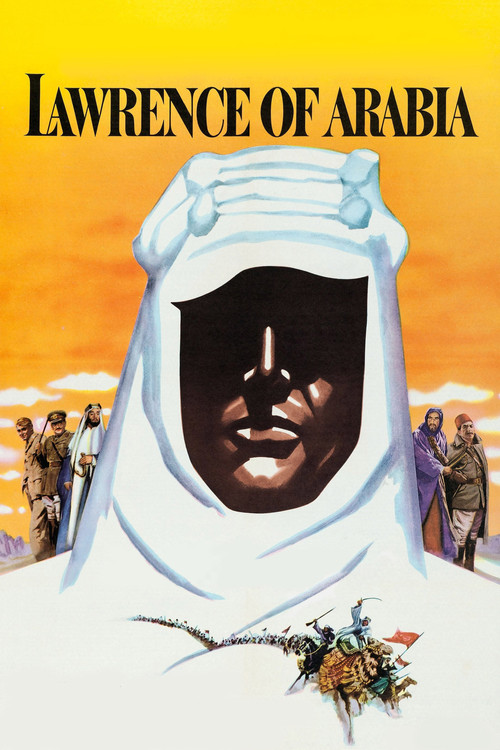
"Nothing is written."
Director: David Lean
Cast: Peter O'Toole, Alec Guinness, Omar Sharif, Anthony Quinn, Jack Hawkins
Lawrence of Arabia — Characters & Cast
Character Analysis
T.E. Lawrence
Peter O'Toole
Motivation
Lawrence's motivations are complex and often contradictory. Initially, he seeks a stage grand enough for his ambitions and a way to escape the stifling conformity of British military life. He possesses a genuine romantic admiration for the Arab people and their cause for independence. However, this is intertwined with a powerful ego, a desire for glory, and perhaps a masochistic need to test his own limits. He is driven by the belief that he can write his own destiny: "Nothing is written."
Character Arc
Lawrence begins as an eccentric, arrogant, and brilliant but marginalized British officer. The desert allows him to unleash his potential, and he transforms into a charismatic, messianic war leader. He embraces his new identity as 'El Aurens,' believing himself to be a man of destiny. However, the burdens of leadership, the brutality of war, and his capture and torture shatter his spirit and his sense of self. He becomes increasingly ruthless and disillusioned, culminating in his tragic realization that his dream of a unified Arabia was a mirage and he was merely a tool for British imperial interests. He leaves Arabia a broken man, stripped of the identity he fought so hard to create.
Sherif Ali
Omar Sharif
Motivation
Ali's primary motivation is a fierce loyalty to his people and a deep-seated desire for Arab independence. He is pragmatic and grounded in the realities of tribal politics and desert life. He follows Lawrence because he believes Lawrence is the key to achieving Arab unity and victory against the Turks. His loyalty is to the cause, not to Lawrence's personal mythology.
Character Arc
Sherif Ali is initially introduced as a fierce and traditional Bedouin warrior, distrustful of the British outsider. His relationship with Lawrence evolves from suspicion to a deep, complex friendship built on mutual respect. Ali acts as Lawrence's guide, both literally in the desert and morally. He is the first to recognize Lawrence's extraordinary qualities but also the first to be horrified by his growing brutality. As Lawrence loses his humanity, Ali becomes the film's moral compass. Their friendship ultimately fractures under the weight of Lawrence's messiah complex and bloodlust, and Ali abandons him in Damascus, disillusioned.
Prince Faisal
Alec Guinness
Motivation
Faisal is driven by a long-term vision of a modern, independent Arab state. He is less interested in the romance of battle and more focused on the political outcome. He uses Lawrence's military genius to further his own strategic goals, knowing that the real battle will be fought not in the desert but at the negotiating tables in Europe. His motivation is the survival and sovereignty of his people.
Character Arc
Prince Faisal is a wise, shrewd, and pragmatic Arab leader. He is initially cautious of Lawrence but recognizes his potential value to the Arab Revolt. He serves as a mentor figure, guiding Lawrence in the complexities of Arab politics. Faisal understands the larger political game being played by the British far better than Lawrence does. His arc is one of a shrewd politician navigating the treacherous waters between tribal factions and imperial powers. While Lawrence's journey ends in personal failure, Faisal ultimately transitions from a desert revolt leader to a political player on the world stage, prepared to negotiate the future of his people with the British, even after their betrayal.
Auda abu Tayi
Anthony Quinn
Motivation
Auda is motivated by personal pride, wealth, and the thrill of battle. He famously declares, "I am a river to my people!" He fights for the prosperity and honor of his tribe above all else. While Lawrence convinces him to fight for a larger Arab cause, his primary interests remain more personal and material than the idealistic goals of Lawrence or the political ambitions of Faisal. He scorns being a servant to anyone, Turk or British.
Character Arc
Auda abu Tayi, the leader of the powerful Howeitat tribe, is a force of nature—volatile, proud, and driven by a desire for plunder and glory. He is initially a mercenary, allied with the Turks, but Lawrence persuades him to join the Arab Revolt with promises of gold and the chance to take Aqaba. Auda represents the untamable, individualistic spirit of the Bedouin warrior, which is both a great strength and a great weakness for the Arab cause. His arc shows him becoming a committed patriot, but he remains deeply cynical about politics, ultimately returning to the desert when the dream of a unified Arab council in Damascus collapses into squabbling.
Cast
Explore More About This Movie
Dive deeper into specific aspects of the movie with our detailed analysis pages