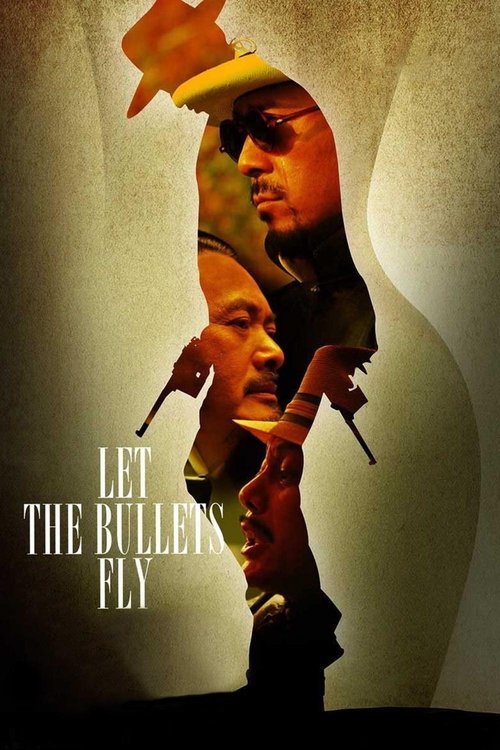
讓子彈飛
"A comic western legend."
Let the Bullets Fly - Symbolism & Philosophy
Symbols & Motifs
The Horse-Drawn Train
A visual pun on Marxism-Leninism (in Chinese, Ma-Lie sounds like "Horse-Train"). It symbolizes the absurdity of importing foreign ideologies (the steam train/Western modernity) into a feudal Chinese context (pulled by horses) without the proper infrastructure, resulting in a system that looks advanced but functions primitively.
The opening scene where a steam train is pulled by horses, which is then hijacked by Zhang Mazi.
The Bowl of Jelly
The weaponization of innocence and the trap of moral perfectionism. It shows how the corrupt use the integrity of the righteous against them. Sixth Brother commits suicide to prove a trivial truth (he ate only one bowl), effectively losing his life for a meaningless victory in a rigged game.
Sixth Brother is accused of eating two bowls of jelly but paying for one. He disembowels himself to prove his innocence to the crowd.
The Empty Chair
The fragility of power. The position of "Governor" or "Master" is just a role that anyone can fill. When the chair is empty or the double is killed, the idea of the ruler dies, regardless of the man himself.
Used in the final confrontation where the execution of the body double is enough to break Huang's psychological hold on the town.
Philosophical Questions
Can a revolution ever truly succeed, or does it only replace the oppressor?
The film ends with the overthrow of the tyrant, yet the victorious revolutionaries immediately abandon their leader to pursue wealth in the big city (Shanghai). This suggests a pessimistic view that human greed inevitably corrupts revolutionary ideals, turning the 'dragon slayers' into future 'dragons'.
What is the value of truth in a society built on lies?
Sixth Brother dies to prove a truth (he ate one bowl), but his death changes nothing in the power structure. The film suggests that in a corrupt political system, 'truth' is a weakness that can be exploited, and only power and perception (the empty chair, the body double) actually drive change.
Core Meaning
At its heart, Let the Bullets Fly is a biting political allegory about the cyclical nature of revolution and the corruption of ideals. Director Jiang Wen critiques how revolutionaries (the dragon slayers) often risk becoming the new tyrants (the dragons) once they taste power and wealth (symbolized by Shanghai). The film suggests that true justice is elusive because the masses are often too passive or opportunistic, siding only with the winner rather than the righteous. It explores the tension between idealism (Zhang Mazi) and pragmatism/opportunism (Ma Bengde), ultimately questioning whether "fairness" is possible in a world driven by greed.