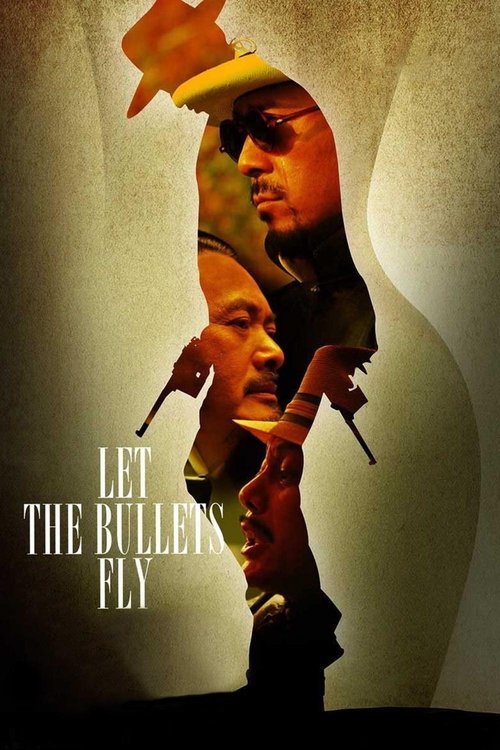
Let the Bullets Fly
讓子彈飛
"A comic western legend."
Overview
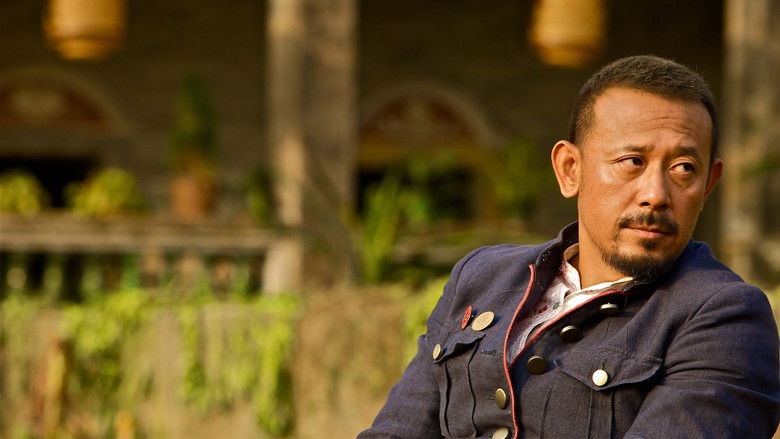
Set in the warlord era of 1920s China, the film follows notorious bandit chief Zhang Mazi (Jiang Wen), who hijacks a train carrying the newly appointed governor of Goose Town. Finding no money on board, Zhang assumes the identity of the governor, Ma Bengde, taking the real governor (Ge You) hostage as his counselor. Upon arriving in Goose Town, Zhang intends to make a quick fortune but instead finds himself in a deadly battle of wits with the local tyrant and mob boss, Master Huang (Chow Yun-Fat).
What begins as a con game escalates into a violent ideological struggle. Zhang, driven by a hidden sense of justice, refuses to bow to Huang's corrupt rule, declaring he wants to "stand tall and earn money." The town becomes a chessboard where the two men trade schemes, assassinations, and public displays of power, all while the fearful townsfolk watch from the sidelines, waiting to see who will emerge victorious.
As the conflict reaches its boiling point, Zhang realizes that defeating Huang requires more than just bullets; it requires waking up the masses. The film culminates in a chaotic and surreal uprising that challenges the very nature of revolution, leaving Zhang victorious but strangely isolated as his surviving brothers leave him for the allure of modern Shanghai, hinting that the cycle of power may simply be starting anew.
Core Meaning
At its heart, Let the Bullets Fly is a biting political allegory about the cyclical nature of revolution and the corruption of ideals. Director Jiang Wen critiques how revolutionaries (the dragon slayers) often risk becoming the new tyrants (the dragons) once they taste power and wealth (symbolized by Shanghai). The film suggests that true justice is elusive because the masses are often too passive or opportunistic, siding only with the winner rather than the righteous. It explores the tension between idealism (Zhang Mazi) and pragmatism/opportunism (Ma Bengde), ultimately questioning whether "fairness" is possible in a world driven by greed.
Thematic DNA
The Cyclical Nature of Revolution
The film posits that history repeats itself. The bandits overthrow the tyrant Huang, but in the end, they leave to pursue the same wealth and comfort (Shanghai) that Huang represented. Zhang Mazi is left alone, suggesting that the pure revolutionary spirit is always isolated and that the new regime often inevitably resembles the old one.
Truth vs. Deception
Identity is fluid in Goose Town. A bandit plays a governor, a governor plays a counselor, and the tyrant has a body double. The film suggests that in politics, truth is secondary to perception. The characters constantly bluff and perform for the public, highlighting how political authority is often a theatrical construction maintained by lies.
Opportunism of the Masses
The citizens of Goose Town are portrayed not as noble victims but as fearful opportunists. They accept guns but don't fight; they accept silver but don't spend it. They only storm the castle after they believe Huang is already defeated. Jiang Wen cynically portrays the public as a force that follows power, not morality.
Dignity vs. Survival
This is encapsulated in the conflict between Zhang and Ma. Ma represents the survivalist instinct to kneel and compromise to get rich ("make money on your knees"). Zhang refuses, insisting on "standing tall" to earn his living. The film asks the price of dignity in a corrupt system.
Character Analysis
Zhang Mazi (Pocky Zhang)
Jiang Wen
Motivation
To bring "Fairness, fairness, and goddamn fairness" to the people and to stand tall while doing it.
Character Arc
A former military pistol instructor turned bandit who seeks to impose justice on a lawless town. He remains steadfast in his principles throughout, refusing to compromise with Huang. Although he wins the battle, he loses his "family" to the allure of the city, ending the film as a lonely warrior.
Master Huang
Chow Yun-Fat
Motivation
To maintain his stranglehold on power and wealth (opium trade).
Character Arc
The ruler of Goose Town who controls the wealth and people through fear and surrogates. He underestimates Zhang's resolve. His downfall comes when his illusions of invincibility are shattered by Zhang's tactical use of the body double.
Ma Bengde (Counselor)
Ge You
Motivation
Survival and profit; he is willing to kneel to anyone who pays.
Character Arc
The real governor who pretends to be a counselor to survive. He constantly switches sides, trying to profit from the conflict between Zhang and Huang. He represents the pragmatic, often corrupt, middle class. His death reveals he had even more secrets he never shared.
Sixth Brother (Liuzi)
Zhang Mo
Motivation
Loyalty to his father figure (Zhang) and absolute honesty.
Character Arc
Zhang's youngest and most loyal follower. He is too honest for the corrupt world of Goose Town. He falls into a psychological trap set by Huang's lackey, sacrificing his life to prove a minor point of truth, galvanizing Zhang's resolve.
Symbols & Motifs
The Horse-Drawn Train
A visual pun on Marxism-Leninism (in Chinese, Ma-Lie sounds like "Horse-Train"). It symbolizes the absurdity of importing foreign ideologies (the steam train/Western modernity) into a feudal Chinese context (pulled by horses) without the proper infrastructure, resulting in a system that looks advanced but functions primitively.
The opening scene where a steam train is pulled by horses, which is then hijacked by Zhang Mazi.
The Bowl of Jelly
The weaponization of innocence and the trap of moral perfectionism. It shows how the corrupt use the integrity of the righteous against them. Sixth Brother commits suicide to prove a trivial truth (he ate only one bowl), effectively losing his life for a meaningless victory in a rigged game.
Sixth Brother is accused of eating two bowls of jelly but paying for one. He disembowels himself to prove his innocence to the crowd.
The Empty Chair
The fragility of power. The position of "Governor" or "Master" is just a role that anyone can fill. When the chair is empty or the double is killed, the idea of the ruler dies, regardless of the man himself.
Used in the final confrontation where the execution of the body double is enough to break Huang's psychological hold on the town.
Memorable Quotes
让子弹飞一会儿 (Ràng zǐdàn fēi yīhuìr)
— Zhang Mazi
Context:
Spoken in the opening scene after his bandits fire shots at the train, but nothing seems to happen immediately.
Meaning:
"Let the bullets fly for a while." This quote urges patience and strategic thinking. It implies that the consequences of an action (or the truth) take time to manifest, and one shouldn't rush to judgment or panic before the dust settles.
公平,公平,还是TMD公平! (Gōngpíng, gōngpíng, háishì TMD gōngpíng!)
— Zhang Mazi
Context:
Zhang declares his three goals for his tenure as governor to the bewildered Counselor Ma.
Meaning:
"Fairness, fairness, and goddamn fairness!" (often translated as "Justice"). It encapsulates the protagonist's core philosophy and the film's central demand for social equality against feudal oppression.
我是想站着,还把钱挣了! (Wǒ shì xiǎng zhànzhe, hái bǎ qián zhèngle!)
— Zhang Mazi
Context:
When Counselor Ma tells him that to make money as a governor, he must kneel to Master Huang.
Meaning:
"I want to stand tall, and still earn the money!" A rejection of the corrupt status quo where one must demean themselves (kneel) to succeed. It is a powerful statement of personal dignity.
Philosophical Questions
Can a revolution ever truly succeed, or does it only replace the oppressor?
The film ends with the overthrow of the tyrant, yet the victorious revolutionaries immediately abandon their leader to pursue wealth in the big city (Shanghai). This suggests a pessimistic view that human greed inevitably corrupts revolutionary ideals, turning the 'dragon slayers' into future 'dragons'.
What is the value of truth in a society built on lies?
Sixth Brother dies to prove a truth (he ate one bowl), but his death changes nothing in the power structure. The film suggests that in a corrupt political system, 'truth' is a weakness that can be exploited, and only power and perception (the empty chair, the body double) actually drive change.
Alternative Interpretations
The film is a Rorschach test for political views. The Pro-Maoist Reading: Zhang Mazi represents Mao Zedong, a pure revolutionary fighting entrenched feudalism (Huang) and revisionist bureaucrats (Ma), eventually betrayed by his followers who choose capitalism (Shanghai). The Anti-Authoritarian Reading: The film critiques the CCP, showing how the 'Liberators' are just bandits in disguise who replace one tyrant with another, leaving the people (Goose Town) just as oppressed. The Cinematographic Reading: It is simply a masterclass in black comedy and a homage to Sergio Leone, with no intended political message other than entertainment.
Cultural Impact
Let the Bullets Fly became a massive cultural phenomenon in China, spawning countless internet memes and political discussions. It revived the genre of the 'Chinese Western' and set a new standard for commercial filmmaking that maintains artistic integrity. Its dialogue entered the vernacular, with 'Let the bullets fly' becoming a common phrase to mean 'wait and see' during political scandals. Philosophically, it sparked intense debate about the legacy of the 1911 and 1949 revolutions, with many young Chinese viewing it as a deconstruction of how revolutionary ardor turns into bureaucratic corruption.
Audience Reception
The film was universally acclaimed by Chinese audiences and critics for its razor-sharp dialogue, pacing, and performances. It holds a legendary status on Chinese rating sites like Douban. Western critics were generally positive but often confused by the dense cultural references and rapid-fire subtitles. Common praises include the 'violent aesthetic' and the chemistry between the three leads. Criticism is mostly directed at the convoluted plot twists and the specific cultural barriers that make the humor hard to translate.
Interesting Facts
- The film was the highest-grossing domestic film in Chinese history at the time of its release, breaking box office records.
- The 'Horse-Drawn Train' (Ma-Lie) is widely interpreted by Chinese netizens as a pun on Marxism-Leninism, satirizing the forced application of foreign ideology.
- Director Jiang Wen cast his own brother, Jiang Wu, as the character 'Wu' (the bearded bandit), and his wife, Zhou Yun, as Flora/Hua Jie.
- The script went through over 30 drafts before Jiang Wen was satisfied with the balance of comedy and political subtext.
- Despite its heavy political satire, the film passed Chinese censorship, reportedly because the censors viewed it merely as a period action comedy, or perhaps because the allegory was too complex to pin down definitively.
Easter Eggs
The 'Ma-Lie' Pun
The opening visual of horses (Ma) pulling a train (Lie) is a homophone for Ma-Lie (Marxism-Leninism). This visual gag sets the stage for the film's allegorical critique of Chinese socialism.
Shanghai vs. Pudong
At the end, the bandits say they are going to "Shanghai," and one mentions "Pudong." In 1920, Pudong was a swamp, but today it is the symbol of China's hyper-capitalist financial power. This anachronism signals that the revolutionaries are heading toward capitalism.
The 9-Barrelled Mask
The bandits wear tiles from the game Mahjong as masks (specifically the 'Disk' suit). Zhang Mazi is 'Nine Dots' (Pocky), symbolizing his name but also perhaps the highest value, or the 'Nine' of power.
⚠️ Spoiler Analysis
Click to reveal detailed analysis with spoilers
Frequently Asked Questions
Explore More About This Movie
Dive deeper into specific aspects of the movie with our detailed analysis pages
Comments (0)
No comments yet. Be the first to share your thoughts!