"He's not the messiah...he's just a naughty boy."
Life of Brian - Ending Explained
⚠️ Spoiler Analysis
The film's narrative arc is a tragedy disguised as a farce. Brian never succeeds in his goals: he doesn't defeat the Romans, he doesn't get the girl (in a meaningful romantic sense—she's just using him for the cause), and he doesn't escape death. The twists are all anti-climactic:
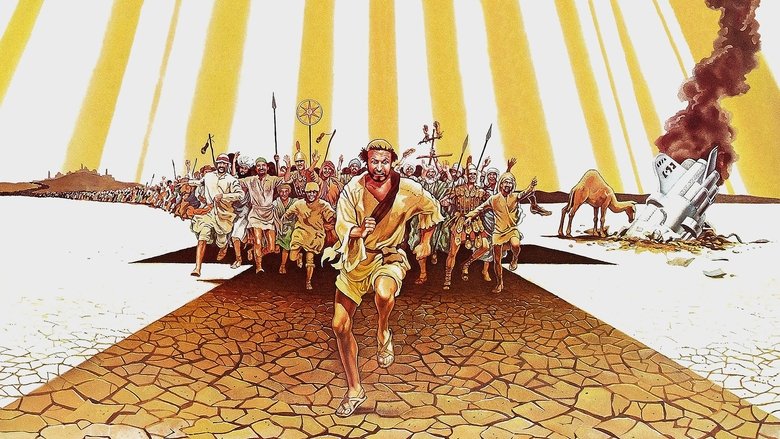
- The Spaceship: Brian is saved from a fall only to be abducted by aliens and crash-land back where he started, changing nothing.
- The Failed Rescue: In a subversion of movie tropes, every group that could save Brian fails to do so. The PFJ reads him a commendation for his martyrdom; Judith praises him for dying for the cause; his mother tells him off.
- The Spartacus Parody: When the Romans offer to release "Brian," everyone claims to be Brian. The real Brian is ignored, and the wrong man is released.
The ending is the ultimate subversion: the hero dies. There is no last-minute miracle. The meaning revealed is that there is no divine intervention coming; we are alone, and our only control is over our own reaction to that fact.
Alternative Interpretations
The 'Heretical but not Blasphemous' View:
Many critics and even the Pythons themselves argue the film is "heretical" (opposing the church structure) but not "blasphemous" (insulting God). They point out that Jesus is depicted as a legitimate, wise teacher in the Sermon on the Mount scene, and the joke is entirely on the people who mishear him ("Blessed are the cheesemakers").
The Political Allegory:
Some interpret the film primarily as a satire of the British Left in the 1970s. The PFJ and their endless meetings, splinter groups, and acronyms mirror the state of British trade unions and socialist movements of the era, suggesting the film is more about political paralysis than religion.
The Nihilistic vs. Stoic Ending:
The ending can be read two ways. Nihilistic: Brian dies, nothing is achieved, and the "Bright Side" song is a cynical joke about the hopelessness of existence. Stoic: The song represents the ultimate triumph of the human spirit—the ability to choose one's attitude even when stripped of all agency and facing death.