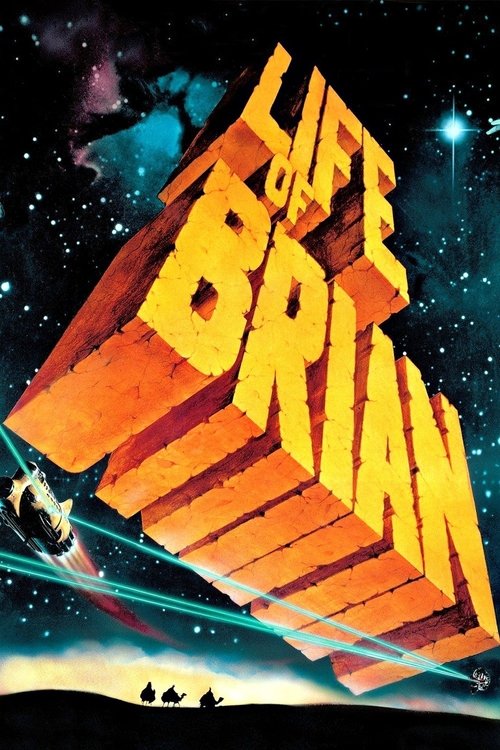
Life of Brian
A biting religious satire and absurdist comedy that skewers blind faith and political dogmatism. Through the tragicomic life of a reluctant messiah, it blends gritty historical realism with surreal humor, culminating in a defiant, musical acceptance of inevitable death.
Life of Brian

Life of Brian

"He's not the messiah...he's just a naughty boy."

17 August 1979 United Kingdom 94 min ⭐ 7.8 (4,760)
Director: Terry Jones
Cast: Graham Chapman, John Cleese, Terry Gilliam, Eric Idle, Terry Jones
Comedy
The Absurdity of Blind Faith Political Ineptitude and Factionalism Individuality vs. Conformity The Banality of Authority
Budget: $4,000,000
Box Office: $20,833,252

Overview

Brian Cohen is born in a stable in Bethlehem, just moments after and next door to Jesus Christ, leading the Three Wise Men to initially mistake him for the Messiah. As an adult in Roman-occupied Judea, Brian is a somewhat naive idealist who resents the occupation and his mother's revelation that his father was a Roman centurion named Naughtius Maximus. Desperate to impress a young rebel named Judith, Brian joins the People's Front of Judea (PFJ), a bickering separatist group that spends more time debating bureaucratic minutiae than fighting the Romans.

Brian's attempt to prove himself by scrawling anti-Roman graffiti on the governor's palace leads to a series of mishaps, resulting in him accidentally gathering a massive following of desperate zealots who interpret his every mundane action as a miracle. despite his desperate pleas that he is not the Messiah, the crowd refuses to listen, stripping him of his individuality and forcing him into a role he never wanted.

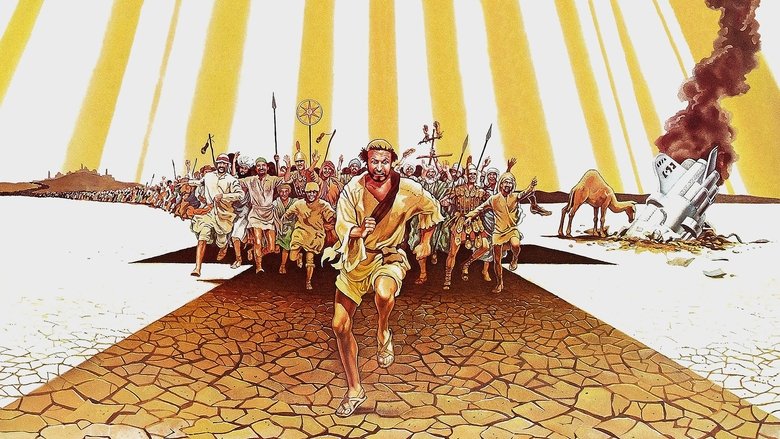
Eventually captured by the Romans and sentenced to crucifixion, Brian hopes for a rescue from the various rebel factions or an alien spaceship that briefly abducted him earlier. Instead, he is abandoned by his followers, the PFJ, and even his mother. The film ends with Brian and his fellow sufferers on the cross singing "Always Look on the Bright Side of Life," finding absurd optimism in the face of certain death.
Core Meaning

The central message of Life of Brian is a critique of groupthink and the human tendency to blindly follow authority—whether religious or political—rather than thinking for oneself. The film posits that dogmatism leads to absurdity and violence, and that individuals often create their own chains by seeking easy answers from charismatic leaders.

Ultimately, the film champions intellectual independence and existential resilience. By showing how easily a "Messiah" can be manufactured by a desperate crowd, it challenges the validity of organized religion while suggesting that the only true salvation lies in one's own attitude toward life's inevitable suffering.

Thematic DNA

The Absurdity of Blind Faith 30%
Political Ineptitude and Factionalism 25%
Individuality vs. Conformity 25%
The Banality of Authority 20%

The Absurdity of Blind Faith

The film relentlessly satirizes how followers project meaning onto nothing. When Brian loses a shoe or holds up a gourd, the crowd immediately fractures into schisms (the "Followers of the Shoe" vs. the "Followers of the Gourd"), mimicking the history of religious sectarianism over trivial differences.

Political Ineptitude and Factionalism

Through groups like the People's Front of Judea (not to be confused with the Judean People's Front), the film mocks the fragmentation of leftist revolutionary movements. The rebels are paralyzed by committee meetings, semantics, and infighting, rendering them completely ineffective against the actual oppressor.

Individuality vs. Conformity

This is epitomized in the scene where Brian tells the crowd, "You are all individuals!" and they chant back in unison, "Yes, we are all individuals!" The film argues that the desire to belong often overrides the desire to be free, creating a paradox where non-conformists all look and act exactly the same.

The Banality of Authority

The Roman oppressors are not depicted as terrifying villains but as bureaucratic bumblers or speech-impaired aristocrats (Pontius Pilate, Biggus Dickus). This strips power of its mystique, suggesting that authority figures are just as ridiculous and fallible as the people they rule.

Character Analysis

Brian Cohen

Graham Chapman

Archetype: The Reluctant Hero / Everyman
Key Trait: Exasperated Rationality

Motivation

To impress Judith and live a quiet, autonomous life free from Roman rule and his mother's overbearing nature.

Character Arc

Brian starts as a man seeking purpose and romance, accidentally stumbles into messiahhood, tries desperately to reject it, and ultimately accepts his fate with a shrug and a song. He is the sane center in an insane world.

Reg

John Cleese

Archetype: The Bureaucratic Revolutionary
Key Trait: Hypocrisy

Motivation

To maintain his status as a leader of the resistance without actually incurring any personal risk or achieving concrete results.

Character Arc

Reg leads the PFJ with fierce cowardice. He talks a big game about revolution but constantly retreats into committee procedures. He abandons Brian at the end to "discuss" the situation rather than act.

Mandy Cohen

Terry Jones

Archetype: The Overbearing Mother
Key Trait: Shrill Pragmatism

Motivation

To maintain control over her son and her own peace of mind.

Character Arc

Mandy remains consistent throughout: she sees Brian as a child and the crowds as a nuisance. She defends Brian from worship ("He's a very naughty boy!") but abandons him on the cross because he didn't listen to her.

Pontius Pilate

Michael Palin

Archetype: The Incompetent Authority
Key Trait: Oblivious Dignity

Motivation

To prove his authority and friendship with Biggus Dickus while suppressing the laughter of his own guards.

Character Arc

He attempts to maintain order and dignity but is constantly undermined by his speech impediment (rhotacism) and his disconnect from the reality of the people he rules.

Judith Iscariot

Sue Jones-Davies

Archetype: The Fanatic
Key Trait: Ideological Blindness

Motivation

To overthrow the Roman Empire through ideological purity and sacrifice (preferably someone else's).

Character Arc

She is the object of Brian's affection but is more married to 'The Cause'. She praises Brian's martyrdom as a political statement rather than trying to save his life.

Symbols & Motifs

The Gourd and the Shoe

Meaning:

These objects symbolize how religious relics and dogmas are created from mundane, meaningless items. They represent the human need to attach sacred significance to the trivial to validate their faith.

Context:

When Brian flees the crowd, he loses a shoe and accidentally drops a gourd. The crowd immediately debates the theological significance of these items, creating instant religious schisms.

The Graffiti (Romanes Eunt Domus)

Meaning:

This symbolizes the intersection of rebellion and bureaucratic education. It highlights the absurdity of the Romans enforcing their grammatical rules even on those trying to overthrow them.

Context:

A Centurion catches Brian writing "Romans Go Home" in incorrect Latin. Instead of arresting him, the Centurion corrects Brian's grammar and forces him to write it out 100 times like a school punishment.

The Cross

Meaning:

Traditionally a symbol of suffering and sacrifice, here it is subverted into a stage for a musical number. It symbolizes the ultimate existential defiance—laughing in the face of death.

Context:

The final scene where the crucified men perform a synchronized whistle and song routine, turning a method of execution into a Broadway-style finale.

Memorable Quotes

He's not the Messiah, he's a very naughty boy!

— Mandy Cohen

Context:

Shouted by Brian's mother to the crowd of worshippers gathered outside her window demanding to see the Messiah.

Meaning:

This line punctures the entire concept of the film's conflict. It reduces the grand theological misunderstanding to a mundane domestic scolding, emphasizing the mother's refusal to see her son as anything other than her property.

All right, but apart from the sanitation, the medicine, education, wine, public order, irrigation, roads, a fresh water system, and public health, what have the Romans ever done for us?

— Reg

Context:

During a secret meeting of the PFJ where they try to list the grievances against Rome but keep finding benefits instead.

Meaning:

A brilliant satire of political rhetoric where dogma clashes with reality. It exposes the hypocrisy of the revolutionaries who benefit from the very civilization they claim to hate.

You're all individuals!

— Brian Cohen

Context:

Brian addresses the crowd from his window, trying to get them to disperse. The crowd chants back in unison: "YES, WE ARE ALL INDIVIDUALS!" followed by one lone voice saying, "I'm not."

Meaning:

The ultimate irony of mass movements: the crowd mindlessly agrees with a statement about independent thought, proving they are incapable of it.

Always look on the bright side of life.

— Mr. Cheeky / Crucified Group

Context:

Sung by the men hanging on crosses as the film ends, accompanied by whistling.

Meaning:

An anthem of British stoicism and absurdist optimism. It suggests that since life is ultimately meaningless and ends in death, the only rational response is to laugh.

He has a wife, you know. You know what she's called? She's called... Incontinentia. Incontinentia Buttocks.

— Pontius Pilate

Context:

Pilate tries to intimidate his guards but fails as he introduces the wife of his friend Biggus Dickus.

Meaning:

Highlighting the juvenile humor that undercuts the serious setting. It shows the fragility of authority when faced with suppressed laughter.

Philosophical Questions

Does the individual exist without the group?

The film explores the tension between the desire for individual identity and the psychological need for group belonging. Brian's plea for individuality is instantly converted into a group chant, raising the question of whether true individuality is possible in a society desperate for conformity.

How is meaning constructed?

Through the gourd and shoe sequence, the film demonstrates semiotics in action—how arbitrary objects are imbued with profound meaning by observers. It questions the validity of all religious symbols, suggesting meaning is projected by the believer rather than inherent in the object.

Is faith a virtue or a failure of critical thinking?

The film presents faith largely as a misunderstanding or a desperate grasp for answers. It challenges the virtue of 'believing without seeing' by showing how easily such belief can be manipulated or mistaken, advocating instead for skepticism and reason.

Alternative Interpretations

The 'Heretical but not Blasphemous' View:
Many critics and even the Pythons themselves argue the film is "heretical" (opposing the church structure) but not "blasphemous" (insulting God). They point out that Jesus is depicted as a legitimate, wise teacher in the Sermon on the Mount scene, and the joke is entirely on the people who mishear him ("Blessed are the cheesemakers").

The Political Allegory:
Some interpret the film primarily as a satire of the British Left in the 1970s. The PFJ and their endless meetings, splinter groups, and acronyms mirror the state of British trade unions and socialist movements of the era, suggesting the film is more about political paralysis than religion.

The Nihilistic vs. Stoic Ending:
The ending can be read two ways. Nihilistic: Brian dies, nothing is achieved, and the "Bright Side" song is a cynical joke about the hopelessness of existence. Stoic: The song represents the ultimate triumph of the human spirit—the ability to choose one's attitude even when stripped of all agency and facing death.

Cultural Impact

Life of Brian is widely considered one of the greatest comedy films ever made. Upon release, it triggered a massive cultural firestorm. Religious groups, including the Catholic Church and rabbinical councils, condemned it as blasphemous. In the UK, the controversy famously played out on television when John Cleese and Michael Palin debated the Bishop of Southwark and Malcolm Muggeridge on the show Friday Night, Saturday Morning.

Despite (or because of) the bans and protests, the film was a box office success. Culturally, it broke ground in what could be satirized, proving that even sacred cows like religion were fair game for comedy if the target was human hypocrisy rather than the divine itself. The song "Always Look on the Bright Side of Life" has since become a cultural anthem in the UK, often sung at football matches and even funerals.

The film is frequently cited by philosophers and theologians today as a profound critique of religious institutions, with many noting that it is technically not blasphemous as it never mocks Jesus (who is shown respectfully in the distance) but rather mocks the followers who distort his message.

Audience Reception

Praises: Audiences and critics alike laud the film for its fearless intelligence, tight script, and the ensemble's performance. It is frequently ranked as the best Python film for its cohesive narrative compared to the sketch-based structure of Holy Grail. The "Latin Lesson" scene and the ending song are universally beloved.

Criticisms: Historically, the criticism came almost exclusively from religious groups who found it offensive and blasphemous. Some modern viewers might find the pacing of certain scenes (like the spaceship) jarring, or the humor regarding gender (Stan wanting to be Loretta) dated, though others view the latter as a prescient satire on identity politics.

Verdict: It stands as a masterpiece of British cinema, holding a 96% rating on Rotten Tomatoes and widely regarded as a "perfect" comedy that balances low-brow slapstick with high-brow intellectual satire.

Interesting Facts

  • George Harrison (The Beatles) mortgaged his house and formed 'HandMade Films' to fund the movie because EMI pulled out at the last minute. He called it 'the world's most expensive cinema ticket.'
  • The film was banned in several countries, including Ireland and Norway. In Sweden, it was marketed with the tagline: 'The film so funny that it was banned in Norway!'
  • Graham Chapman was a qualified medical doctor and was sober during the filming of this movie, unlike during 'Holy Grail', delivering a focused performance.
  • The sets used for the film were largely reused from Franco Zeffirelli's serious mini-series 'Jesus of Nazareth' (1977), which had filmed in the same Tunisian locations.
  • The alien spaceship scene was not in the original script but was added to break the narrative flow and parody the trend of sci-fi blockbusters like 'Star Wars'.
  • Spike Milligan, a comedy legend and influence on Python, happened to be on holiday in Tunisia and was thrown into a scene as a prophet essentially unplanned.
  • The famous 'Biggus Dickus' scene was difficult to film because Michael Palin (Pilate) was genuinely trying to make the extras (who were told not to laugh) crack up.
  • Some local councils in the UK banned the film without even seeing it, leading to a 'banned in X' phenomenon that actually boosted ticket sales in neighboring towns.

Easter Eggs

George Harrison's Cameo

The film's financier, George Harrison, appears briefly in a crowd scene as Mr. Papadopoulos, the owner of the Mount. He wears a red turban and says one line (dubbed later), a nod to his crucial role in saving the production.

Shepherd's Dialogue

In the opening scene, the shepherds speak in a thick dialect that is actually just standard English spoken with very heavy, exaggerated accents, mocking the trope of 'rustic' characters in biblical epics.

The Alien Abduction

The sudden shift to a sci-fi chase sequence is a meta-joke about the film medium itself, deliberately breaking the genre rules of a biblical epic for a moment of pure randomness.

⚠️ Spoiler Analysis

Click to reveal detailed analysis with spoilers

Frequently Asked Questions

Explore More About This Movie

Dive deeper into specific aspects of the movie with our detailed analysis pages

Comments (0)

Leave a comment

No comments yet. Be the first to share your thoughts!