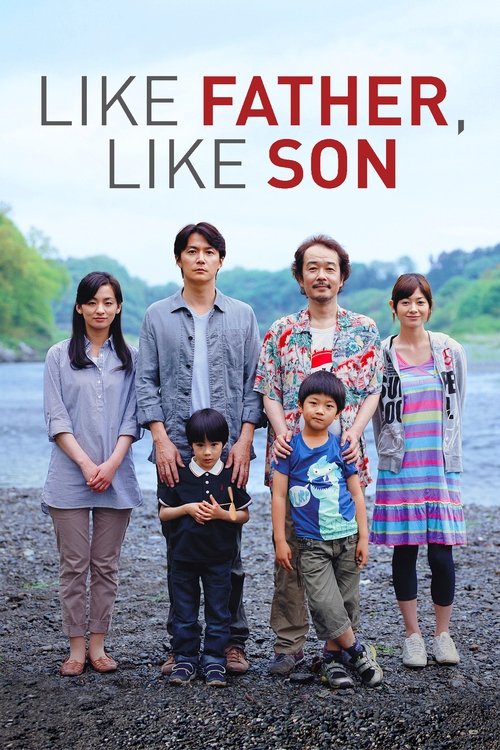
そして父になる
"At what point does a father truly become a father?"
Like Father, Like Son - Symbolism & Philosophy
Symbols & Motifs
The Camera
A symbol of perspective and the 'gaze' of love. Ryota views the world through a lens of judgment, but when he finds the photos Keita took of him (mostly sleeping or working), he finally sees himself through his son's adoring eyes.
Ryota discovers a cache of photos on his camera that Keita took secretly. Seeing these low-angle, candid shots of himself breaks his emotional dam, catalyzing his realization that he was loved despite his distance.
The Two Paths
Visualizes the separation and eventual reconciliation between father and son. It represents the choice between the 'correct' social path (blood) and the emotional path (bond).
In the final scene, Ryota and Keita walk on parallel paths separated by a landscape feature. As Ryota apologizes, the paths converge, allowing them to finally embrace.
Cicadas
A metaphor for the passage of time and the hidden growth that happens beneath the surface. It underscores the idea that relationships, like the cicada's life cycle, require years to mature.
The film references the 15-year life cycle of cicadas, reminding Ryota that the 'work' of raising a child and building a bond is a long, slow process that cannot be rushed or engineered.
The Chewed Straw
Represents Ryota's search for biological 'flaws' or traits. He initially views his biological son's habit as a negative 'nurture' trait from the Saikis, but later questions if it's nature.
Ryota observes his biological son chewing on a drinking straw and visibly disapproves, seeing it as a sign of 'bad' upbringing or a trait he doesn't recognize in himself.
Philosophical Questions
Does blood define family?
The film relentlessly tests the 'blood is thicker than water' adage. Ryota initially believes lineage carries competence and identity, but the film proves that the shared history of six years creates a bond that biology cannot replicate.
Can you buy a 'good' childhood?
Ryota provides expensive toys, lessons, and a safe home, but the Saiki children are happier in their cramped, messy home. The film questions the capitalist value of parenting, suggesting that a child's happiness is derived from engagement, not expenditure.
Is fatherhood a biological fact or a social practice?
Yudai's assertion that 'father is a job' suggests it is a practice requiring time and effort. Ryota feels he is a father simply by virtue of insemination and providing money; the film forces him to learn that fatherhood is an active verb, not a passive noun.
Core Meaning
At its heart, the film challenges the traditional Japanese (and universal) belief in the supremacy of blood ties (lineage) over shared time and affection. Hirokazu Kore-eda posits that fatherhood is not a biological right but a role earned through presence, patience, and love. The film deconstructs the definition of success, contrasting Ryota's material wealth and emotional absence with Yudai's financial modesty and emotional abundance, ultimately suggesting that time is the most valuable currency in a parent-child relationship.