ルックバック
"Manga drew them together. Life made them best friends."
Look Back - Symbolism & Philosophy
Symbols & Motifs
Kyomoto's Door
The door to Kyomoto's room symbolizes the barrier of her social anxiety and reclusiveness. It is a physical obstacle that separates her from the outside world and from Fujino. For their relationship to begin, Fujino must communicate through it by sliding a drawing underneath.
When Fujino first visits, she is unable to get Kyomoto to open the door. Her decision to slide a 4-koma comic underneath is the act that breaks through the barrier, initiating their friendship. Later, after Kyomoto's death, Fujino stands before the same door, now representing her grief and inability to reconnect with her lost friend.
The Window
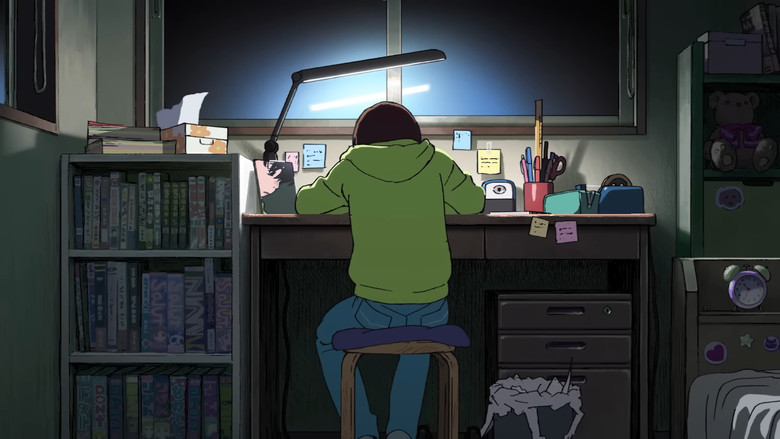
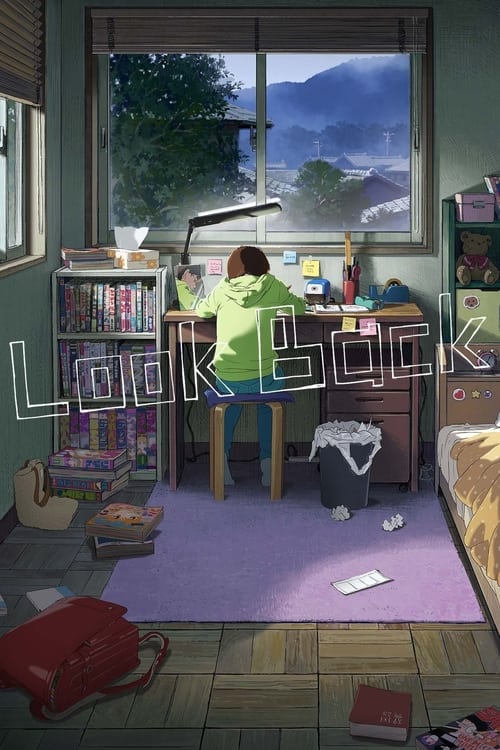
The window in Fujino's room acts as a frame for the passage of time and her dedication to her craft. It also represents a connection to the world she largely ignores while focused on drawing. For Kyomoto, looking out the window of her room is her only connection to the outside.
The film frequently uses shots of Fujino at her desk where the seasons change rapidly outside her window, symbolizing years of tireless practice. After they begin collaborating, Kyomoto sits on the floor, sharing this space. After the tragedy, Fujino looking into Kyomoto's empty room through the window signifies her loss and the now-unbreakable distance between them.
The 4-Koma Comic Strips
The four-panel comic strips are the medium of connection and communication between Fujino and Kyomoto. They are the catalyst for their rivalry, their friendship, and ultimately, Fujino's path to healing.
Their relationship begins with their respective strips in the school paper. Fujino bridges the gap between them by drawing a strip and sliding it under Kyomoto's door. In the film's climax, an imagined 4-koma drawn by Kyomoto, titled "Look Back," is what helps Fujino process her grief and find the strength to draw again.
Rain
Rain in the film symbolizes emotional release and catharsis. It accompanies a pivotal moment of pure, uninhibited joy and creative breakthrough for Fujino.
After her first meeting with Kyomoto, where Kyomoto's praise validates her art and reignites her passion, Fujino walks home in the rain. Her initial hesitant steps build into joyful, unrestrained skipping and splashing. This wordless scene, one of the film's most memorable animated sequences, visually represents the explosion of emotion and relief she feels.
Philosophical Questions
What is the true purpose of creating art?
The film explores multiple motivations for artistic creation. Initially, Fujino draws for praise and ego. Her journey suggests that a deeper purpose is found in connection—creating for a specific person can be more powerful than creating for a faceless audience. It ultimately asks if art's purpose is to immortalize memories and process emotions, serving as a way to move forward after loss, even if it can't prevent tragedy itself.
Can art save people?
Fujino mournfully states, "Art never saved anyone," after Kyomoto's death. The film wrestles with this idea. While Fujino's art literally draws Kyomoto out of her isolation, it also indirectly places her on the path that leads to her death, creating a devastating paradox for Fujino. The ending suggests a revised answer: art may not be able to save someone from physical harm or death, but it can save the living from despair, giving them a reason to continue. Fujino continues to draw to honor Kyomoto, saving herself from being consumed by grief.
How do we find meaning in the face of senseless tragedy?
Kyomoto's death is random and meaningless, mirroring the real-world tragedies that inspired it. Fujino's struggle is to find meaning in its aftermath. She finds it not by changing the past, but by 'looking back' at the joy and connection their shared passion brought them. The meaning is found in continuing the creative legacy and keeping the memory of her friend alive through the very act that once bound them together.
Core Meaning
The core meaning of "Look Back" is an exploration of why we create art and how those creations connect us to others. The film posits that art is not just about skill or accolades, but a means of communication, a way to reach out and form profound bonds. It delves into the immense grief and guilt that follows a senseless tragedy, questioning whether art has the power to save anyone. Ultimately, the film suggests that while art cannot prevent tragedy, it provides a way to process loss, honor memory, and find the motivation to move forward. The journey of creation, with its shared joys and struggles, becomes more significant than the final product, leaving an indelible mark on those who create and those who are touched by their work.