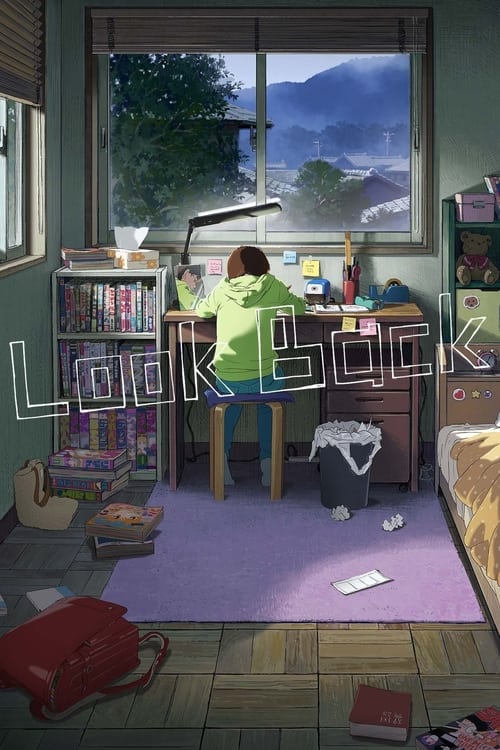
Look Back
A meditative, poignant animated drama where the delicate lines of friendship and rivalry between two young manga artists sketch a heartbreaking, yet life-affirming ode to creation, loss, and the cathartic power of looking back.
Look Back

Look Back

ルックバック

"Manga drew them together. Life made them best friends."

28 June 2024 Japan 58 min ⭐ 8.1 (411)
Director: Kiyotaka Oshiyama
Cast: Yuumi Kawai, Mizuki Yoshida, Yoichiro Saito, Kota Oka, Kureha Maki
Drama Animation
The Passion and Pain of Creation Friendship, Rivalry, and Collaboration Grief, Guilt, and Moving Forward The Fragility of Life and Potential
Box Office: $12,648,664

Overview

"Look Back" tells the story of Ayumu Fujino, a confident and popular fourth-grader who enjoys the praise she receives for her four-panel manga strips in the school newspaper. Her comfortable world is shaken when her teacher asks her to share the space with Kyomoto, a reclusive, truant classmate whose technically brilliant artwork far surpasses her own.

This sparks an intense, one-sided rivalry in Fujino, who dedicates herself to improving her skills, isolating herself from friends and family in the process. After years of obsessive practice, a twist of fate finally brings the two girls face-to-face, leading to an unlikely and deeply collaborative friendship that blossoms around their shared passion for creating manga. The film follows their journey through adolescence as they navigate the pressures of their creative ambitions, the complexities of their bond, and the diverging paths that success and life present.
Core Meaning

The core meaning of "Look Back" is an exploration of why we create art and how those creations connect us to others. The film posits that art is not just about skill or accolades, but a means of communication, a way to reach out and form profound bonds. It delves into the immense grief and guilt that follows a senseless tragedy, questioning whether art has the power to save anyone. Ultimately, the film suggests that while art cannot prevent tragedy, it provides a way to process loss, honor memory, and find the motivation to move forward. The journey of creation, with its shared joys and struggles, becomes more significant than the final product, leaving an indelible mark on those who create and those who are touched by their work.

Thematic DNA

The Passion and Pain of Creation 35%
Friendship, Rivalry, and Collaboration 30%
Grief, Guilt, and Moving Forward 25%
The Fragility of Life and Potential 10%

The Passion and Pain of Creation

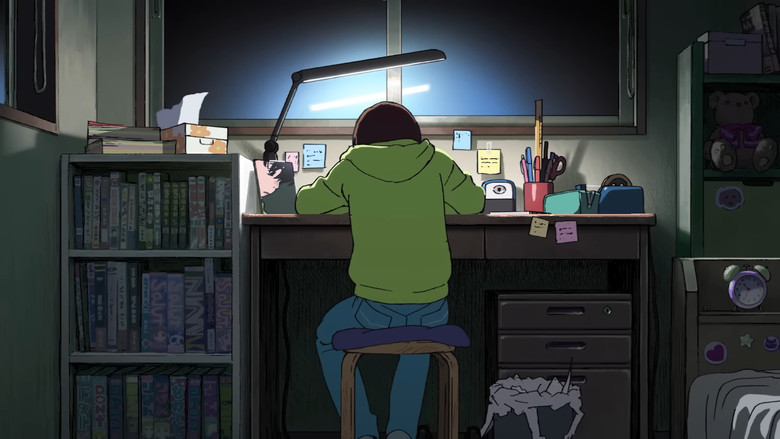
The film provides an intimate look at the creative process, portraying it as both exhilarating and grueling. It shows Fujino's obsessive dedication, spending years honing her craft through montages of her at her desk as seasons change outside. It honors the unseen labor behind every panel, acknowledging the isolation, self-doubt, and punishing deadlines that artists face. The film explores the motivations behind creation—from ego and a desire for validation to a profound need to connect with another person.

Friendship, Rivalry, and Collaboration

The central relationship between Fujino and Kyomoto evolves from a one-sided rivalry into a powerful creative partnership. Initially driven by jealousy, Fujino's motivation shifts once she connects with Kyomoto, whose admiration for her work fuels her passion anew. Their collaboration highlights how their complementary skills—Fujino's storytelling and Kyomoto's detailed backgrounds—make them stronger together. However, the film also explores the strain that individual ambitions and diverging life paths place on their bond.

Grief, Guilt, and Moving Forward

A sudden, senseless tragedy forms the emotional core of the film's latter half. It plunges Fujino into a deep state of grief and survivor's guilt, forcing her to confront devastating "what if" scenarios. The film masterfully portrays the stages of grief, from denial and anger to a profound depression where she questions the very purpose of her art. Her journey becomes about finding a way to honor Kyomoto's memory and rediscovering her reason to draw, suggesting that creation can be an act of resilience and remembrance.

The Fragility of Life and Potential

The film is underscored by a poignant awareness of life's fragility and the randomness of fate. The central tragedy, inspired by the real-world Kyoto Animation arson attack, highlights how lives dedicated to creation can be tragically and senselessly cut short. This imbues the characters' artistic journey with a sense of urgency and preciousness, asking whether the endless hours of dedication are worth it when the future is never guaranteed. The film suggests that the value lies in the journey and the connection, not just the unrealized potential.

Character Analysis

Ayumu Fujino

Yuumi Kawai

Archetype: The Driven Artist (Anti-Hero to Hero)
Key Trait: Proud and Passionate

Motivation

Initially, her motivation is external validation and being the best. This evolves into a desire to create with and for her friend, Kyomoto. After the tragedy, her motivation becomes honoring Kyomoto's memory and the belief she had in her.

Character Arc

Fujino begins as a talented but arrogant child, motivated by the praise of her classmates. Kyomoto's superior skill wounds her pride, turning her motivation into obsessive, jealous rivalry. Her first interaction with Kyomoto, who reveals herself to be a huge fan, transforms her; she finds a deeper purpose in creating art for someone. Their partnership mellows her, but she retains a sharp, sometimes cruel edge, as seen when she belittles Kyomoto for wanting to go to art school. After Kyomoto's death, she is crushed by guilt and grief, forcing her to look back and understand that her connection to Kyomoto was her most important motivation all along. Her arc completes when she decides to continue drawing not for praise, but to honor her friend's memory.

Kyomoto

Mizuki Yoshida

Archetype: The Reclusive Genius
Key Trait: Timid and Talented

Motivation

Her primary motivation is her deep love for drawing and her immense admiration for Fujino, who she sees as her idol. This admiration fuels her desire to connect with Fujino and, eventually, to improve her own skills independently.

Character Arc

Kyomoto starts as a shut-in (hikikomori) with crippling social anxiety but prodigious artistic talent. She exists only through her drawings. Her admiration for Fujino's comics gives her the courage to emerge from her shell. The friendship and collaboration with Fujino empower her, allowing her to gradually leave her room and experience the world. She develops the confidence to pursue her own path by deciding to attend art school to improve her skills further, even if it means parting ways with Fujino. Though her life is tragically cut short, her arc is one of finding strength and a connection to the world through her art and her friendship with Fujino.

Symbols & Motifs

Kyomoto's Door

Meaning:

The door to Kyomoto's room symbolizes the barrier of her social anxiety and reclusiveness. It is a physical obstacle that separates her from the outside world and from Fujino. For their relationship to begin, Fujino must communicate through it by sliding a drawing underneath.

Context:

When Fujino first visits, she is unable to get Kyomoto to open the door. Her decision to slide a 4-koma comic underneath is the act that breaks through the barrier, initiating their friendship. Later, after Kyomoto's death, Fujino stands before the same door, now representing her grief and inability to reconnect with her lost friend.

The Window

Meaning:

The window in Fujino's room acts as a frame for the passage of time and her dedication to her craft. It also represents a connection to the world she largely ignores while focused on drawing. For Kyomoto, looking out the window of her room is her only connection to the outside.

Context:

The film frequently uses shots of Fujino at her desk where the seasons change rapidly outside her window, symbolizing years of tireless practice. After they begin collaborating, Kyomoto sits on the floor, sharing this space. After the tragedy, Fujino looking into Kyomoto's empty room through the window signifies her loss and the now-unbreakable distance between them.

The 4-Koma Comic Strips

Meaning:

The four-panel comic strips are the medium of connection and communication between Fujino and Kyomoto. They are the catalyst for their rivalry, their friendship, and ultimately, Fujino's path to healing.

Context:

Their relationship begins with their respective strips in the school paper. Fujino bridges the gap between them by drawing a strip and sliding it under Kyomoto's door. In the film's climax, an imagined 4-koma drawn by Kyomoto, titled "Look Back," is what helps Fujino process her grief and find the strength to draw again.

Rain

Meaning:

Rain in the film symbolizes emotional release and catharsis. It accompanies a pivotal moment of pure, uninhibited joy and creative breakthrough for Fujino.

Context:

After her first meeting with Kyomoto, where Kyomoto's praise validates her art and reignites her passion, Fujino walks home in the rain. Her initial hesitant steps build into joyful, unrestrained skipping and splashing. This wordless scene, one of the film's most memorable animated sequences, visually represents the explosion of emotion and relief she feels.

Memorable Quotes

Art never saved anyone.

— Ayumu Fujino

Context:

This is likely said during her period of intense grief following the news of Kyomoto's death. She questions the entire purpose of her creative journey, seeing it as meaningless in the face of such a devastating loss. The rest of the film serves as a response to this statement, suggesting that while art may not save lives, it can save a person from despair.

Meaning:

This line, spoken by Fujino at her lowest point, encapsulates the film's central philosophical question. It reflects her profound despair and guilt after Kyomoto's death, feeling that all their years of dedication to their craft were ultimately powerless to prevent a senseless tragedy.

Philosophical Questions

What is the true purpose of creating art?

The film explores multiple motivations for artistic creation. Initially, Fujino draws for praise and ego. Her journey suggests that a deeper purpose is found in connection—creating for a specific person can be more powerful than creating for a faceless audience. It ultimately asks if art's purpose is to immortalize memories and process emotions, serving as a way to move forward after loss, even if it can't prevent tragedy itself.

Can art save people?

Fujino mournfully states, "Art never saved anyone," after Kyomoto's death. The film wrestles with this idea. While Fujino's art literally draws Kyomoto out of her isolation, it also indirectly places her on the path that leads to her death, creating a devastating paradox for Fujino. The ending suggests a revised answer: art may not be able to save someone from physical harm or death, but it can save the living from despair, giving them a reason to continue. Fujino continues to draw to honor Kyomoto, saving herself from being consumed by grief.

How do we find meaning in the face of senseless tragedy?

Kyomoto's death is random and meaningless, mirroring the real-world tragedies that inspired it. Fujino's struggle is to find meaning in its aftermath. She finds it not by changing the past, but by 'looking back' at the joy and connection their shared passion brought them. The meaning is found in continuing the creative legacy and keeping the memory of her friend alive through the very act that once bound them together.

Alternative Interpretations

The film's most debated sequence involves the ending and the alternate timeline. After Kyomoto's death, Fujino is consumed by guilt and imagines a scenario where their friendship never started, only for fate to bring them together again, allowing her to save Kyomoto from the attack using karate.

One interpretation is that this is a grief-induced fantasy—a coping mechanism allowing Fujino to process her feelings of helplessness and reframe her guilt. The 4-koma strip from this imagined timeline, which magically appears in her present, is symbolic of her finding a new reason to draw, gifted to her by her memory of Kyomoto.

Another, more literal (though less common) interpretation could suggest a supernatural or metaphysical event, where a glimpse into an alternate reality is granted to her. This reading focuses on the themes of fate and the unshakeable bond between the two artists that transcends even time and space. However, most analysis points toward the sequence being an internal, psychological journey for Fujino to find catharsis and the will to move on.

Cultural Impact

"Look Back" was met with widespread critical acclaim and significant box office success in Japan upon its release. Its cultural resonance stems deeply from its poignant handling of grief and creativity, particularly as it serves as an artistic tribute to the victims of the 2019 Kyoto Animation arson attack. This real-world context gives the film a profound weight, turning it into a meditation on the fragility of life within the anime and manga industry. The film has been lauded by critics and audiences for its emotional depth, mature storytelling, and stunning, unconventional animation that emphasizes a hand-drawn aesthetic. It has resonated strongly with artists and creators who see their own struggles and passions reflected in the narrative. Its success has further solidified Tatsuki Fujimoto's reputation as a masterful storyteller beyond his work on "Chainsaw Man" and has highlighted the talent of director Kiyotaka Oshiyama and the newly-founded Studio Durian.

Audience Reception

Audience reception for "Look Back" has been overwhelmingly positive and deeply emotional. Viewers frequently describe the film as a "masterpiece," "heartbreaking," and a "beautifully bittersweet" experience that leaves a lasting impact long after the credits roll. Many praise its stunning, expressive animation and the powerful storytelling that conveys so much with minimal dialogue. The film's quiet, meditative pacing and emotional weight often led to silent, tearful theaters. The primary point of criticism, though minor, comes from some viewers who found the tragic turn in the final act to be overly melodramatic or a part of a hollow trend in modern anime. However, for the vast majority, the emotional climax was seen as earned and profoundly moving, cementing the film as a contender for one of the best animated features of the year.

Interesting Facts

  • The story is considered semi-autobiographical for its creator, Tatsuki Fujimoto. The protagonist's name, Fujino, is a stand-in for Fujimoto, and her fictional manga "Shark Punch" is a nod to his real works like "Fire Punch" and "Chainsaw Man".
  • The film's plot is heavily influenced by the tragic 2019 Kyoto Animation arson attack, which claimed 36 lives. Fujimoto published the original manga on the tragedy's two-year anniversary as a way to process the event.
  • Director Kiyotaka Oshiyama was initially hesitant to adapt the manga, feeling it lacked the dynamic scenes typical of animation. However, he related deeply to its story about creators and made it a condition that the film's style should preserve the raw, hand-drawn feel of the animators' key frames.
  • Tatsuki Fujimoto gave director Kiyotaka Oshiyama significant creative freedom, telling him, "if you think it's good, then I think it's good. Go for it."
  • The film's visual style is unique in that it often uses the key animators' rougher, more expressive drawings directly in the final product, rather than cleaning them up with in-between animation, to maintain a raw, human touch.
  • Haruka Nakamura, the film's composer, was friends with the late, influential music producer Nujabes and was working on an album with him before his untimely death, adding another layer of personal resonance to the film's themes of loss.

Easter Eggs

In the film, Fujino's successful manga series is called "Shark Punch."

This is a direct reference to Tatsuki Fujimoto's own manga. The title and themes are a clear nod to his earlier major work, Fire Punch, and the general aggressive, action-oriented style is reminiscent of his most famous work, Chainsaw Man. This detail reinforces the semi-autobiographical nature of the story, with Fujino acting as an avatar for Fujimoto himself.

⚠️ Spoiler Analysis

Click to reveal detailed analysis with spoilers

Frequently Asked Questions

Explore More About This Movie

Dive deeper into specific aspects of the movie with our detailed analysis pages

Comments (0)

Leave a comment

No comments yet. Be the first to share your thoughts!