Mamma Roma - Symbolism & Philosophy
Symbols & Motifs
Religious Paintings (The Last Supper, Lamentation of Christ)
These allusions elevate the story of the Roman underclass to the level of sacred tragedy. "The Last Supper" composition at the pimp's wedding foreshadows betrayal and sacrifice, while Ettore's death pose, mirroring Mantegna's "Lamentation of Christ," explicitly casts him as a Christ-figure, a martyr sacrificed by an indifferent society. It sanctifies the suffering of the profane.
The film opens with the wedding banquet scene framed to resemble Leonardo da Vinci's "The Last Supper." The final scenes show Ettore dying on a prison cot, filmed from an angle that directly references Andrea Mantegna's painting of the dead Christ.
The Dome of San Giovanni Bosco
The dome, constantly visible from Mamma Roma's new apartment, symbolizes the bourgeois respectability and the promise of salvation she desperately seeks. It represents the official, institutional Church, which ultimately offers no real help or solace. At the end, as she contemplates suicide, her gaze falls upon the dome, a final, ironic reminder of the spiritual and social salvation that remains forever out of her reach.
The dome is a recurring visual motif seen from the window of Mamma Roma's apartment in the new housing project. The final shot of the film is Mamma Roma's point of view as she looks out her window at the dome after learning of Ettore's death.
The Motorcycle
The motorcycle Mamma Roma buys for Ettore represents her attempt to purchase his happiness and integration into a modern, consumerist society. It is a symbol of fleeting freedom and youthful rebellion, but also of the superficial, materialistic values of the new petit-bourgeois world she wants him to join. It's a tool for his aimless wandering, not for productive advancement.
Mamma Roma proudly buys a new motorcycle for Ettore after she secures a job for him. He is seen riding it with his friends and, in a moment of joy, with his mother clinging to him.
Ancient Roman Aqueducts
The ruins of the aqueducts represent the past, an archaic, pre-capitalist world that Pasolini romanticized. They stand in stark contrast to the new, soulless apartment buildings. This is the space where Ettore and his friends, the subproletariat youth, feel at home, signifying their connection to this older, more authentic Italy and their alienation from the modern world Mamma Roma tries to force upon them.
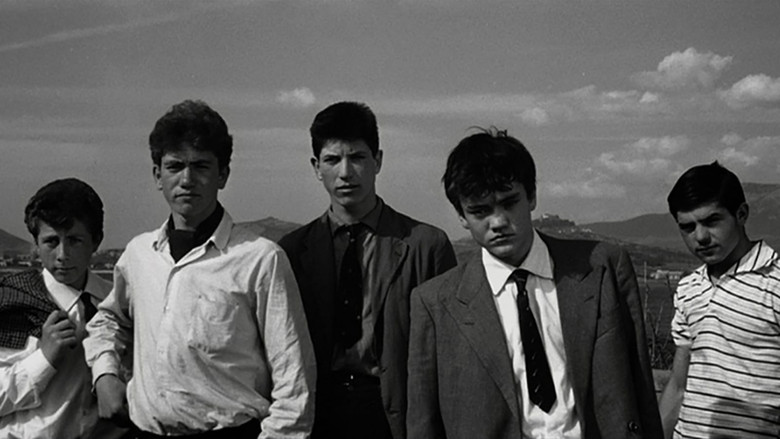
Ettore and his gang of friends frequently hang out and wander through the Parco degli Acquedotti, with the ancient ruins forming the backdrop to their aimless existence.
Philosophical Questions
Can an individual ever truly escape their past and social class?
The film relentlessly explores this question through Mamma Roma's tragic struggle. She believes that through sheer force of will, hard work, and relocation, she can reinvent herself and her son. However, Pasolini presents a deterministic universe where social and economic forces are inescapable. Her past continuously re-emerges through her pimp, her own ingrained behaviors (using blackmail), and the societal prejudices that keep her on the margins. The film's tragic conclusion strongly suggests that, for the subproletariat, the past is not a memory but a prison, and the dream of upward mobility is a cruel illusion designed by the very system that ensures their entrapment.
Where can the sacred be found in a profane world?
Pasolini challenges traditional notions of holiness by finding it in the most unlikely of places: the lives of prostitutes, pimps, and thieves in the Roman slums. By framing their suffering with the iconography of Christian martyrdom—likening Ettore to the dead Christ—the film posits that divinity and grace are not confined to churches but are present in the raw, unfiltered humanity of the dispossessed. The film asks whether true spirituality lies not in bourgeois respectability or religious institutions, but in the epic, primal struggles of those who are socially and morally condemned.
Does 'progress' inevitably lead to spiritual decay?
The film is a lament for the perceived loss of authenticity that came with Italy's post-war economic boom. Mamma Roma's aspiration to join the petit-bourgeoisie is framed as a spiritually empty goal. The new, modern apartment buildings are depicted as sterile and soulless compared to the ancient ruins where Ettore feels at ease. Pasolini questions the very definition of progress, suggesting that the move away from an archaic, rural, and even 'sordid' past towards a clean, consumerist modernity is a form of spiritual death, stripping away the vitality, poetry, and tragic grandeur of a more 'primitive' way of life.
Core Meaning
At its core, "Mamma Roma" is a powerful and tragic critique of post-war Italian society and the illusion of the "economic miracle." Pasolini explores the impossibility of escaping one's social class and past in a society rife with inequality. The film suggests that the new, modern Rome, with its sterile housing projects, offers only a superficial escape, while the true human spirit, with all its vulgarity and vitality, resides in the marginalized subproletariat that society seeks to contain and control. Mamma Roma's dream of bourgeois respectability is portrayed as a futile and ultimately destructive aspiration, a betrayal of her own authentic self. The film is a lament for a lost, pre-capitalist world and a damning indictment of a society that offers redemption only to condemn those who seek it.