Mamma Roma
Overview
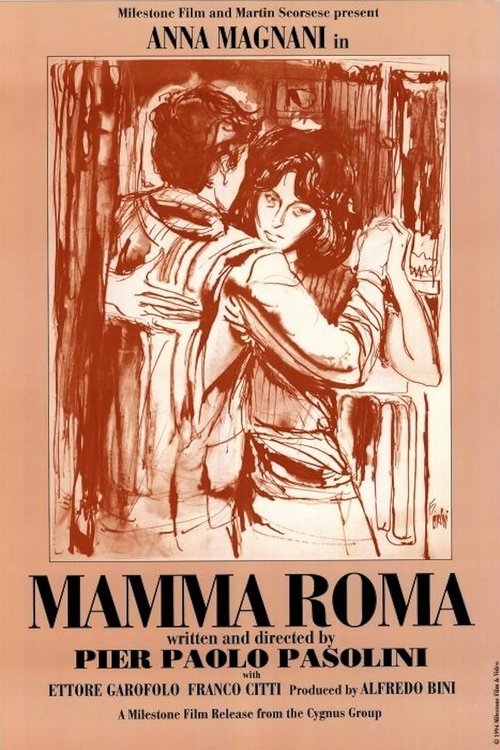
"Mamma Roma" is the second feature film from director Pier Paolo Pasolini, released in 1962. It tells the poignant story of Mamma Roma (Anna Magnani), a middle-aged prostitute who endeavors to leave her past behind for the sake of her estranged teenage son, Ettore (Ettore Garofolo). After her pimp, Carmine (Franco Citti), marries and seemingly frees her from her obligations, she buys an apartment in a respectable neighborhood and a fruit stand to make an honest living.
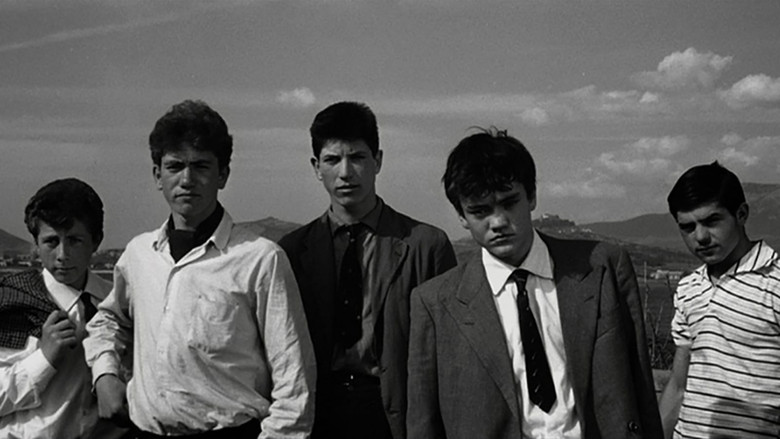
She brings Ettore, who has grown up in the countryside, to live with her in Rome, hoping to provide him with a better life, a good education, and a respectable future. However, Ettore is disaffected and listless, quickly falling in with a crowd of petty criminals and showing little interest in his mother's aspirations. Mamma Roma's fierce and sometimes desperate efforts to steer him onto the right path are complicated when her past, in the form of Carmine, returns to haunt her, threatening to destroy the fragile new life she has built.
Core Meaning
At its core, "Mamma Roma" is a powerful and tragic critique of post-war Italian society and the illusion of the "economic miracle." Pasolini explores the impossibility of escaping one's social class and past in a society rife with inequality. The film suggests that the new, modern Rome, with its sterile housing projects, offers only a superficial escape, while the true human spirit, with all its vulgarity and vitality, resides in the marginalized subproletariat that society seeks to contain and control. Mamma Roma's dream of bourgeois respectability is portrayed as a futile and ultimately destructive aspiration, a betrayal of her own authentic self. The film is a lament for a lost, pre-capitalist world and a damning indictment of a society that offers redemption only to condemn those who seek it.
Thematic DNA
The Impossibility of Social Mobility
Mamma Roma's central struggle is to transcend her past and ascend to the lower-middle class. She invests all her hopes in her son, Ettore, believing that by providing him with a respectable life, she can redeem herself. However, the film relentlessly demonstrates that the societal structures are stacked against them. Her past, personified by her pimp Carmine, literally drags her back into prostitution. Her attempts to secure a legitimate job for Ettore ultimately rely on blackmail, using the very methods of the underworld she wants to escape. Pasolini argues that the "economic miracle" is a facade, and for the subproletariat, there is no real escape from their predetermined fate.
The Sacred and the Profane
Pasolini, a Marxist with deep Catholic roots, masterfully blends sacred iconography with the gritty, profane reality of the Roman slums. The film is rich with religious symbolism, from the opening wedding scene that evokes Da Vinci's "The Last Supper" to the final, harrowing shots of Ettore's death, which are explicitly modeled on Andrea Mantegna's painting "Lamentation of Christ." By portraying the suffering of marginalized figures like prostitutes and petty thieves through a religious lens, Pasolini imbues their struggles with a sense of epic, tragic grandeur. He finds a raw, spiritual beauty in the lives of the dispossessed, suggesting that the sacred can be found in the most profane corners of society.
Maternal Love and Sacrifice
The film is a powerful, if tragic, exploration of maternal love. Anna Magnani's performance as Mamma Roma is a tour de force, embodying a fierce, desperate, and all-consuming love for her son. She is willing to do anything to give Ettore a better life, from working tirelessly at her market stall to returning to the streets. Her love is complex, oscillating between tender affection and furious frustration at Ettore's indifference. Ultimately, her obsessive drive to shape him into something he is not contributes to his downfall, making her a figure of both immense love and tragic error. Her story becomes a universal tragedy of a mother's sacrifice in a world that offers no grace.
Past vs. Present
A central conflict in the film is the inescapable nature of the past. Mamma Roma believes she can simply start a new life and erase her history as a prostitute, but it continually resurfaces to destroy her present aspirations. This theme is mirrored in the film's visual landscape, where modern, sterile housing projects are juxtaposed with ancient Roman ruins. The new buildings represent the false promise of progress and the petit-bourgeois life Mamma Roma desires, while the ruins symbolize an older, more authentic, and perhaps inescapable reality. Pasolini critiques the new Italy of the economic boom, suggesting it is a spiritually vacant society built on the erasure of a deeper, more complex past.
Character Analysis
Mamma Roma (Roma Garofolo)
Anna Magnani
Motivation
Her sole motivation is to provide a better, petit-bourgeois life for her son, Ettore, and through him, to redeem herself and escape the stigma of her past as a prostitute. She is driven by a fierce, almost primal maternal love and a desperate desire for social acceptance and respectability.
Character Arc
Mamma Roma begins the film full of boisterous hope, believing she can single-handedly create a new, respectable life for herself and her son. She moves from prostitute to small business owner, actively trying to shed her past. However, her journey is a downward spiral. As her son rejects her values and her former pimp reasserts his control, her hope curdles into desperation. She resorts to old tricks (blackmail) to achieve her new goals, blurring the line she tried to draw. Her arc ends in complete despair, her dreams shattered, as she realizes the impossibility of her escape, culminating in a suicidal grief upon her son's death.
Ettore
Ettore Garofolo
Motivation
Ettore is largely unmotivated, characterized by a deep-seated lethargy and an inability to connect with his mother's world. He is primarily driven by a desire for peer acceptance and is easily influenced by his friends and his crush, Bruna. His actions are more reactions to his environment and his inner turmoil than pursuits of any clear goal.
Character Arc
Ettore starts as a naive, passive country boy, suddenly thrust into the alien environment of Rome's outskirts. He is initially aimless but harmless. As the film progresses, he becomes increasingly alienated and rebellious, rejecting his mother's bourgeois aspirations and falling in with a gang of petty thieves. His discovery of his mother's past is the final catalyst, pushing him fully into a life of crime. His arc is one of tragic corruption and decline, ending in his pointless death in prison, where he becomes a symbol of a generation sacrificed by social and economic forces beyond their control.
Carmine
Franco Citti
Motivation
Carmine's motivation is simple greed and control. He sees Mamma Roma as a source of income and exerts his power over her to extract money, threatening to reveal her past to Ettore if she refuses. He is a parasite who feeds on her vulnerability.
Character Arc
Carmine's character is static. He represents the unchangeable, exploitative nature of the past. He begins the film seemingly moving on by getting married, which gives Mamma Roma her window of freedom. However, he quickly returns to his old ways. His reappearance is the force that systematically destroys Mamma Roma's new life, forcing her back into prostitution and ensuring she can never truly escape. He doesn't develop; he simply reasserts his power, acting as the narrative's primary antagonist and the embodiment of fate.
Bruna
Silvana Corsini
Motivation
Bruna's motivations are immediate and uncomplicated. She seems to drift through life, seeking companionship and amusement. She is attracted to Ettore but is also involved with other boys in the neighborhood, representing a world where relationships are fluid and transactional rather than aligned with the bourgeois ideals of stability Mamma Roma cherishes.
Character Arc
Bruna is a local girl and single mother who represents the casual, amoral sexuality of the slum. She serves as Ettore's introduction to romance and sex. Her character does not have a significant arc; she remains a fixture of the environment that pulls Ettore away from his mother's ambitions. She embodies the life of the subproletariat that Mamma Roma fears for her son, a life of early parenthood, aimlessness, and casual relationships.
Symbols & Motifs
Religious Paintings (The Last Supper, Lamentation of Christ)
These allusions elevate the story of the Roman underclass to the level of sacred tragedy. "The Last Supper" composition at the pimp's wedding foreshadows betrayal and sacrifice, while Ettore's death pose, mirroring Mantegna's "Lamentation of Christ," explicitly casts him as a Christ-figure, a martyr sacrificed by an indifferent society. It sanctifies the suffering of the profane.
The film opens with the wedding banquet scene framed to resemble Leonardo da Vinci's "The Last Supper." The final scenes show Ettore dying on a prison cot, filmed from an angle that directly references Andrea Mantegna's painting of the dead Christ.
The Dome of San Giovanni Bosco
The dome, constantly visible from Mamma Roma's new apartment, symbolizes the bourgeois respectability and the promise of salvation she desperately seeks. It represents the official, institutional Church, which ultimately offers no real help or solace. At the end, as she contemplates suicide, her gaze falls upon the dome, a final, ironic reminder of the spiritual and social salvation that remains forever out of her reach.
The dome is a recurring visual motif seen from the window of Mamma Roma's apartment in the new housing project. The final shot of the film is Mamma Roma's point of view as she looks out her window at the dome after learning of Ettore's death.
The Motorcycle
The motorcycle Mamma Roma buys for Ettore represents her attempt to purchase his happiness and integration into a modern, consumerist society. It is a symbol of fleeting freedom and youthful rebellion, but also of the superficial, materialistic values of the new petit-bourgeois world she wants him to join. It's a tool for his aimless wandering, not for productive advancement.
Mamma Roma proudly buys a new motorcycle for Ettore after she secures a job for him. He is seen riding it with his friends and, in a moment of joy, with his mother clinging to him.
Ancient Roman Aqueducts
The ruins of the aqueducts represent the past, an archaic, pre-capitalist world that Pasolini romanticized. They stand in stark contrast to the new, soulless apartment buildings. This is the space where Ettore and his friends, the subproletariat youth, feel at home, signifying their connection to this older, more authentic Italy and their alienation from the modern world Mamma Roma tries to force upon them.
Ettore and his gang of friends frequently hang out and wander through the Parco degli Acquedotti, with the ancient ruins forming the backdrop to their aimless existence.
Memorable Quotes
Io c'ho avuto un solo amore in vita mia, e quello sei te!
— Mamma Roma
Context:
This is said to Ettore during one of their more intimate and emotional moments, as Mamma Roma tries to break through his apathy and make him understand the depth of her sacrifice and devotion.
Meaning:
Translation: "I've only had one love in my life, and that's you!" This line encapsulates the core of Mamma Roma's being. It reveals that all her struggles, her past, and her hopes for the future are centered entirely on her obsessive love for her son, making the film's tragic outcome even more devastating.
Il male che fai è come 'na strada che poi l'innocenti ce devono camminà sopra.
— Mamma Roma
Context:
Mamma Roma says this during one of her nocturnal walks, soliloquizing about her life and the cruel fate that seems to bind both her and her son.
Meaning:
Translation: "The evil you do is like a highway the innocent have to walk down." This quote reflects the film's theme of fate and the inescapable consequences of the past. Mamma Roma understands that her own history has created a difficult path for her son, one that he is forced to travel regardless of his own choices. It is a moment of profound, fatalistic insight.
Philosophical Questions
Can an individual ever truly escape their past and social class?
The film relentlessly explores this question through Mamma Roma's tragic struggle. She believes that through sheer force of will, hard work, and relocation, she can reinvent herself and her son. However, Pasolini presents a deterministic universe where social and economic forces are inescapable. Her past continuously re-emerges through her pimp, her own ingrained behaviors (using blackmail), and the societal prejudices that keep her on the margins. The film's tragic conclusion strongly suggests that, for the subproletariat, the past is not a memory but a prison, and the dream of upward mobility is a cruel illusion designed by the very system that ensures their entrapment.
Where can the sacred be found in a profane world?
Pasolini challenges traditional notions of holiness by finding it in the most unlikely of places: the lives of prostitutes, pimps, and thieves in the Roman slums. By framing their suffering with the iconography of Christian martyrdom—likening Ettore to the dead Christ—the film posits that divinity and grace are not confined to churches but are present in the raw, unfiltered humanity of the dispossessed. The film asks whether true spirituality lies not in bourgeois respectability or religious institutions, but in the epic, primal struggles of those who are socially and morally condemned.
Does 'progress' inevitably lead to spiritual decay?
The film is a lament for the perceived loss of authenticity that came with Italy's post-war economic boom. Mamma Roma's aspiration to join the petit-bourgeoisie is framed as a spiritually empty goal. The new, modern apartment buildings are depicted as sterile and soulless compared to the ancient ruins where Ettore feels at ease. Pasolini questions the very definition of progress, suggesting that the move away from an archaic, rural, and even 'sordid' past towards a clean, consumerist modernity is a form of spiritual death, stripping away the vitality, poetry, and tragic grandeur of a more 'primitive' way of life.
Alternative Interpretations
While the primary reading of the film is a socio-political critique, other interpretations exist. Some critics have focused on a psychoanalytic reading, particularly regarding the intense, almost incestuous relationship between Mamma Roma and Ettore. Her desperate attempts to control him and the tango scene they share can be viewed through an Oedipal lens, where her smothering love contributes as much to his destruction as any external societal force.
Another interpretation views Ettore not just as a social victim but as a metaphor for a pre-modern, poetic Italy being destroyed by the soulless consumerism of the new era. In this view, his passivity and eventual death represent the death of an authentic, rural culture that Pasolini cherished. His final pose as Christ is not just about religious suffering, but the crucifixion of an entire way of being. Furthermore, some analyses have read Ettore's alienation and "disaffection from reality" as a subtle metaphor for homosexuality within a repressive society, a theme Pasolini would explore more overtly in later works.
Cultural Impact
"Mamma Roma" was a pivotal film in Pier Paolo Pasolini's career and in the evolution of Italian cinema. Created in the context of Italy's post-war "economic miracle," the film served as a harsh critique of this supposed progress, arguing that it led to spiritual decay and the destruction of the country's subproletarian culture. It both extended and repudiated the traditions of Neorealism; while it used real locations and non-professional actors, its highly stylized, poetic, and symbolic visual language (mixing Vivaldi with slums, and Renaissance art with modern despair) was a departure from the movement's focus on unadorned reality.
Upon its release, the film was met with significant controversy. It was attacked by both the political right for its perceived immorality and the left for its pessimistic view and religious overtones. It was temporarily censored, and Pasolini himself was physically attacked by neo-fascists. This scandal cemented Pasolini's reputation as a provocative and controversial public figure. Despite a poor initial box office performance, the film's reputation has grown immensely over time. It is now considered a masterpiece, praised for Anna Magnani's powerhouse performance and Pasolini's unique vision. Its influence can be seen in the works of directors who explore the lives of the marginalized with a blend of gritty realism and poetic lyricism. The film's themes of social entrapment and its potent blend of the sacred and the profane continue to resonate with critics and audiences today.
Audience Reception
Audience reception for "Mamma Roma" has evolved significantly since its controversial debut. Initially, many viewers in 1962 were shocked by its raw language and unflinching depiction of the Roman underworld, leading to accusations of obscenity. However, contemporary audiences generally view it as a powerful and moving work of art. The most universally praised aspect is Anna Magnani's performance, which is often described as a tour de force—a raw, volcanic, and heartbreaking portrayal of maternal love. Viewers are often struck by the film's bleakness and its devastatingly tragic ending, which some find difficult to watch but ultimately powerful. Points of criticism sometimes focus on the passivity of Ettore's character, whom some find unsympathetic, and the heavy-handedness of the religious symbolism. Nevertheless, the overall verdict from modern cinephiles is that it is a masterpiece of Italian cinema, a challenging but deeply rewarding film that powerfully captures a specific time and place while exploring universal themes of love, loss, and social struggle.
Interesting Facts
- The film was initially banned in Italy for obscenity and for being "offensive to good morals" due to its language and subject matter. A police complaint was filed the day it premiered at the Venice Film Festival.
- Director Pier Paolo Pasolini based the screenplay on the true story of a young man, Marcello Elisei, who had died in prison.
- Pasolini cast mostly non-professional actors, a hallmark of the Italian Neorealism movement. The one major exception was the star, Anna Magnani, a globally famous actress and a symbol of that very movement.
- Pasolini and Anna Magnani reportedly had a difficult working relationship and clashed over her performance style, which he felt was too much in the vein of traditional acting for the neorealistic world he was creating.
- On the night of the film's premiere in Rome, Pasolini was confronted and attacked by a group of neo-fascist protestors.
- The film's domestic box office was a humble 168 million lira, its commercial success hampered by the controversy surrounding it.
- The film's U.S. premiere did not occur until 1988, 26 years after its initial release.
- Many of the filming locations were in the newly built outskirts of Rome, such as the Quadraro neighborhood, juxtaposing the modern buildings with the ancient ruins of the Parco degli Acquedotti.
Easter Eggs
Dedication to Roberto Longhi
The film is dedicated to the Italian art historian Roberto Longhi. Pasolini had studied art history under Longhi at the University of Bologna. This dedication highlights the profound influence of Italian Renaissance art on Pasolini's visual style, particularly his careful, painterly compositions, such as the allusions to Mantegna and Da Vinci.
⚠️ Spoiler Analysis
Click to reveal detailed analysis with spoilers
Frequently Asked Questions
Explore More About This Movie
Dive deeper into specific aspects of the movie with our detailed analysis pages
Comments (0)
No comments yet. Be the first to share your thoughts!