"Woody Allen's New Comedy Hit"
Manhattan - Symbolism & Philosophy
Symbols & Motifs
New York City Skyline
It represents the romanticized, timeless ideal of life that Isaac strives for but cannot attain. The black-and-white photography transforms the gritty city into a majestic, almost dreamlike backdrop, symbolizing the gap between Isaac's fantasy world and his messy reality.
The opening montage features iconic shots of the skyline set to Rhapsody in Blue, establishing the city as a primary character and the idealized setting for the narrative.
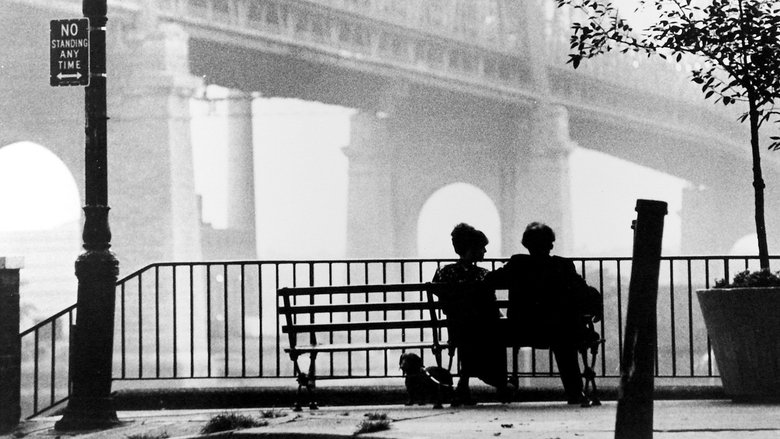
The Queensboro Bridge Bench
Symbolizes a moment of connection and beauty that is fleeting. It represents the peak of Isaac and Mary's romance—a perfect cinematic image that hides the underlying instability of their relationship.
Isaac and Mary sit on a bench overlooking the bridge at dawn. Notably, the bridge lights stay on (due to a real-life timer/production issue), creating a magical but artificial atmosphere.
The Planetarium
Represents the insignificance of human problems in the grand scheme of the universe. It suggests that the characters' neuroses and romantic entanglements are trivial against the vastness of space.
Isaac and Mary take refuge in the Hayden Planetarium during a rainstorm, walking as silhouettes against a backdrop of the moon and stars.
The 'Don't Walk' Sign
A visual warning against the ill-advised romance between Isaac and Mary. It foreshadows the failure of their relationship.
As Isaac and Mary walk down the street after their first 'date', a flashing red 'Don't Walk' sign is prominently visible in the background between them.
The Skeleton
A reminder of mortality and the primal nature underlying human intellectualism. It mocks the characters' attempts to be sophisticated.
Isaac lectures Yale about morality in a classroom, standing next to a hanging skeleton and a diagram of an ape, highlighting the contrast between his high-minded speech and basic human instincts.
Philosophical Questions
Can art redeem a flawed existence?
The film constantly juxtaposes the beauty of art (Gershwin, the skyline, museums) with the ugliness of the characters' behaviors. It asks if surrounding oneself with 'high culture' makes one a better person, ultimately suggesting that it does not—honesty and kindness (Tracy) are more valuable than intellectualism.
Is morality absolute or relative?
Isaac argues for absolute morality (lecturing Yale on fidelity), yet he practices relative morality (dating a teenager because she 'doesn't count' as a serious partner). The film challenges the viewer to decide if Isaac's rigid moral code is valid or just a tool for his ego.
Does intellect lead to happiness?
The most intelligent characters (Isaac, Mary) are the most miserable and neurotic, while the 'lesser' intellect (Tracy) possesses the most wisdom and emotional stability. The film questions the value of over-intellectualizing life at the expense of feeling it.
Core Meaning
At its heart, Manhattan is a critique of the narcissism and moral confusion of the modern urban intellectual. Woody Allen contrasts the grandeur of the city—romanticized through black-and-white cinematography and Gershwin's music—with the messy, neurotic, and often selfish lives of its inhabitants. The film suggests that while people may hide behind art, philosophy, and 'sophistication' to rationalize their behavior, true worth is found in simple human decency, honesty, and the courage to trust others, as embodied by the character of Tracy.