Skip to content
Marsupilami
A sun-drenched, slapstick adventure where chaotic family warmth meets exuberant jungle wonder, leaping like a yellow lightning bolt across high-seas turbulence to restore a broken home through wild, unconditional love.
Marsupilami

Marsupilami

"Hairy mess incoming!"

04 February 2026 France 99 min 6.4 (148)

Director: Philippe Lacheau

Cast: Philippe Lacheau, Jamel Debbouze, Tarek Boudali, Élodie Fontan, Julien Arruti

Comedy Adventure Reconstruction of Family and Fatherhood Wildlife Conservation vs. Exploitation Chaos as a Unifying Force Friendship and Loyalty
Budget: $33,555,600

Overview

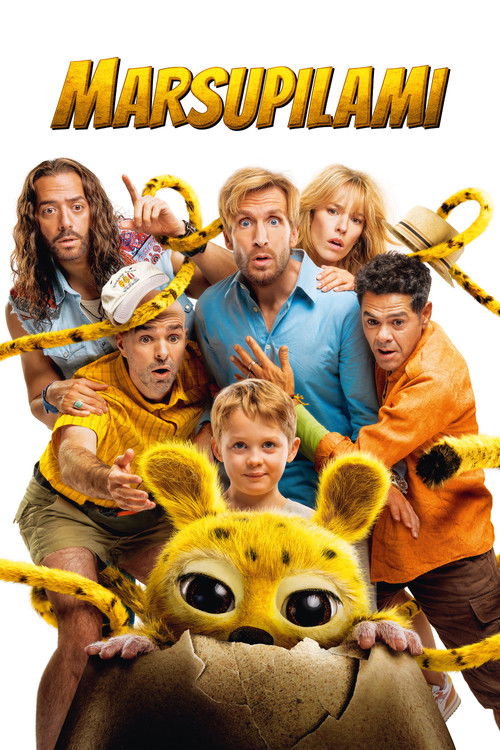
Directed by Philippe Lacheau, Marsupilami (2026) is a high-octane French adventure comedy that reimagines the legendary comic book character created by André Franquin in 1952. The story centers on David Ticoule (Philippe Lacheau), an anxious zoo accountant whose job is suddenly threatened after a chaotic, alcohol-fueled mistake results in exotic animals running wild across the facilities. In a desperate bid to save his career, David accepts a shady, off-the-books assignment from his demanding boss, Jeffrey Malone (Jean Reno): travel to South America and discreetly retrieve a high-value confidential package.

To pull off the mission without raising suspicion, David books passage on a luxury transatlantic cruise ship, bringing along his ex-wife Tess (Élodie Fontan) and their young son Léo (Corentin Guillot) under the guise of a family reconciliation trip. To avoid personal liability, David tricks his bumbling, dim-witted colleague Stéphane (Julien Arruti) into carrying the sealed parcel. Pandemonium erupts when Stéphane curiosity gets the better of him and he opens the container mid-voyage, unleashing an extraordinarily rare, yellow-furred baby Marsupilami with an impossibly long prehensile tail.

As the ultra-energetic creature ("Bibi") accidentally goes viral on social media, the luxury cruise descends into madness. Greedy exotic animal traffickers, relentless mercenaries, and overzealous customs officers lock onto the ship, forcing David, his dysfunctional family, and eccentric animal rights activist Pablito Camaron (Jamel Debbouze) to protect the mythical creature at all costs while trying to reach the jungle safe-haven of Palombia.
Core Meaning

Behind its irreverent humor and frantic slapstick pacing, Marsupilami carries a sincere message about familial connection, responsibility, and anti-commodified nature. Director Philippe Lacheau uses the mythical creature as a catalyst that strips away modern corporate distractions and superficial evasions. David begins his journey purely focused on corporate self-preservation and workplace status, willing to manipulate those closest to him. However, the wild, unfiltered innocence of the baby Marsupilami forces David to confront his shortcomings as a father and partner. Ultimately, the film argues that true protection—whether of a mythical species or one's own family—requires vulnerability, unselfish courage, and recognizing that life's most precious bonds cannot be packaged or traded.

Thematic DNA

Reconstruction of Family and Fatherhood 35%
Wildlife Conservation vs. Exploitation 25%
Chaos as a Unifying Force 20%
Friendship and Loyalty 20%

Reconstruction of Family and Fatherhood

The primary emotional engine is David's attempt to bridge the distance between himself, his ex-wife Tess, and his son Léo. Protecting the fragile baby Marsupilami serves as a mirror for David’s parental duty, teaching him to put his son's emotional needs above his own career security.

Wildlife Conservation vs. Exploitation

The contrast between Pablito’s unyielding protection of Palombia’s fauna and Jeffrey Malone's corporate greed underscores the theme of environmental ethics. The baby creature represents pristine nature, constantly threatened by human commercialization and viral internet sensationalism.

Chaos as a Unifying Force

In classic "La Bande à Fifi" fashion, order must completely shatter before genuine relationships can heal. The disruptive antics of the Marsupilami force the human characters out of their rigid societal roles and into genuine, unscripted teamwork.

Friendship and Loyalty

Through the clumsy antics of Stéphane and the absurd bravery of Pablito, the film explores how loyalty perseveres despite deceit, foolish mistakes, and high-stakes danger.

Character Analysis

David Ticoule

Philippe Lacheau

Archetype: The Reluctant Everyday Hero / Flawed Father Key Trait: Resourceful anxiety under extreme panic.

Motivation

To keep his job at the zoo and win back the respect of his son Léo.

Character Arc

Starts as an insecure, self-centered zoo accountant obsessed with saving his job through dishonest shortcuts; evolves into a courageous protector who prioritizes his family and the creature over his career.

Pablito Camaron

Jamel Debbouze

Archetype: The Eccentric Mentor / Passionate Animal Advocate Key Trait: Unapologetic eccentricity and street-smart jungle knowledge.

Motivation

To shield Palombia’s native wildlife from human exploitation.

Character Arc

Reprising his role from the 2012 film, Pablito transitions from an eccentric local guide into a fiercely loyal protector who guides David’s crew through the dangers of animal trafficking.

All 5 characters and cast

Symbols & Motifs

The Prehensile Tail (7 Meters)

Meaning:

Symbolizes flexibility, unpredictable intervention, and an extended reach of affection.

Context:

Used dynamically throughout the film as both an improvised weapon during action sequences and a tether that physically brings separated characters together.

The Sealed Shipping Container

Meaning:

Symbolizes corporate secrecy, emotional compartmentalization, and suppressed truth.

Context:

Its breaking open represents the inevitable release of honesty and chaotic reality.

The Ocean Cruise Ship

Meaning:

Symbolizes a floating artificial paradise isolated from raw nature.

Context:

It serves as an enclosed pressure cooker where societal norms gradually break down under the creature's influence.

Palombia Orchid / Jungle

Meaning:

Represents uncorrupted sanctuary, origin, and ecological balance.

Context:

It acts as the ultimate destination where the characters must return what they took to find emotional peace.

Memorable Quotes

Houba ! Houba !
— Baby Marsupilami

Context

First uttered when Stéphane accidentally breaks the parcel seal in the ship cabin.

Meaning

The iconic signature sound of Franquin’s creature, used throughout the film to express joy, warning, and triumph.

Tu ne bouges pas du tout, Ganja !
— Pablito Camaron

Context

Said while Pablito attempts to control a stubborn animal during a jungle pursuit.

Meaning

A nostalgic callback to Jamel Debbouze’s famous line from Alain Chabat’s Asterix & Obelix: Mission Cleopatra (where he addressed a stubborn donkey named Cannabis).

All 5 quotes

Philosophical Questions

Can wild nature ever be ethically integrated into human civilization, or must it remain untouched?

Explored through David's realization that no zoo or domestic home—no matter how loving—can replace the creature's native habitat in Palombia.

Does corporate utility destroy human empathy?

Demonstrated by how David initially treats his colleague Stéphane as a disposable shield and the creature as cargo, before discovering his own moral conscience.

Alternative Interpretations

Critics note two distinct readings. On one hand, the film functions as a lighthearted escapist comedy meant to deliver rapid visual gags every thirty seconds. On the other hand, it can be viewed as an allegory for modern parental guilt: David literally smuggles a wild force into his family dynamic because he feels incapable of connecting with his son through normal means.

Full ending explanation

Cultural Impact

Marsupilami (2026) arrived at a pivotal moment for mainstream French cinema, where legacy comic book IPs (BD franco-belge) are systematically adapted for modern family audiences. While Alain Chabat’s 2012 adaptation leaned into absurdist, Canal+ style comedy, Lacheau’s 2026 version fuses Franquin’s world with "La Bande à Fifi’s" trademark high-velocity slapstick. By generating over 5.6 million admissions, it proved that blending nostalgia for classic comic lore with modern action-comedy mechanics could dominate the European theatrical box office against Hollywood blockbusters.

Audience Reception

Critics and audiences widely praised the film’s relentless comedic pacing, inventive physical stunts, and the charm of the animatronic baby Marsupilami. Tarek Boudali and Jamel Debbouze were highlighted for delivering stand-out comedic performances.

Some reviewers noted that the emotional family storyline felt formulaic and subordinate to the gag-heavy screenplay. A few critics argued that the irreverent, adult-leaning humor of "La Bande à Fifi" occasionally clashed with the wholesome family tone of the comic book original.

Overall Verdict: A box-office triumph and a crowdspleasing family hit (IMDb ~6.2/10, positive French user ratings), lauded as a generous, highly entertaining comedy spectacle.

Interesting Facts

  • Fourteen-Year Personal Revenge: Philippe Lacheau originally auditioned for a role in Alain Chabat’s 2012 film Sur la piste du Marsupilami but was rejected. Pathé approached him a decade later to direct this version, turning a career disappointment into his largest directorial project.
  • Practical Animatronics: Rather than relying purely on CGI, Lacheau utilized a fully functioning, state-of-the-art animatronic robot for close-ups of the baby Marsupilami. Inspired by E.T. and Jurassic Park, this allowed the actors—especially child actor Corentin Guillot—to interact with a tangible physical prop.
  • Massive Budget: Produced with a substantial budget of €28.68 million ($31+ million), making it one of the most expensive French comedy productions of 2026.
  • Cinematic Crossover: Jamel Debbouze is the sole actor bridging Alain Chabat’s 2012 film and Lacheau’s 2026 film, reprising his character Pablito Camaron.
  • Box-Office Juggernaut: Released on February 4, 2026, the film became the #1 French box-office hit of the year, drawing over 5.6 million theater admissions across France.

Easter Eggs

Steven Spielberg Homages (E.T. & Jurassic Park)

The scene where Léo hides the baby creature in a basket wrapped in a blanket directly mirrors E.T., while quiet jungle tension shots pay homage to Jurassic Park raptor sequences.

Pathé Logo Gag

The traditional Pathé opening studio logo displays signature black Marsupilami spots across its emblem before the film begins.

French Comedy Legends Cameos

Features prominent cameo appearances from French comedy royalty, including Gérard Jugnot as the ship's stressed cruise captain and Didier Bourdon as Pablito's father.

Martial Arts and Manga Parodies

The baby Marsupilami performs energetic, over-the-top combat maneuvers referencing Dragon Ball Z and classic 1980s action cinema.

Physical Gag Homage

A sequence in which Tarek Boudali’s character loses his bicycle seat mid-jump and lands on the metal post is a direct physical tribute to classic French slapstick comedy tropes.

Frequently Asked Questions

Explore More About This Movie

Dive deeper into specific aspects of the movie with our detailed analysis pages

Comments (0)

Leave a comment

No comments yet. Be the first to share your thoughts!

Similar Movies