
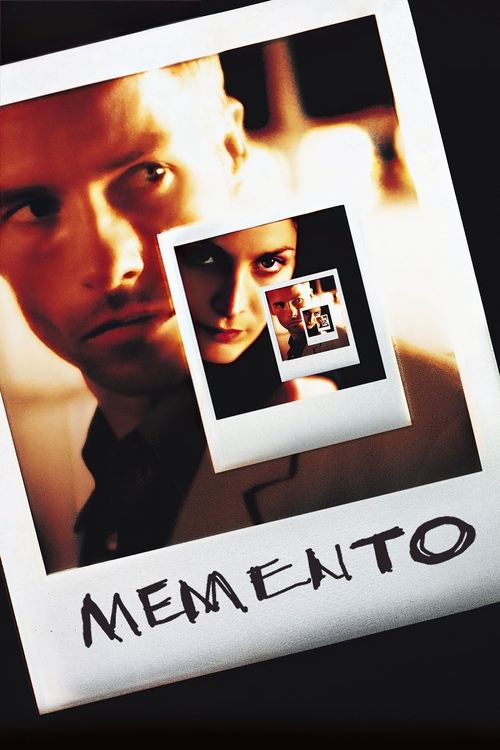
"Some memories are best forgotten."
Memento - Symbolism & Philosophy
Symbols & Motifs
Tattoos
The tattoos represent Leonard's attempt to create a permanent, undeniable truth on his own body. They are meant to be immutable facts that transcend his fleeting memory, acting as the very foundation of his identity and purpose. However, they ultimately symbolize the flaw in his system; a fact without context can be misleading. As he loses the memory of why he got a tattoo, its meaning can be distorted, showing that even seemingly solid truths can become instruments of self-deception.
Leonard's body is covered in crucial clues and commands related to his investigation, such as "John G raped and murdered my wife" and the license plate number of his target. The most significant tattoo is "Remember Sammy Jankis," a constant reminder of a story that is central to his understanding of his own condition, but is ultimately a fabrication to conceal his own past trauma.
Polaroid Photographs
The Polaroids symbolize fleeting, impermanent memories. Unlike tattoos, they are external objects that can be written on, reinterpreted, lost, or deliberately destroyed. They represent the fragile, moment-to-moment reality that Leonard inhabits. Shaking a Polaroid to develop it becomes a visual metaphor for Leonard trying to bring a new memory into focus before it fades.
Leonard constantly takes pictures of people, places, and objects to create an instant, annotated reality. He writes notes on them like "Don't believe his lies" for Teddy or identifies his car. The film opens with a reverse-motion shot of a Polaroid of the dead Teddy 'undeveloping,' visually establishing the film's reverse chronology and the theme of memory's decay.
Black-and-White vs. Color Scenes
The two visual styles represent different states of Leonard's consciousness and timelines. The black-and-white scenes, presented chronologically, symbolize a more detached, seemingly objective past where Leonard attempts to lay out the 'facts' of his story. The color scenes, shown in reverse, represent his chaotic, subjective, and emotionally charged present. The transition from black-and-white to color at the film's chronological center marks the moment Leonard chooses self-deception over truth.
The film alternates between these two styles. The black-and-white sequences largely consist of Leonard in his motel room, speaking on the phone and explaining his condition and the story of Sammy Jankis. The color sequences depict his interactions with Natalie and Teddy as he hunts for 'John G.' The two timelines converge when the Polaroid Leonard takes of Jimmy's body develops, transitioning the film from the objective past into the subjective present he has created for himself.
Sammy Jankis
Sammy Jankis is a symbol of Leonard's repressed guilt and self-deception. He is a story Leonard tells himself to cope with the unbearable truth that he may have been responsible for his own wife's death. Sammy becomes a cautionary tale and a key part of Leonard's constructed identity, representing the past Leonard cannot—or will not—face. By projecting his own story onto Sammy, Leonard absolves himself of guilt and justifies his quest for revenge.
Throughout the black-and-white scenes, Leonard recounts his investigation of Sammy Jankis (Stephen Tobolowsky), an amnesiac whose insurance claim he denied. He tells the story of how Sammy's wife, desperate to prove he was faking, tested him by repeatedly asking for her insulin shot, leading to a fatal overdose. In the final confrontation, Teddy reveals that Sammy was a real con man, but the story about the wife and the insulin is actually Leonard's own.
Philosophical Questions
What constitutes personal identity if not continuous memory?
The film is a direct engagement with John Locke's theory of personal identity, which posits that our identity is tied to the continuity of our consciousness. Leonard lacks this continuity. He tries to substitute it with an external system of notes and tattoos. The film questions if this is a valid substitute. Does Leonard have a consistent identity, or is he a new person every few minutes, merely acting on the instructions of a stranger (his past self)? "Memento" suggests that identity may be less about an accurate record of the past and more about the ongoing narrative we construct to define ourselves in the present.
Can there be an objective truth if reality is only accessible through subjective experience?
"Memento" is a powerful exploration of epistemology, the philosophical study of knowledge. Leonard's entire existence is a search for a single, objective fact: the identity of his wife's killer. Yet, his every perception is flawed and incomplete. He must rely on the interpretations of others and the contextless 'facts' he's written down. The film argues that what we call 'truth' is often just a belief that is reinforced by our own curated evidence. Leonard's final decision to knowingly create a false 'fact' demonstrates that for him, a useful, purpose-giving reality is more valuable than an objective, nihilistic truth.
What is the nature of justice and revenge when the act cannot be remembered?
The film scrutinizes the purpose of revenge. If Leonard kills his wife's attacker but cannot remember doing so, is justice served? Can he achieve closure or healing? Teddy argues that the act is meaningless because it provides no satisfaction. The film suggests that for Leonard, the process of seeking revenge is more important than the outcome. The endless hunt provides him with the identity and purpose his condition took from him, making the vengeance itself a means to an end, rather than the end itself.
Core Meaning
The core meaning of "Memento" revolves around the subjective nature of reality and the unreliability of memory as a foundation for identity and truth. Director Christopher Nolan explores the idea that we are all, to some extent, unreliable narrators of our own lives. Leonard Shelby's condition is an extreme metaphor for the human tendency to construct narratives that serve our emotional needs, even if it means distorting or ignoring the objective truth. The film posits that identity is not a static product of past experiences but a continuous story we tell ourselves. Leonard's desperate attempt to create meaning and purpose through a revenge quest—even by deliberately manipulating his own system of facts—suggests that the need for a coherent narrative can be more powerful than the desire for truth itself. Ultimately, "Memento" is a profound meditation on how memory, truth, and self-deception intertwine to shape who we are.