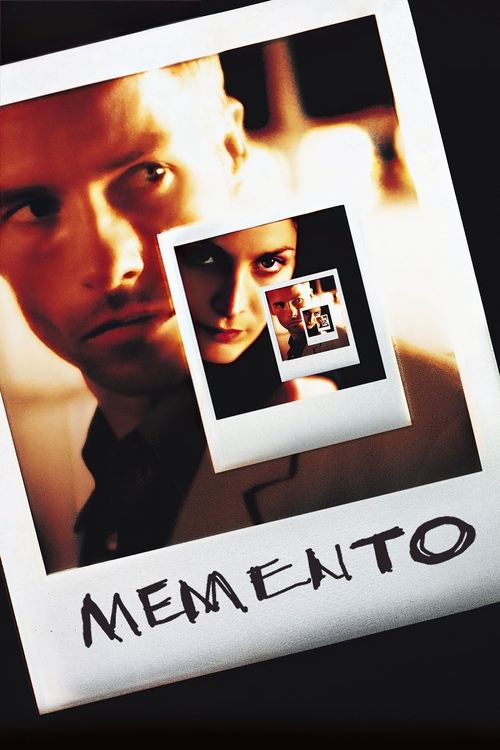
Memento
"Some memories are best forgotten."
Overview
"Memento" is a psychological thriller that follows Leonard Shelby, a former insurance investigator who suffers from anterograde amnesia, a condition where he's unable to form new memories. The last thing he remembers is the brutal attack that left him with this condition and resulted in his wife's death. Consumed by a singular purpose, Leonard embarks on a relentless hunt for his wife's killer, a man he knows only as "John G."
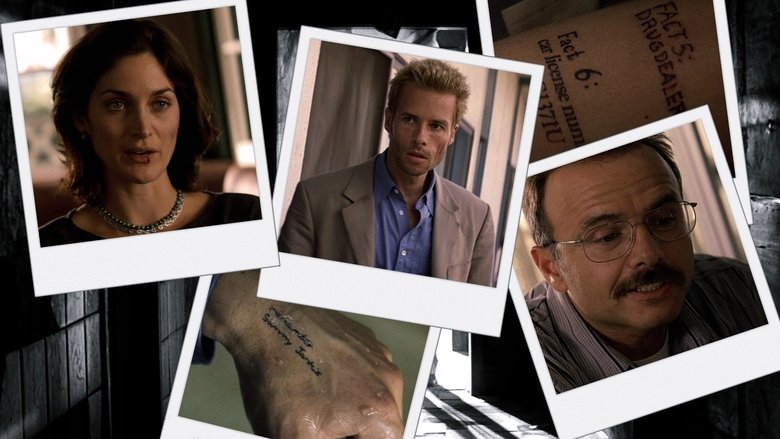
To compensate for his memory loss, Leonard has developed a meticulous system of Polaroids, handwritten notes, and crucial facts tattooed onto his body. The film's narrative is uniquely structured, presented in two alternating timelines. One, in black-and-white, moves forward chronologically, showing Leonard in a motel room recounting his past. The other, in color, unfolds in reverse chronological order, thrusting the audience into Leonard's disorienting present, where each scene begins without the context of what immediately preceded it.
As Leonard navigates a treacherous world of manipulation, he encounters Natalie, a bartender who seems to want to help him, and Teddy, who claims to be his friend but whose motives are unclear. The two timelines converge in a stunning climax that forces both Leonard and the audience to question everything they thought they knew about the past, the nature of memory, and the very foundation of Leonard's quest for revenge.
Core Meaning
The core meaning of "Memento" revolves around the subjective nature of reality and the unreliability of memory as a foundation for identity and truth. Director Christopher Nolan explores the idea that we are all, to some extent, unreliable narrators of our own lives. Leonard Shelby's condition is an extreme metaphor for the human tendency to construct narratives that serve our emotional needs, even if it means distorting or ignoring the objective truth. The film posits that identity is not a static product of past experiences but a continuous story we tell ourselves. Leonard's desperate attempt to create meaning and purpose through a revenge quest—even by deliberately manipulating his own system of facts—suggests that the need for a coherent narrative can be more powerful than the desire for truth itself. Ultimately, "Memento" is a profound meditation on how memory, truth, and self-deception intertwine to shape who we are.
Thematic DNA
Memory and Identity
The film's central theme is the symbiotic relationship between memory and personal identity. Leonard's inability to form new memories forces him to construct his identity based on external 'facts' like tattoos and notes. This raises the philosophical question, first posed by John Locke, of whether a person remains the same without a continuous consciousness. The film suggests that identity is not just a collection of past events, but an ongoing narrative we create for ourselves. Leonard's story of Sammy Jankis is revealed to be a projection of his own trauma, a way to displace guilt and create a more palatable identity for himself.
Subjectivity of Truth and Deception
"Memento" constantly challenges the notion of objective truth. Because the audience experiences the story through Leonard's fragmented perspective, we are as susceptible to manipulation as he is. Characters like Teddy and Natalie exploit his condition, feeding him information that serves their own purposes. The film's climax reveals the ultimate deception: Leonard deceives himself, choosing to create a new "truth" by targeting Teddy to give his life continued purpose. This implies that truth can be a malleable construct, shaped by desire and interpretation rather than impartial facts.
Revenge and Grief
Leonard's quest for revenge is the engine that drives the narrative. However, the film portrays this quest as a self-perpetuating cycle rather than a path to closure. Since he cannot remember achieving his goal, he is trapped in a loop of vengeance, unable to heal from the grief of his wife's death. His condition is a metaphor for being stuck in a moment of trauma, unable to move forward. Teddy points out the futility of it all, revealing that Leonard has already killed the real attacker, but Leonard chooses to continue the hunt because the mission is all that gives his life meaning.
Manipulation and Trust
Leonard's amnesia makes him extremely vulnerable to manipulation. He has no choice but to trust the people he encounters or the system he has created. Natalie and Teddy both exploit this vulnerability for their own ends. Natalie uses his condition to get him to deal with a man named Dodd, while Teddy uses him to eliminate criminals and profit from it. The central dilemma for both Leonard and the audience is determining who, if anyone, can be trusted. The film ultimately shows that even Leonard's own system of 'facts' can be corrupted by his own desires, making him the ultimate manipulator of his own reality.
Character Analysis
Leonard Shelby
Guy Pearce
Motivation
His stated motivation is to find and kill the man who murdered his wife, thereby achieving justice and avenging her death. However, his deeper, subconscious motivation is the need for a purpose. Without the ability to form new memories, his life lacks meaning. The hunt for John G. provides him with an identity and a reason to exist. As Teddy reveals, even after finding the real killer, Leonard continues the hunt because he needs the puzzle, not the solution.
Character Arc
Leonard's journey is not a traditional character arc of growth, but a cyclical one. He begins and ends in the same state: hunting a man named John G. His development is an illusion constructed for himself and the audience. The true 'arc' is the audience's understanding of him. We initially see him as a tragic hero on a righteous quest, but by the end, we understand he is a man who actively chooses self-deception to give his life a purpose, trapping himself in a loop of violence. He doesn't change; he perpetuates his own condition.
Teddy (John Edward Gammell)
Joe Pantoliano
Motivation
Teddy's motivations are a mix of pity, greed, and frustration. He was the investigating officer on Leonard's wife's case and genuinely helped him find the real killer a year prior. Afterwards, he began using Leonard to eliminate criminals like Jimmy Grantz and take their money. He seems to believe he is giving Leonard a purpose while also profiting from his condition. He is motivated by a cynical pragmatism, seeing Leonard as a tool to be aimed at 'bad guys.'
Character Arc
Teddy's character is revealed in reverse. He is initially presented as a suspicious and potentially villainous figure, whom Leonard's notes warn him not to trust. As the film moves backward chronologically, we see him acting more like a frustrated handler or even a friend. The final revelation casts him as a corrupt cop who initially pitied Leonard and helped him get his revenge, but then began using him for his own gain. His arc is a peeling back of layers, from antagonist to a complex, morally ambiguous figure who tells Leonard the truth he doesn't want to hear.
Natalie
Carrie-Anne Moss
Motivation
Natalie's primary motivation is self-preservation. After Leonard kills her drug-dealing boyfriend, Jimmy Grantz, she finds herself in trouble with Jimmy's partner, Dodd. Her goal is to use Leonard as a weapon to eliminate the threat Dodd poses. She is driven by a cynical understanding of human nature, recognizing Leonard's condition as a tool she can use to survive in her dangerous world.
Character Arc
Natalie embodies the classic femme fatale archetype, a woman who is both alluring and dangerous. Initially, she appears to be a sympathetic victim, grieving her boyfriend Jimmy and wanting to help Leonard. However, the film's reverse structure quickly reveals her manipulative nature. In a key scene, she deliberately provokes Leonard into hitting her, knowing he will forget, so she can exploit his guilt and use him to get rid of Dodd. Her character doesn't change, but our perception of her does, shifting from ally to a self-serving survivor who is adept at using Leonard's weakness to her advantage.
Symbols & Motifs
Tattoos
The tattoos represent Leonard's attempt to create a permanent, undeniable truth on his own body. They are meant to be immutable facts that transcend his fleeting memory, acting as the very foundation of his identity and purpose. However, they ultimately symbolize the flaw in his system; a fact without context can be misleading. As he loses the memory of why he got a tattoo, its meaning can be distorted, showing that even seemingly solid truths can become instruments of self-deception.
Leonard's body is covered in crucial clues and commands related to his investigation, such as "John G raped and murdered my wife" and the license plate number of his target. The most significant tattoo is "Remember Sammy Jankis," a constant reminder of a story that is central to his understanding of his own condition, but is ultimately a fabrication to conceal his own past trauma.
Polaroid Photographs
The Polaroids symbolize fleeting, impermanent memories. Unlike tattoos, they are external objects that can be written on, reinterpreted, lost, or deliberately destroyed. They represent the fragile, moment-to-moment reality that Leonard inhabits. Shaking a Polaroid to develop it becomes a visual metaphor for Leonard trying to bring a new memory into focus before it fades.
Leonard constantly takes pictures of people, places, and objects to create an instant, annotated reality. He writes notes on them like "Don't believe his lies" for Teddy or identifies his car. The film opens with a reverse-motion shot of a Polaroid of the dead Teddy 'undeveloping,' visually establishing the film's reverse chronology and the theme of memory's decay.
Black-and-White vs. Color Scenes
The two visual styles represent different states of Leonard's consciousness and timelines. The black-and-white scenes, presented chronologically, symbolize a more detached, seemingly objective past where Leonard attempts to lay out the 'facts' of his story. The color scenes, shown in reverse, represent his chaotic, subjective, and emotionally charged present. The transition from black-and-white to color at the film's chronological center marks the moment Leonard chooses self-deception over truth.
The film alternates between these two styles. The black-and-white sequences largely consist of Leonard in his motel room, speaking on the phone and explaining his condition and the story of Sammy Jankis. The color sequences depict his interactions with Natalie and Teddy as he hunts for 'John G.' The two timelines converge when the Polaroid Leonard takes of Jimmy's body develops, transitioning the film from the objective past into the subjective present he has created for himself.
Sammy Jankis
Sammy Jankis is a symbol of Leonard's repressed guilt and self-deception. He is a story Leonard tells himself to cope with the unbearable truth that he may have been responsible for his own wife's death. Sammy becomes a cautionary tale and a key part of Leonard's constructed identity, representing the past Leonard cannot—or will not—face. By projecting his own story onto Sammy, Leonard absolves himself of guilt and justifies his quest for revenge.
Throughout the black-and-white scenes, Leonard recounts his investigation of Sammy Jankis (Stephen Tobolowsky), an amnesiac whose insurance claim he denied. He tells the story of how Sammy's wife, desperate to prove he was faking, tested him by repeatedly asking for her insulin shot, leading to a fatal overdose. In the final confrontation, Teddy reveals that Sammy was a real con man, but the story about the wife and the insulin is actually Leonard's own.
Memorable Quotes
I have to believe in a world outside my own mind. I have to believe that my actions still have meaning, even if I can't remember them.
— Leonard Shelby
Context:
This is part of Leonard's voice-over narration in one of the black-and-white scenes. He is reflecting on his condition and the philosophical implications of living without the ability to form new memories, trying to anchor himself to a sense of purpose.
Meaning:
This quote encapsulates Leonard's existential struggle. It's his personal mantra, an affirmation of faith needed to continue his mission. He acknowledges the solipsistic trap of his condition but chooses to believe his actions have consequence and reality exists independently of his perception, which is the only way he can justify his quest for vengeance.
Memory can change the shape of a room; it can change the color of a car. And memories can be distorted. They're just an interpretation, they're not a record.
— Leonard Shelby
Context:
Leonard says this to Teddy early in the film's reverse chronology (but late in the story). He is explaining why he trusts his notes and tattoos over the subjective memories of other people, unaware that he himself is the most unreliable interpreter of all.
Meaning:
This is a moment of profound irony. Leonard explains the fallibility of human memory, arguing that his system of 'facts' is superior. He believes he has overcome the weakness of interpretation. However, the entire film is an exercise in proving this very quote, showing how Leonard's own 'facts' are subject to his interpretation and emotional needs, ultimately leading him to distort his own reality.
We all need mirrors to remind ourselves who we are. I'm no different.
— Leonard Shelby
Context:
This line is part of Leonard's narration. He is looking at his reflection while contemplating his system, justifying his unusual methods by comparing them to the ordinary ways people reinforce their sense of self.
Meaning:
This quote speaks to the universal human need for self-reflection and identity. For most people, memories and interactions serve as these 'mirrors.' For Leonard, the mirrors are literal: his notes, photos, and tattoos. It highlights his humanity and connects his extreme condition to a common experience, suggesting everyone constructs their identity from external confirmations.
You don't want the truth. You make up your own truth.
— Teddy
Context:
Teddy shouts this at Leonard in the abandoned building after revealing the entire truth: that Leonard already killed the real attacker, that Sammy's story is Leonard's, and that Teddy has been using him. This is the moment before Leonard decides to make Teddy his next 'John G.'
Meaning:
This is the devastating accusation Teddy levels at Leonard in the film's climax. It cuts to the heart of the movie's core theme: that Leonard is not a passive victim of his condition but an active participant in his own delusion. It reveals that Leonard's quest is not about finding truth, but about creating a reality he can live with.
I'm not a killer. I'm just someone who wanted to make things right.
— Leonard Shelby
Context:
Leonard says this at the very end of the film's chronological timeline, just after Teddy has revealed the truth. He is grappling with what he has become and what he has done, right before he decides to lie to himself and frame Teddy.
Meaning:
This is Leonard's self-justification, the core belief that allows him to commit murder. He doesn't see himself as a violent man but as an agent of justice, a widower correcting a great wrong. This belief purifies his actions in his own mind, allowing him to pull the trigger without viewing himself as a monster.
Philosophical Questions
What constitutes personal identity if not continuous memory?
The film is a direct engagement with John Locke's theory of personal identity, which posits that our identity is tied to the continuity of our consciousness. Leonard lacks this continuity. He tries to substitute it with an external system of notes and tattoos. The film questions if this is a valid substitute. Does Leonard have a consistent identity, or is he a new person every few minutes, merely acting on the instructions of a stranger (his past self)? "Memento" suggests that identity may be less about an accurate record of the past and more about the ongoing narrative we construct to define ourselves in the present.
Can there be an objective truth if reality is only accessible through subjective experience?
"Memento" is a powerful exploration of epistemology, the philosophical study of knowledge. Leonard's entire existence is a search for a single, objective fact: the identity of his wife's killer. Yet, his every perception is flawed and incomplete. He must rely on the interpretations of others and the contextless 'facts' he's written down. The film argues that what we call 'truth' is often just a belief that is reinforced by our own curated evidence. Leonard's final decision to knowingly create a false 'fact' demonstrates that for him, a useful, purpose-giving reality is more valuable than an objective, nihilistic truth.
What is the nature of justice and revenge when the act cannot be remembered?
The film scrutinizes the purpose of revenge. If Leonard kills his wife's attacker but cannot remember doing so, is justice served? Can he achieve closure or healing? Teddy argues that the act is meaningless because it provides no satisfaction. The film suggests that for Leonard, the process of seeking revenge is more important than the outcome. The endless hunt provides him with the identity and purpose his condition took from him, making the vengeance itself a means to an end, rather than the end itself.
Alternative Interpretations
The brilliance of "Memento" lies in its ambiguity, which has led to several compelling alternative interpretations, primarily revolving around the information provided by Teddy.
Interpretation 1: Teddy is Telling the Truth.
This is the most widely accepted reading. In this view, Leonard's wife survived the initial attack but was diabetic. Depressed by Leonard's condition and perhaps doubting its authenticity, she tested him by having him repeatedly administer her insulin shots, leading to her accidental death at his hands. To cope, Leonard suppressed this memory and created the story of Sammy Jankis, projecting his own tragedy onto a former insurance case. Teddy, the original cop, helped him find and kill the actual attacker a year ago. Since then, Teddy has been using Leonard's quest to eliminate other criminals. Leonard's decision to target Teddy is a conscious act of self-deception to create a new purpose.
Interpretation 2: Leonard's Original Story is True.
In this interpretation, everything Leonard believes at the start is correct. His wife was killed in the attack, there was a second attacker, and Teddy is a manipulative liar trying to throw him off the scent and use him. When Teddy tells Leonard the 'truth' at the end, it is simply the ultimate lie designed to save his own skin and confuse Leonard. The story of Sammy Jankis is just as Leonard tells it. This reading positions Leonard as a more traditional tragic hero, whose system is ultimately undermined by a cunning villain rather than his own psychological needs.
Interpretation 3: Sammy Jankis is a Complete Fabrication.
A variation on the first interpretation suggests that while Leonard's wife did die from the insulin overdose, Sammy Jankis may never have existed at all. He could be a complete construct of Leonard's mind, a necessary fiction to house the traumatic memory of his wife's death. Teddy's claim that Sammy was a real 'conman' could just be another manipulation, something he knows will resonate with Leonard's past as an investigator.
Cultural Impact
Released in 2000, "Memento" arrived at a time of growing interest in complex, non-linear narratives in independent cinema. It became a breakout film for Christopher Nolan, establishing his reputation as a master of intricate, high-concept storytelling. Its reverse-chronological structure was not just a gimmick but a vital storytelling device that immersed the audience in the protagonist's subjective experience, a technique that has been studied and emulated since.
Critically, the film was hailed as a masterpiece of neo-noir, praised for its originality, complexity, and Oscar-nominated screenplay. It had a significant influence on subsequent psychological thrillers, popularizing narrative puzzles and unreliable narrators. Films and TV shows exploring memory and identity, such as "Eternal Sunshine of the Spotless Mind" and "Westworld" (co-created by Jonathan Nolan), owe a debt to the groundwork laid by "Memento."
The film also prompted widespread discussion among audiences and academics about philosophical questions of personal identity, memory, and the nature of truth, often being used as a case study in philosophy and psychology courses. Its central premise has become a part of the cultural lexicon, with the "Memento-style" narrative becoming shorthand for stories told in reverse. The film remains a landmark of independent filmmaking and a cornerstone of 21st-century cinema.
Audience Reception
Audiences were largely captivated and challenged by "Memento." Viewers praised its ingenious non-linear structure, which uniquely simulated the protagonist's state of mind and turned the film into an interactive puzzle. The compelling performances by Guy Pearce, Carrie-Anne Moss, and Joe Pantoliano were frequently highlighted as strengths. Many viewers found the film to be a deeply thought-provoking experience that lingered long after the credits, sparking intense debate and discussion about its ending and themes.
The main point of criticism, for some, was that the complex narrative structure felt like a gimmick that overshadowed emotional engagement. A minority of viewers found the film confusing or overly complicated, feeling that the plot's cleverness came at the expense of character depth. The ambiguous ending was a point of controversy; while most praised it for its intellectual and philosophical richness, others were frustrated by the lack of a definitive resolution. Overall, the verdict from audiences was overwhelmingly positive, solidifying the film's status as a modern classic and a must-see for fans of psychological thrillers.
Interesting Facts
- The idea for the film was conceived by Jonathan Nolan during a cross-country road trip with his brother, Christopher, in 1996.
- The film's screenplay, written by Christopher Nolan, is based on his brother Jonathan's short story, "Memento Mori." The story was not published until after the film was released, which made the script eligible for a Best Original Screenplay Oscar nomination.
- The entire film was shot in just 25 days.
- Brad Pitt was initially considered for the role of Leonard Shelby, but passed due to scheduling conflicts. Nolan then decided a lesser-known actor like Guy Pearce would be more effective.
- Stephen Tobolowsky, who plays Sammy Jankis, had a real-life experience with amnesia caused by an experimental painkiller he took during surgery. He shared this story with Nolan during his audition.
- The tattoo parlor in the film is named "Emma's Tattoos" after Christopher Nolan's wife and producer, Emma Thomas.
- In the scene where Teddy yells at Leonard, the line "you freak!" was not to Christopher Nolan's liking. He dubbed over actor Joe Pantoliano's voice with his own for those two words.
- The reverse-motion opening sequence, particularly the shot of the bullet casing flying back into the gun, was a complex practical effect and served as an inspiration for Nolan's later film, "Tenet."
Easter Eggs
A Batman logo can be seen in a store window in the background of one scene.
This is a coincidental but interesting bit of foreshadowing, as Christopher Nolan would go on to direct the highly successful "The Dark Knight" trilogy. A similar Batman logo also appeared in his first film, "Following."
Christopher Nolan's own white Honda Civic is parked next to Leonard's Jaguar in the parking lot of the Discount Inn.
This is a small, personal cameo from the director, inserting a piece of his own life into the film's backdrop.
The name of the killer, "John G.," may be an homage to Jonathan Nolan's screenwriting professor at Georgetown University, John Glavin.
This detail provides a bit of insight into the personal origins of the story's central mystery, connecting the fictional antagonist to a real-life figure in the writer's life.
Actor Thomas Lennon plays the doctor who tests Sammy Jankis.
This marks the first of two times Thomas Lennon would play a doctor in a Christopher Nolan film. He later appeared as Bruce Wayne's doctor in "The Dark Knight Rises."
⚠️ Spoiler Analysis
Click to reveal detailed analysis with spoilers
Frequently Asked Questions
Explore More About This Movie
Dive deeper into specific aspects of the movie with our detailed analysis pages
Comments (0)
No comments yet. Be the first to share your thoughts!