살인의 추억
"The worst of them will stay with you... forever."
Memories of Murder - Symbolism & Philosophy
Symbols & Motifs
The Golden Fields
The vast, golden rice fields represent a deceptive bucolic innocence. They are the idyllic face of the countryside, masking the brutal violence that occurs within them. They are both beautiful and menacing, a place where life-giving crops grow but also where bodies are discovered.
The film opens and closes with shots of these fields. The first victim is found in a ditch at the edge of a field. The fields are a recurring visual motif, often filmed in a way that emphasizes their vastness and the isolation of the rural setting, making them a perfect hunting ground for the killer.
Rain
Rain is a classic noir trope, but here it functions as a harbinger of death and a symbol of the cleansing of evidence. It's the condition under which the killer strikes, creating an atmosphere of dread and foreboding whenever the weather turns. It also washes away potential clues, contributing to the detectives' frustration and the overall sense of futility.
The detectives quickly establish that the killer only strikes on rainy nights. This leads to scenes of mounting tension where the detectives desperately try to prevent another murder as the rain begins to fall. The sound and sight of rain become synonymous with the killer's presence.
The Color Red
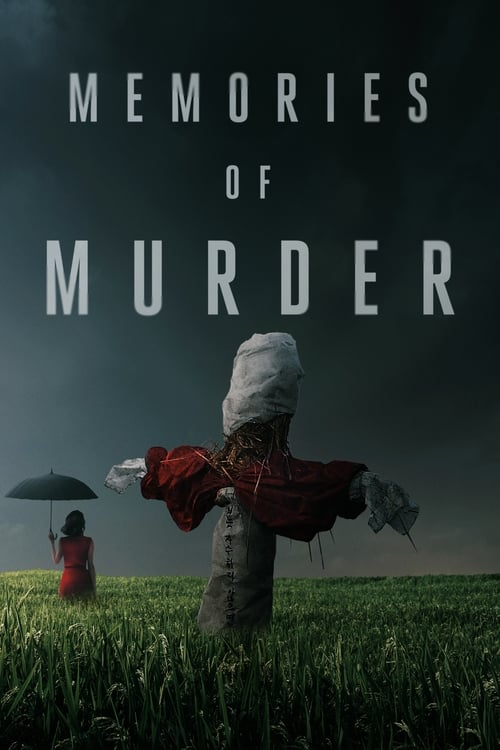
Red is a direct symbol of the victims. The killer specifically targets women wearing red, turning a vibrant color associated with life and passion into a marker for death. For the detectives and the audience, the sight of a woman in red on a rainy night becomes a source of extreme anxiety.
The detectives discover the killer's preference for victims in red clothing early in the investigation. This leads to a tense sequence where they use a female officer in a red dress as bait in a failed attempt to trap the murderer.
The Final Gaze
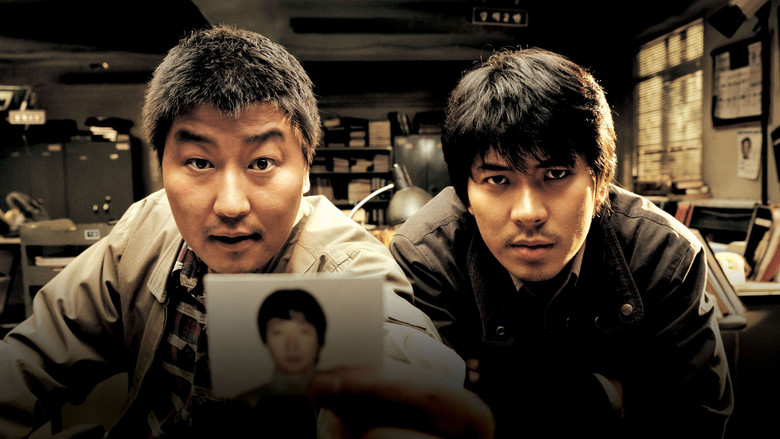
Detective Park's direct stare into the camera in the final shot breaks the fourth wall. It symbolizes his, and the director's, accusation towards the audience. At the time of the film's release, the real killer was still at large, and Bong Joon Ho believed he would see the movie. The gaze is a confrontation, suggesting the killer is an ordinary person who could be sitting in the theater. It transforms the film from a historical crime story into a present and unsettling interrogation of the viewer, asking: 'Are you the killer? Do you know who is?'
In 2003, years after quitting the force, Park returns to the site of the first murder. A young girl tells him another man with a "plain" face was just there, reminiscing about something he did there long ago. Realizing this was the killer, Park looks up and stares directly into the camera, at the audience.
Philosophical Questions
What is the nature of truth in a world of uncertainty?
The film relentlessly undermines every system the characters use to find truth. Park's intuition is wrong. Cho's violence extracts false confessions. Seo's precious documents and evidence prove inconclusive. Even technology, in the form of the much-awaited DNA results, fails to provide a clear answer. The film suggests that objective truth can be elusive, perhaps even nonexistent, when filtered through flawed human systems and perceptions. It forces the audience to question how we can be certain of anything when our methods for discovering truth are so fallible.
Can order prevail over chaos?
The entire investigation is a struggle to impose order on the chaos unleashed by the killer. The detectives try to find patterns (rainy nights, red clothes, a song) to make sense of the senseless violence. However, the killer remains a step ahead, a force of chaos that cannot be contained by their flawed attempts at creating order. The unresolved ending suggests a pessimistic answer: that chaos is a fundamental force, and our attempts to control it are often futile, leading not to justice but to obsession and ruin.
Where does evil come from?
The film rejects easy answers. The detectives initially look for a monster, a deviant, someone easily identifiable as 'other'—the mentally handicapped boy, the 'pervert' in the factory. But the final revelation is that the killer is "plain" and "ordinary." This suggests that evil is not an external, monstrous force but something that can arise from within the mundane fabric of society. The final stare implicates everyone, suggesting that the capacity for evil is not marked on the surface but is an unsettlingly common human potential.
Core Meaning
"Memories of Murder" is a profound exploration of failure, uncertainty, and the elusiveness of truth. Director Bong Joon Ho uses the framework of a detective story to critique the incompetence and brutality of the police force under South Korea's military dictatorship in the 1980s. The film suggests that the systemic failures of the state are as much a villain as the killer himself. More deeply, it's a film about how individuals and a society grapple with the trauma of the unknown. The unresolved nature of the case forces the characters, and by extension the audience, to confront the uncomfortable reality that some questions have no answers and that justice is not always attainable. The famous final shot, where Detective Park stares directly into the camera, is a powerful statement suggesting the killer could be anyone, an ordinary face in the crowd, implicating the audience in the search for truth and justice.