Memories of Murder
A haunting crime thriller where the oppressive atmosphere of a rural Korean town mirrors the detectives' frustrating descent into obsession and impotence.
Memories of Murder

Memories of Murder

살인의 추억

"The worst of them will stay with you... forever."

25 April 2003 South Korea 131 min ⭐ 8.1 (4,224)
Director: Bong Joon Ho
Cast: Song Kang-ho, Kim Sang-kyung, Kim Roi-ha, Song Jae-ho, Byun Hee-bong
Drama Crime Thriller
The Fallibility of Justice and Authority The Clash Between Intuition and Logic The Elusiveness of Truth Memory and Trauma
Budget: $2,800,000
Box Office: $26,000,000

Overview

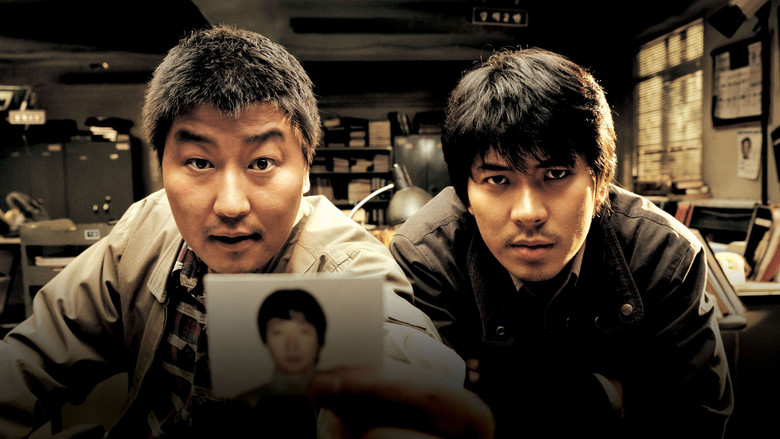
Set in 1986, in the South Korean province of Gyeonggi, "Memories of Murder" follows the investigation into a series of brutal rapes and murders of young women. Local detective Park Doo-man (Song Kang-ho), who relies on his intuition and often brutal methods, is quickly overwhelmed by the case. He is soon joined by Seo Tae-yoon (Kim Sang-kyung), a more methodical and by-the-book detective from Seoul.

Their conflicting investigative styles initially create tension, but they are forced to collaborate as the killer continues to elude them. A grim pattern emerges: the murders occur on rainy nights when a specific song is requested on the local radio, and the victims are often wearing red. The detectives pursue several suspects, including a mentally handicapped boy and a quiet factory worker, but each lead dissolves into ambiguity and frustration. The investigation becomes a desperate and all-consuming obsession for the detectives as they grapple with their own limitations and the dawning horror that the killer may never be caught.


Core Meaning

"Memories of Murder" is a profound exploration of failure, uncertainty, and the elusiveness of truth. Director Bong Joon Ho uses the framework of a detective story to critique the incompetence and brutality of the police force under South Korea's military dictatorship in the 1980s. The film suggests that the systemic failures of the state are as much a villain as the killer himself. More deeply, it's a film about how individuals and a society grapple with the trauma of the unknown. The unresolved nature of the case forces the characters, and by extension the audience, to confront the uncomfortable reality that some questions have no answers and that justice is not always attainable. The famous final shot, where Detective Park stares directly into the camera, is a powerful statement suggesting the killer could be anyone, an ordinary face in the crowd, implicating the audience in the search for truth and justice.

Thematic DNA

The Fallibility of Justice and Authority 35%
The Clash Between Intuition and Logic 30%
The Elusiveness of Truth 25%
Memory and Trauma 10%

The Fallibility of Justice and Authority

The film relentlessly portrays the incompetence of the police investigation. Evidence is contaminated, suspects are tortured into false confessions, and detectives rely on superstition over facts. This is set against the backdrop of an oppressive military dictatorship in 1980s South Korea, where the authorities are more concerned with suppressing dissent than solving crimes against women. The failure to catch the killer represents a larger failure of the system to protect its citizens and deliver justice.

The Clash Between Intuition and Logic

The central conflict between the two lead detectives, Park and Seo, embodies this theme. Park is the rural, instinct-driven cop who believes he can identify a criminal just by looking into their eyes. Seo, from the city, represents a modern, evidence-based approach, insisting that "documents never lie." As the film progresses, both methods prove inadequate. Park's intuition leads to wrongful accusations, while Seo's reliance on facts is thwarted by a lack of evidence and inconclusive results, culminating in his own descent into rage and violence.

The Elusiveness of Truth

Ultimately, the film is less about who the killer is and more about the devastating impact of not knowing. Every promising lead dissolves, and the final piece of DNA evidence comes back inconclusive. The film denies the audience and the characters the catharsis of resolution. The ending, where a young girl describes the killer as having a "plain" or "ordinary" face, reinforces this theme. The truth is not some monstrous anomaly but something horrifyingly mundane and unknowable, hidden in plain sight.

Memory and Trauma

The title itself points to the significance of memory. The entire film is a retrospective look at a national trauma. The detectives are haunted by their memories of the case, a failure that defines their lives. The final scene, with Park returning to the crime scene years later, shows how the memory of the murders lingers, not just for him but for the entire community. The film suggests that unresolved trauma continues to echo through time, shaping the present.

Character Analysis

Park Doo-man

Song Kang-ho

Archetype: The flawed antihero
Key Trait: Intuitive but incompetent

Motivation

Initially, his motivation is simply to close the case by any means necessary, including fabricating evidence and forcing confessions, to maintain his authority and sense of control. As the case deepens, his motivation shifts to a genuine, all-consuming obsession with catching the killer who has so thoroughly outsmarted him.

Character Arc

Park begins as a confident, corrupt, and incompetent local detective who relies on his supposed "shaman's eyes" and brutal interrogation tactics. He is a satirical representation of the old-guard police force. His journey is one of disillusionment. The relentless, unsolvable case strips away his arrogance, forcing him to confront his own limitations and the failure of his methods. He ultimately abandons his intuition-based approach for a desperate faith in forensics, only for that to fail him as well. By the end, he has left the police force, a man haunted by his failure to bring justice.

Seo Tae-yoon

Kim Sang-kyung

Archetype: The idealist turned cynic
Key Trait: Logical and methodical

Motivation

His primary motivation is to solve the crime through proper, scientific police work. He is driven by a strong sense of justice and a belief in the power of facts and evidence to uncover the truth. He wants to prove that his modern methods are superior to the provincial brutality he witnesses.

Character Arc

Seo arrives from Seoul as the rational, methodical, and modern detective, a stark contrast to Park. He believes firmly in evidence and logic, proclaiming that "documents never lie." However, the case's perpetual ambiguity and the killer's cruelty slowly erode his idealism. His faith in procedure and evidence crumbles when the DNA results come back inconclusive. He ultimately succumbs to the same violent rage as the other detectives, nearly executing a suspect in a dark tunnel, completing his transformation from a man of logic to one of desperate fury.

Cho Yong-koo

Kim Roi-ha

Archetype: The brutal enforcer
Key Trait: Violent and aggressive

Motivation

Cho is motivated by a simplistic and thuggish desire to assert dominance and force confessions. He believes that violence is the most effective tool for solving crimes and deals with his frustration by lashing out physically. His motivation is less about justice and more about violent enforcement.

Character Arc

Cho is Park's partner and the physical embodiment of the police force's brutality. His defining characteristic is his penchant for violence, particularly his flying drop-kicks. He has little to no character arc; he remains a violent and short-tempered man throughout. However, his actions escalate, culminating in a fight with civilians that leads to his leg being amputated after being hit by a train—a grimly ironic fate for a man defined by his kicking.

Park Hyeon-gyu

Park Hae-il

Archetype: The ambiguous suspect
Key Trait: Enigmatic

Motivation

His motivation is entirely unclear, which is central to his character's function in the story. If he is the killer, his motivation is the unfathomable psychopathy driving the murders. If he is innocent, his motivation is simply to survive the brutal police investigation. The film deliberately leaves his true motives a mystery.

Character Arc

As the primary suspect in the latter half of the film, Hyeon-gyu's arc is defined by ambiguity. He is soft-spoken and physically delicate, yet he is the most plausible suspect the detectives find. He endures interrogation and brutality with a calm demeanor that could be interpreted as either innocence or the cold confidence of a killer. He is arrested and nearly killed but is ultimately released when the DNA evidence proves inconclusive, leaving his guilt or innocence an open question that haunts the detectives and the audience.

Symbols & Motifs

The Golden Fields

Meaning:

The vast, golden rice fields represent a deceptive bucolic innocence. They are the idyllic face of the countryside, masking the brutal violence that occurs within them. They are both beautiful and menacing, a place where life-giving crops grow but also where bodies are discovered.

Context:

The film opens and closes with shots of these fields. The first victim is found in a ditch at the edge of a field. The fields are a recurring visual motif, often filmed in a way that emphasizes their vastness and the isolation of the rural setting, making them a perfect hunting ground for the killer.

Rain

Meaning:

Rain is a classic noir trope, but here it functions as a harbinger of death and a symbol of the cleansing of evidence. It's the condition under which the killer strikes, creating an atmosphere of dread and foreboding whenever the weather turns. It also washes away potential clues, contributing to the detectives' frustration and the overall sense of futility.

Context:

The detectives quickly establish that the killer only strikes on rainy nights. This leads to scenes of mounting tension where the detectives desperately try to prevent another murder as the rain begins to fall. The sound and sight of rain become synonymous with the killer's presence.

The Color Red

Meaning:

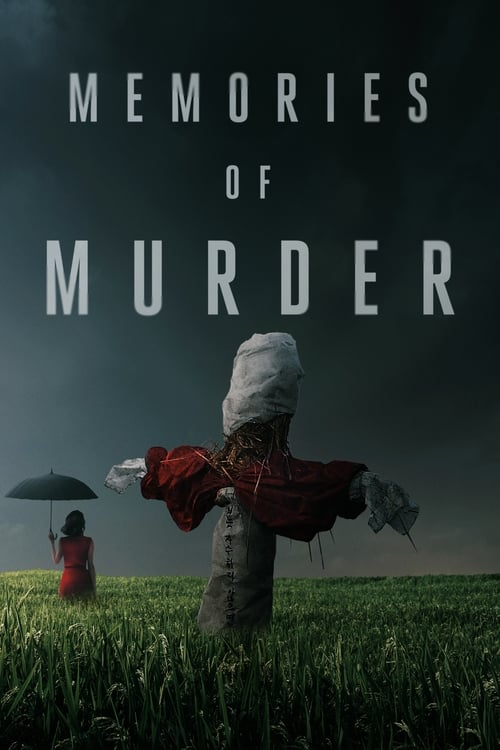
Red is a direct symbol of the victims. The killer specifically targets women wearing red, turning a vibrant color associated with life and passion into a marker for death. For the detectives and the audience, the sight of a woman in red on a rainy night becomes a source of extreme anxiety.

Context:

The detectives discover the killer's preference for victims in red clothing early in the investigation. This leads to a tense sequence where they use a female officer in a red dress as bait in a failed attempt to trap the murderer.

The Final Gaze

Meaning:

Detective Park's direct stare into the camera in the final shot breaks the fourth wall. It symbolizes his, and the director's, accusation towards the audience. At the time of the film's release, the real killer was still at large, and Bong Joon Ho believed he would see the movie. The gaze is a confrontation, suggesting the killer is an ordinary person who could be sitting in the theater. It transforms the film from a historical crime story into a present and unsettling interrogation of the viewer, asking: 'Are you the killer? Do you know who is?'

Context:

In 2003, years after quitting the force, Park returns to the site of the first murder. A young girl tells him another man with a "plain" face was just there, reminiscing about something he did there long ago. Realizing this was the killer, Park looks up and stares directly into the camera, at the audience.

Memorable Quotes

서류는 거짓말 안 해.

— Seo Tae-yoon

Context:

Seo says this repeatedly throughout the first half of the film, particularly when arguing with Park about his unscientific methods and his focus on baseless hunches over hard evidence.

Meaning:

"Documents never lie." This is Seo's mantra, encapsulating his faith in evidence-based, rational investigation. It stands in stark contrast to Park's reliance on intuition. The tragic irony is that the final document—the DNA result from America—fails to provide a conclusive answer, effectively lying by omission and shattering Seo's worldview.

Well... kind of plain.

— Schoolgirl

Context:

In 2003, Park Doo-man, now a civilian, revisits a crime scene. A little girl tells him another man was just there looking at the same spot. When Park asks what he looked like, she delivers this hauntingly simple line.

Meaning:

This description of the killer's face in the final scene is the devastating anti-climax of the entire investigation. After years of searching for a monster, the truth is that the killer is utterly ordinary and non-descript. This line crystallizes the film's core theme: evil doesn't always have a monstrous face; it can be horrifyingly mundane, hiding in plain sight.

Fuck, I don't know.

— Park Doo-man

Context:

After the DNA results fail to incriminate Park Hyeon-gyu, he is allowed to walk free. In a dark tunnel, Park stops him and stares intently into his eyes, trying to get a definitive read. When he finds nothing, he collapses in frustration and shouts this line.

Meaning:

This exclamation marks the complete breakdown of Park's self-assured worldview. After the inconclusive DNA results release the prime suspect, Park confronts him one last time, looks into his eyes as he always does, but for the first time, his "shaman's eyes" fail him. He can't see the truth. This moment signifies his ultimate defeat and the destruction of the only investigative tool he ever truly trusted.

Philosophical Questions

What is the nature of truth in a world of uncertainty?

The film relentlessly undermines every system the characters use to find truth. Park's intuition is wrong. Cho's violence extracts false confessions. Seo's precious documents and evidence prove inconclusive. Even technology, in the form of the much-awaited DNA results, fails to provide a clear answer. The film suggests that objective truth can be elusive, perhaps even nonexistent, when filtered through flawed human systems and perceptions. It forces the audience to question how we can be certain of anything when our methods for discovering truth are so fallible.

Can order prevail over chaos?

The entire investigation is a struggle to impose order on the chaos unleashed by the killer. The detectives try to find patterns (rainy nights, red clothes, a song) to make sense of the senseless violence. However, the killer remains a step ahead, a force of chaos that cannot be contained by their flawed attempts at creating order. The unresolved ending suggests a pessimistic answer: that chaos is a fundamental force, and our attempts to control it are often futile, leading not to justice but to obsession and ruin.

Where does evil come from?

The film rejects easy answers. The detectives initially look for a monster, a deviant, someone easily identifiable as 'other'—the mentally handicapped boy, the 'pervert' in the factory. But the final revelation is that the killer is "plain" and "ordinary." This suggests that evil is not an external, monstrous force but something that can arise from within the mundane fabric of society. The final stare implicates everyone, suggesting that the capacity for evil is not marked on the surface but is an unsettlingly common human potential.

Alternative Interpretations

The film's ambiguous ending has led to several interpretations, primarily centered on the final scene and the identity of the killer.

  • The Social Commentary Interpretation: The most widely accepted interpretation is that the killer's identity is secondary to the film's critique of the societal and systemic failures of 1980s South Korea. The inability to catch the killer is a metaphor for the incompetence and corruption of the authoritarian government. The final gaze into the camera is not just about finding one man, but about confronting a society that allows such evil to exist, unseen. The killer is "ordinary" because the potential for such violence is latent within the society itself.
  • The Literal Interpretation: Before the real killer was caught, many viewers debated whether the final suspect, Park Hyeon-gyu, was indeed the murderer. The inconclusive DNA evidence could mean he was innocent, or it could be another failure of the bungled investigation (e.g., contaminated evidence). His calm demeanor could be a sign of innocence or the chilling composure of a psychopath. The film deliberately leaves this unresolved, forcing the viewer to grapple with the uncertainty that haunted the real detectives.
  • The Metaphysical Interpretation: Some viewers interpret the film on a more philosophical level, seeing it as a story about the inherent unknowability of evil. The detectives' journey from certainty (Park's intuition, Seo's faith in facts) to utter despair reflects a confrontation with a chaos that logic and belief cannot penetrate. The killer is less a person and more an abstract force of brutal randomness that defies explanation. The final stare is a moment of existential horror, a recognition that evil is an ordinary, inexplicable part of the human landscape.

Cultural Impact

"Memories of Murder" is widely regarded as a masterpiece of South Korean cinema and one of the greatest crime films ever made. Released in 2003, it was a massive commercial success, becoming the most-watched film in South Korea that year and helping to save its production company from bankruptcy.

Its influence on subsequent Korean crime thrillers is immense, setting a new standard for the genre with its blend of dark humor, social satire, and gripping suspense. The film came at a crucial time in South Korean history, allowing for a critical examination of the police brutality and incompetence that was rampant during the 1980s military dictatorship under Chun Doo-hwan—a topic that was previously difficult to address so openly. The film's depiction of a failing state bureaucracy resonated deeply with a public that had lived through that oppressive era.

Internationally, the film brought director Bong Joon Ho to global prominence and was a key part of the "Korean New Wave." Critics praised its masterful tone, which seamlessly shifts from slapstick comedy to harrowing tragedy, its beautiful and atmospheric cinematography, and its profound thematic depth. The film's unresolved ending sparked countless discussions and analyses, particularly its final, fourth-wall-breaking shot. After the real killer was identified in 2019, the film gained a new layer of poignancy and relevance, with many noting how accurately it had portrayed the tragic incompetence of the original investigation.

Audience Reception

Audience reception for "Memories of Murder" has been overwhelmingly positive since its release. On review aggregator Rotten Tomatoes, it holds a 95% approval rating, with the consensus praising its blend of the crime genre with social satire and comedy, capturing the characters' "all-too human desperation." Viewers consistently laud the film as a masterpiece, highlighting Bong Joon Ho's masterful direction, the powerful performances (especially by Song Kang-ho), and the haunting, atmospheric cinematography.

A common point of praise is the film's unique and fluctuating tone. Audiences were struck by its ability to be darkly funny one moment and devastatingly tragic the next, without ever feeling jarring. The main point of discussion, and for some, initial frustration, is the ambiguous ending. However, most viewers and critics agree that the unresolved conclusion is the film's greatest strength, elevating it from a simple whodunit to a profound meditation on failure, memory, and the nature of evil. The final shot is frequently cited as one of the most powerful and chilling endings in cinema history. The film's reputation has only grown over time, and it is now widely considered a classic of world cinema.

Interesting Facts

  • The film is based on the real-life Hwaseong serial murders, South Korea's first confirmed serial killings, which occurred between 1986 and 1991.
  • At the time of the film's release in 2003, the killer had not been caught. Director Bong Joon Ho has stated he was confident the killer would see the film.
  • The actual killer, Lee Choon-jae, was identified in 2019 through modern DNA analysis while already serving a life sentence for the 1994 rape and murder of his sister-in-law.
  • Upon his confession, Lee Choon-jae admitted he had watched the film in prison and felt nothing.
  • The film had the most shooting locations of any Korean film at the time, in an effort to realistically portray the era.
  • Quentin Tarantino listed "Memories of Murder" as one of his top 20 favorite films made since 1992.
  • The commercial success of the film is credited with saving one of its production companies, Sidus Pictures, from bankruptcy.
  • Director Bong Joon Ho researched the case for six months and incorporated many factual details from the actual investigation into the script.

⚠️ Spoiler Analysis

Click to reveal detailed analysis with spoilers

Frequently Asked Questions

Explore More About This Movie

Dive deeper into specific aspects of the movie with our detailed analysis pages

Comments (0)

Leave a comment

No comments yet. Be the first to share your thoughts!