
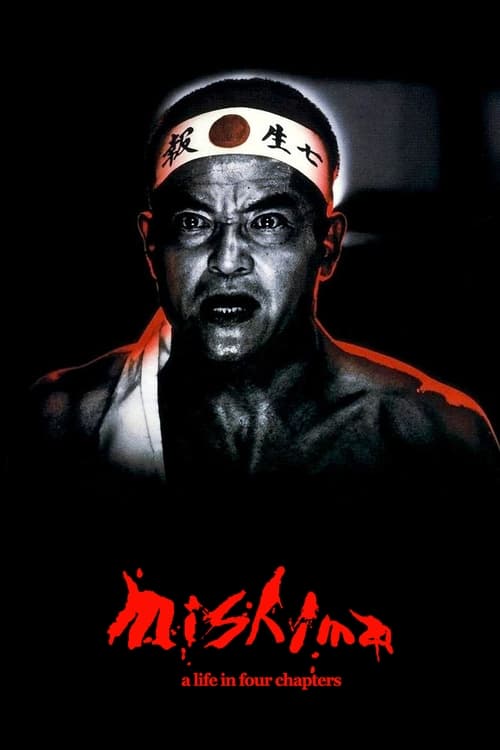
"On November 25, 1970, Japan's most celebrated writer, Yukio Mishima, shocked the world."
Director: Paul Schrader
Cast: Ken Ogata, Kenji Sawada, Bandō Mitsugorō X, Toshiyuki Nagashima, Masayuki Shionoya
Mishima: A Life in Four Chapters — Characters & Cast
Character Analysis
Yukio Mishima
Ken Ogata
Motivation
Mishima's primary motivation is to achieve an impossible harmony between the pen and the sword, to merge the aesthetic world of art with the tangible world of action. He is driven by a profound dissatisfaction with the limitations of words and a desire to make his life itself his greatest work of art. He fears the decay of beauty and the decline of traditional Japanese spirit, motivating him to pursue a 'beautiful death' as a way to preserve his ideals and his physical form at their peak.
Character Arc
The film portrays Mishima's arc not as a traditional rise and fall, but as a deliberate, lifelong journey towards a self-orchestrated martyrdom. He develops from a frail, word-obsessed boy into a celebrated author who feels increasingly alienated from his own body and the modern world. His arc is a quest to resolve his internal contradictions—body vs. spirit, art vs. action—by systematically transforming his own life into a myth. He obsessively builds his body, forms a private army, and finally stages his own death, believing this final act will achieve the perfect synthesis he sought. His development is one of increasing radicalization, culminating in an act of ultimate self-definition.
Mizoguchi
Bandō Mitsugorō X (credited as Yasosuke Bando)
Motivation
Mizoguchi is motivated by a complex mixture of adoration and resentment for the Golden Pavilion. His stutter makes him feel inferior and unable to connect with the world, so he projects his desires and frustrations onto the temple. He believes its perfect, eternal beauty "poisons" and diminishes ordinary life. His motivation is to liberate himself and the world from this oppressive ideal through its destruction.
Character Arc
Mizoguchi is a character from Mishima's novel "The Temple of the Golden Pavilion." A young acolyte with a debilitating stutter, his arc is one of escalating obsession. Initially overwhelmed by the temple's beauty, he comes to see it as a corrupting force that makes real life seem inferior. His journey is a descent into nihilism, leading him to believe that the only way to free himself from the tyranny of perfect beauty is to destroy it. His arc culminates in this act of arson, a radical attempt to assert his own existence over an aesthetic ideal.
Isao
Toshiyuki Nagashima
Motivation
Isao is driven by a radical, romanticized patriotism. He is fiercely loyal to the Emperor and the traditional samurai code. He is motivated by a desire to purge Japan of what he sees as its modern corruption and restore its ancient honor. This ideological purity leads him to believe that a violent, sacrificial death is the most meaningful action he can take.
Character Arc
Isao is the protagonist of the "Runaway Horses" segment. He is a young, fervent nationalist and kendo student who believes Japan has been corrupted by politicians and capitalists. His arc is a swift, violent path toward martyrdom. He forms a group of young cadets to carry out assassinations, but their plot is discovered. Rather than be captured, Isao fulfills his ideological commitment by committing seppuku, believing his death will be a poetic and inspiring act—"a line of poetry written in a splash of blood."
Masakatsu Morita
Masayuki Shionoya
Motivation
Morita's motivation is his absolute loyalty to Mishima and his ideals. He is completely subsumed by Mishima's charisma and philosophy. His desire is to serve his leader's cause to the very end, viewing their shared death as the ultimate expression of their commitment. When Mishima asks his followers to stay alive to represent them in court, Morita is one of those who insists on dying with him.
Character Arc
Morita is one of Mishima's most loyal cadets in the Tatenokai. His arc is one of unwavering devotion that leads to his own demise. He follows Mishima without question into the military headquarters, fully prepared to die alongside his leader. The film shows him as the chosen second (kaishakunin) for Mishima's seppuku. In the film's closing moments, after Mishima's death, Morita attempts his own seppuku, solidifying his role as the ultimate follower who cannot exist without his master. His arc is a tragic reflection of Mishima's powerful influence.
Cast
Explore More About This Movie
Dive deeper into specific aspects of the movie with our detailed analysis pages