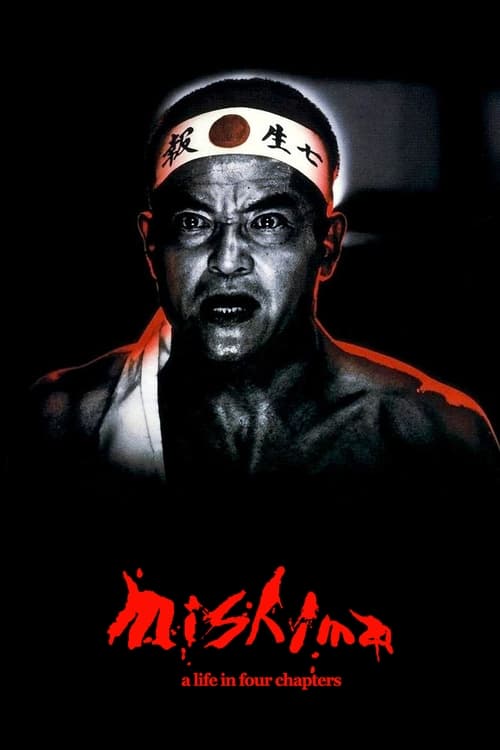
Mishima: A Life in Four Chapters
A visually stunning and deeply philosophical cinematic collage exploring the turbulent life and controversial death of a man who blurred the lines between art, action, and self-destruction.
Mishima: A Life in Four Chapters

Mishima: A Life in Four Chapters

"On November 25, 1970, Japan's most celebrated writer, Yukio Mishima, shocked the world."

20 September 1985 Japan 121 min ⭐ 7.8 (325)
Director: Paul Schrader
Cast: Ken Ogata, Kenji Sawada, Bandō Mitsugorō X, Toshiyuki Nagashima, Masayuki Shionoya
Drama
The Fusion of Art and Life Beauty and Its Impermanence The Contradiction of Pen and Sword Nationalism and Tradition vs. Modernity
Budget: $5,000,000
Box Office: $502,758

Overview

"Mishima: A Life in Four Chapters" is a highly stylized and unconventional biographical film that chronicles the life of acclaimed Japanese author Yukio Mishima (portrayed by Ken Ogata). The film is structured in a non-linear fashion, interweaving three distinct visual and narrative threads. The first follows the events of November 25, 1970, the last day of Mishima's life, as he and his private militia, the Tatenokai, enact a failed coup d'état at a military base, culminating in his ritual suicide by seppuku. This present-day timeline is shot in a naturalistic color palette.

The second thread consists of black-and-white flashbacks to key moments in Mishima's past, from his sickly childhood and formative experiences to his rise as a literary giant and his growing obsession with physical perfection and nationalist ideals. These sequences are often narrated with excerpts from his autobiographical writings. The third element is the dramatization of scenes from three of his novels: "The Temple of the Golden Pavilion," "Kyoko's House," and "Runaway Horses." These segments are presented on surreal, theatrical sets with vibrant and symbolic color schemes, reflecting the inner world and obsessions of Mishima's characters, which in turn mirror his own.

The film is divided into four thematic chapters—"Beauty," "Art," "Action," and "Harmony of Pen and Sword"—that guide the audience through the complex and often contradictory facets of Mishima's personality and philosophy. Through this fragmented structure, director Paul Schrader creates a psychological portrait rather than a straightforward biography, exploring the connections between Mishima's life, his art, and his ultimate, tragic performance of death.
Core Meaning

The core meaning of "Mishima: A Life in Four Chapters" revolves around the search for a synthesis between art and life, the pen and the sword. Director Paul Schrader explores the profound internal conflict of a man who felt that words alone were insufficient and that true beauty could only be realized through action, culminating in a beautiful death. The film posits that Mishima's entire life was a performance, a meticulously crafted work of art with his ritual suicide as its final, shocking act.

It delves into the idea that Mishima saw his own body and existence as a canvas for his philosophical and aesthetic ideals. His obsession with physical perfection, his deep-seated nationalism, and his literary creations were all interconnected expressions of his desire to unite the spiritual and the physical. The film suggests that by turning his life into "a line of poetry written with a splash of blood," Mishima sought to achieve a form of transcendence and create an enduring legacy that his art alone could not. Ultimately, the film is a meditation on the complex, often dangerous, relationship between an artist's imagination and their reality.

Thematic DNA

The Fusion of Art and Life 35%
Beauty and Its Impermanence 25%
The Contradiction of Pen and Sword 25%
Nationalism and Tradition vs. Modernity 15%

The Fusion of Art and Life

The film's central theme is the inextricable link between Yukio Mishima's life and his artistic creations. Schrader structures the narrative to demonstrate how Mishima's personal obsessions, philosophies, and experiences are directly mirrored in his novels. The stylized adaptations of his books are not separate from his biography but are presented as windows into his psyche. For instance, the protagonist's obsession with beauty and destruction in "The Temple of the Golden Pavilion" reflects Mishima's own complicated relationship with beauty's impermanence. The film argues that for Mishima, there was no separation; his life was a performance of his art, and his art was a rehearsal for his life, particularly his dramatic death.

Beauty and Its Impermanence

A profound sense of beauty, and the anxiety of its inevitable decay, permeates the film. Mishima's transformation from a frail boy to a muscular bodybuilder is shown as an attempt to sculpt his own body into a perfect work of art. This theme is explored through the literary segments as well. In "Kyoko's House," the idea is raised that the only way to preserve beauty at its peak is through a timely death. The film presents Mishima's final act of seppuku as a logical, if extreme, conclusion to this philosophy: an attempt to immortalize himself at the height of his physical and artistic prowess before age could diminish him.

The Contradiction of Pen and Sword

The film explores Mishima's lifelong struggle to reconcile the world of words (the pen) with the world of action (the sword). He felt a disconnect between the passive nature of writing and the visceral reality of physical engagement. His formation of the Tatenokai, a private militia, and his obsession with martial discipline were attempts to bridge this gap. The final chapter, "Harmony of Pen and Sword," represents his ultimate effort to merge these two conflicting elements, believing that his final, violent act would give his words and ideals a tangible, undeniable power.

Nationalism and Tradition vs. Modernity

Mishima's fervent nationalism and his disdain for what he saw as the materialism and spiritual emptiness of post-war Japan are a key driving force in the narrative. He longed for a return to the traditional samurai values (Bushido) and the reinstatement of the Emperor as a divine sovereign. The film portrays his attempted coup as a desperate, theatrical plea against the tide of modernity, a last stand for a romanticized vision of Japan's past. His final speech to the soldiers, which is met with ridicule, underscores the tragic disconnect between his ideals and the reality of contemporary Japan.

Character Analysis

Yukio Mishima

Ken Ogata

Archetype: The Antihero / The Martyr
Key Trait: Obsessive

Motivation

Mishima's primary motivation is to achieve an impossible harmony between the pen and the sword, to merge the aesthetic world of art with the tangible world of action. He is driven by a profound dissatisfaction with the limitations of words and a desire to make his life itself his greatest work of art. He fears the decay of beauty and the decline of traditional Japanese spirit, motivating him to pursue a 'beautiful death' as a way to preserve his ideals and his physical form at their peak.

Character Arc

The film portrays Mishima's arc not as a traditional rise and fall, but as a deliberate, lifelong journey towards a self-orchestrated martyrdom. He develops from a frail, word-obsessed boy into a celebrated author who feels increasingly alienated from his own body and the modern world. His arc is a quest to resolve his internal contradictions—body vs. spirit, art vs. action—by systematically transforming his own life into a myth. He obsessively builds his body, forms a private army, and finally stages his own death, believing this final act will achieve the perfect synthesis he sought. His development is one of increasing radicalization, culminating in an act of ultimate self-definition.

Mizoguchi

Bandō Mitsugorō X (credited as Yasosuke Bando)

Archetype: The Obsessed Youth
Key Trait: Nihilistic

Motivation

Mizoguchi is motivated by a complex mixture of adoration and resentment for the Golden Pavilion. His stutter makes him feel inferior and unable to connect with the world, so he projects his desires and frustrations onto the temple. He believes its perfect, eternal beauty "poisons" and diminishes ordinary life. His motivation is to liberate himself and the world from this oppressive ideal through its destruction.

Character Arc

Mizoguchi is a character from Mishima's novel "The Temple of the Golden Pavilion." A young acolyte with a debilitating stutter, his arc is one of escalating obsession. Initially overwhelmed by the temple's beauty, he comes to see it as a corrupting force that makes real life seem inferior. His journey is a descent into nihilism, leading him to believe that the only way to free himself from the tyranny of perfect beauty is to destroy it. His arc culminates in this act of arson, a radical attempt to assert his own existence over an aesthetic ideal.

Isao

Toshiyuki Nagashima

Archetype: The Fanatical Idealist
Key Trait: Zealous

Motivation

Isao is driven by a radical, romanticized patriotism. He is fiercely loyal to the Emperor and the traditional samurai code. He is motivated by a desire to purge Japan of what he sees as its modern corruption and restore its ancient honor. This ideological purity leads him to believe that a violent, sacrificial death is the most meaningful action he can take.

Character Arc

Isao is the protagonist of the "Runaway Horses" segment. He is a young, fervent nationalist and kendo student who believes Japan has been corrupted by politicians and capitalists. His arc is a swift, violent path toward martyrdom. He forms a group of young cadets to carry out assassinations, but their plot is discovered. Rather than be captured, Isao fulfills his ideological commitment by committing seppuku, believing his death will be a poetic and inspiring act—"a line of poetry written in a splash of blood."

Masakatsu Morita

Masayuki Shionoya

Archetype: The Devoted Follower
Key Trait: Loyal

Motivation

Morita's motivation is his absolute loyalty to Mishima and his ideals. He is completely subsumed by Mishima's charisma and philosophy. His desire is to serve his leader's cause to the very end, viewing their shared death as the ultimate expression of their commitment. When Mishima asks his followers to stay alive to represent them in court, Morita is one of those who insists on dying with him.

Character Arc

Morita is one of Mishima's most loyal cadets in the Tatenokai. His arc is one of unwavering devotion that leads to his own demise. He follows Mishima without question into the military headquarters, fully prepared to die alongside his leader. The film shows him as the chosen second (kaishakunin) for Mishima's seppuku. In the film's closing moments, after Mishima's death, Morita attempts his own seppuku, solidifying his role as the ultimate follower who cannot exist without his master. His arc is a tragic reflection of Mishima's powerful influence.

Symbols & Motifs

The Sun

Meaning:

The sun symbolizes purity, Japanese national identity (as on the flag), and the moment of sublime, explosive death. It represents the ultimate aesthetic and spiritual enlightenment that Mishima seeks.

Context:

The sun is a recurring visual motif. In the finale, as the protagonist of "Runaway Horses" commits seppuku, the narrator describes "the bright disk of the sun" soaring behind his eyelids. This imagery is cross-cut with Mishima's own suicide, linking his death to this moment of transcendent, fiery beauty and linking him to the very heart of Japan's identity.

Masks

Meaning:

Masks symbolize the various personas Mishima adopted throughout his life: the writer, the bodybuilder, the husband, the nationalist. They represent the idea that life is a performance and that one must wear a mask to navigate a world one cannot change. It also alludes to his autobiographical novel, "Confessions of a Mask."

Context:

As Mishima puts on his Tatenokai uniform on his final day, there is a rapid montage of him seeing his reflection wearing different masks, including a Noh mask and a kendo mask. The narration explicitly states, "To survive in this atmosphere, man, like an actor, must wear a mask."

The Golden Pavilion

Meaning:

The Temple of the Golden Pavilion symbolizes absolute, unattainable beauty that can be both intoxicating and oppressive. Its destruction represents a radical act of liberation from the tyranny of this perfect beauty, a theme that resonates with Mishima's own self-destructive path.

Context:

In the highly stylized dramatization of his novel, the stuttering acolyte Mizoguchi becomes obsessed with the temple's perfection. He feels that its overwhelming beauty "poisons us" and "blocks out our lives." Ultimately, he burns it to the ground, an act that parallels Mishima's decision to destroy his own beautiful, carefully constructed life.

The Blade (Sword/Dagger)

Meaning:

The blade represents the intersection of pain, beauty, and action. It is both a tool of creation (carving a new reality) and destruction (suicide). It symbolizes the "sword" in his philosophy of the "Harmony of Pen and Sword," representing the tangible, violent action he felt was necessary to complement his art.

Context:

The blade is a constant presence, from the seppuku in "Runaway Horses" to the dagger Mishima uses for his own ritual suicide. The film's climax intercuts the fictional suicides with Mishima's, culminating in the narrator stating, "The instant the blade tore open his flesh, the bright disk of the sun soared up behind his eyelids." This act becomes the final, bloody brushstroke of his life's work.

Memorable Quotes

In my earliest years, I realized life consisted of two contradictory elements. One was words, which could change the world. The other was the world itself, which had nothing to do with words.

— Yukio Mishima (narration)

Context:

This line is part of the voice-over narration that begins early in the film, setting the philosophical stage for the entire narrative. It is spoken over flashbacks to his childhood, explaining the origins of his lifelong internal struggle.

Meaning:

This quote establishes the central conflict of Mishima's life and the film's core theme: the struggle to reconcile thought and action, art and reality. It highlights his feeling of being separated from the physical world by his intellectual and literary nature, a gap he would spend his life trying to bridge.

Beauty is like a rotten tooth. It rubs against your tongue, hurting, insisting on its own importance. Finally you go to a dentist and have it pulled. Then you look at the small bloody tooth in your hand and say, 'Is that all it was?'

— Kashiwagi (in The Temple of the Golden Pavilion segment)

Context:

This line is spoken by the club-footed character Kashiwagi to the protagonist Mizoguchi in the dramatization of "The Temple of the Golden Pavilion." He is trying to disillusion Mizoguchi about his pure and overwhelming obsession with the temple's beauty.

Meaning:

This cynical quote offers a counterpoint to the romantic idealization of beauty. It suggests that beauty can be an obsessive, painful force, and that confronting and destroying it can be a form of liberation, revealing its ultimate insignificance. This reflects the dark side of aesthetic obsession that leads to destruction.

Perfect purity is possible if you turn your life into a line of poetry written with a splash of blood.

— Isao (narration from Runaway Horses)

Context:

This line is narrated during the "Runaway Horses" segment, explaining the ideology of the young, fanatical cadets. The concept is then visually and thematically linked directly to Mishima's own preparation for his seppuku, making it clear that this is his personal philosophy as well.

Meaning:

This quote encapsulates the romantic and violent ideal that drives Mishima's final actions. It is the ultimate expression of the 'Harmony of Pen and Sword,' suggesting that life and death can be transformed into a work of art through a sacrificial, aesthetically charged act of violence. It is the philosophical justification for martyrdom.

Somewhere there must be a higher principle that reconciles art and action. That principle... was death.

— Yukio Mishima (narration)

Context:

This chilling realization is voiced by the narrator in the film's final moments, as Mishima prepares for and commits seppuku. It is the philosophical climax of the film, providing the clearest explanation for his suicide as he flies in a jet, feeling a sense of peace in the lifeless upper atmosphere.

Meaning:

This is the ultimate conclusion of Mishima's lifelong quest. It explicitly states his belief that only through the act of dying could he finally unite the two contradictory halves of his existence: the creator and the man of action. Death becomes the ultimate artistic and philosophical statement, resolving all contradictions.

Philosophical Questions

Can life itself be considered a work of art, and what is the role of death in that creation?

The film relentlessly explores this question by framing Mishima's entire existence as a performance. His bodybuilding, his writings, his political activism, and ultimately his suicide are all presented as deliberate aesthetic choices. The film adapts his novels to show how his characters grapple with similar ideas, such as the belief that the body must be sacrificed at its peak beauty to become true art. By intercutting his meticulously planned seppuku with the dramatic deaths of his fictional characters, the film posits that Mishima saw his death not as an end, but as the final, immortalizing act of his greatest artistic creation: himself.

What is the relationship between beauty and destruction?

The film suggests that for Mishima, beauty and destruction were intrinsically linked. This is most vividly explored in the "Temple of the Golden Pavilion" segment, where the protagonist destroys the object of his aesthetic obsession to free himself from its power. The film implies that Mishima viewed his own life, which he had painstakingly molded into a thing of beauty, in the same way. The act of self-destruction becomes the ultimate aesthetic statement, a way of asserting control over beauty and preventing its natural decay, thus preserving it in a moment of violent glory.

Are words sufficient to change the world, or is action necessary?

This question forms the basis of Mishima's "pen vs. sword" dilemma. As a celebrated author, he possessed immense power through words, yet he felt this was a passive, incomplete existence. The film charts his growing conviction that ideas must be backed by physical deeds to have true meaning. His formation of a private army and his eventual coup attempt are portrayed as the logical conclusion of this belief. However, the film leaves the answer ambiguous; his final action fails to inspire the change he desires, suggesting that the harmony he sought between pen and sword may have been a fatal delusion.

Alternative Interpretations

While the dominant interpretation sees the film as a portrait of a man merging his life with his art, other readings exist. One perspective is that the film is less about the historical Yukio Mishima and more a projection of director Paul Schrader's own artistic and psychological obsessions. Schrader is known for his fascination with tortured, lonely male protagonists who seek transcendence through violence (like Travis Bickle in "Taxi Driver," which he wrote). From this viewpoint, Mishima is another of Schrader's 'men in a room,' a character through whom the director explores his own recurring themes of self-destruction, spiritual crisis, and the mythology of suicidal glory.

Another interpretation focuses on the film's critique of Mishima's ideology. While the film presents his philosophy with aesthetic grandeur, it does not necessarily endorse it. The final scene of his speech to the Japan Self-Defense Forces, where he is met with heckling and indifference, can be read as a powerful anticlimax that undercuts his grand ambitions. This interpretation suggests the film portrays Mishima as a tragic, deeply flawed figure, whose beautiful, elaborate vision of himself and Japan was ultimately out of touch with reality—a performance for an audience that wasn't listening. His suicide, then, is not just a sublime union of art and action, but an admission of failure.

A third reading might view the film through the lens of queer theory, focusing on Mishima's repressed homosexuality as a key driver of his actions. His obsession with the hyper-masculine—bodybuilding, samurai, swords—can be seen as a complex performance of masculinity to overcompensate for or sublimate his desires, which were taboo in his society. The denied use of his novel "Forbidden Colors" is telling. In this light, his final act is not just political or aesthetic, but a deeply personal and tragic resolution to a lifetime of internal conflict over his identity and sexuality.

Cultural Impact

"Mishima: A Life in Four Chapters" was created in a climate where its subject, Yukio Mishima, was still a deeply polarizing and taboo figure in his native Japan. His spectacular suicide in 1970 had shocked the nation, and his right-wing, emperor-worshipping ideology was deeply controversial. The film's production by an American director was met with suspicion in Japan, and fears of retaliation from right-wing groups were a real concern during filming. Consequently, the film has never had a formal theatrical release in Japan, making it a famous piece of 'banned' cinema in its own country of origin.

Critically, the film was hailed as a masterpiece in the West upon its release, particularly for its audacious structure, stunning visual design by Eiko Ishioka, and the powerful score by Philip Glass. It won a special award for artistic contribution at the 1985 Cannes Film Festival. It has had a lasting influence on the biopic genre, demonstrating that a film about a real person could eschew linear, fact-based storytelling in favor of a more poetic, psychological, and visually abstract approach. Its unique triptych structure—blending the final day, flashbacks, and fictional adaptations—has been praised as a groundbreaking way to explore an artist's inner life.

Audiences and critics alike have praised its intellectual depth and visual splendor, though some have found its structure complex and its subject unsympathetic. The film solidified Paul Schrader's reputation as a visionary director, and he himself considers it his finest directorial work. While it never achieved mainstream commercial success, its impact on filmmaking, production design, and film scoring is significant. It remains a cornerstone of 1980s art-house cinema and a benchmark for biographical films that dare to be as complex and contradictory as their subjects.

Audience Reception

Audience reception for "Mishima: A Life in Four Chapters" has generally been one of awe for its artistic ambition and visual splendor, though it is often considered a challenging film. Viewers frequently praise its stunning cinematography, the mesmerizing score by Philip Glass, and the brilliant, highly stylized production design by Eiko Ishioka. Many regard it as a unique and powerful biopic that transcends the genre's typical conventions.

The main points of praise center on the film's intelligent and complex structure, which artfully weaves together the different strands of Mishima's life and work to create a profound psychological portrait. The performance by Ken Ogata in the lead role is also widely acclaimed. However, a common point of criticism from some viewers is that the film can feel cold, overly intellectual, and emotionally distant. Its non-linear, fragmented nature can be confusing for those unfamiliar with Mishima's life and work.

The controversial nature of Mishima himself—his extreme nationalism and the manner of his death—can make him an unsympathetic protagonist for some audiences, who may struggle to connect with his motivations despite the film's aesthetic beauty. The overall verdict among cinephiles and audiences who appreciate art-house cinema is overwhelmingly positive, with many calling it a masterpiece and one of Paul Schrader's greatest achievements.

Interesting Facts

  • The film has famously never been officially released in Japan due to its controversial subject matter. Yukio Mishima remains a scandalous and divisive figure, and right-wing groups who were unhappy with the film's portrayal of him (particularly its homosexual undertones) created pressure that made a release untenable.
  • Director Paul Schrader considers "Mishima" to be the best film he has ever directed.
  • Executive producers Francis Ford Coppola and George Lucas were instrumental in getting the film made. Their involvement helped secure funding and distribution, particularly from Warner Bros.
  • The stunning, highly theatrical sets for the novel dramatizations were designed by Eiko Ishioka, who had never worked on a film before but would go on to be a world-renowned, Oscar-winning designer.
  • The musical score was composed by the legendary Philip Glass. It was the first narrative feature film he scored, and the music is considered one of the most influential and iconic film scores of its era.
  • Mishima's widow, Yoko Mishima, initially granted the rights to his novels but later tried to revoke them. She specifically denied the use of the novel "Forbidden Colors," which dealt more explicitly with homosexuality, leading Schrader to use "Kyoko's House" instead to explore Mishima's narcissism and sexual ambiguity.
  • Paul Schrader did not speak Japanese, creating a significant challenge while directing an almost entirely Japanese cast and crew.
  • The black-and-white flashback sequences were intentionally shot to emulate the style of classic Japanese filmmakers of the 1940s and 50s, such as Yasujirō Ozu, about whom Schrader had written academically.
  • In the original American theatrical release and early VHS versions, the narration was performed by actor Roy Scheider. A later DVD release mistakenly used a different narrator, but subsequent releases restored Scheider's track as an option alongside Ken Ogata's Japanese narration.

⚠️ Spoiler Analysis

Click to reveal detailed analysis with spoilers

Frequently Asked Questions

Explore More About This Movie

Dive deeper into specific aspects of the movie with our detailed analysis pages

Comments (0)

Leave a comment

No comments yet. Be the first to share your thoughts!