
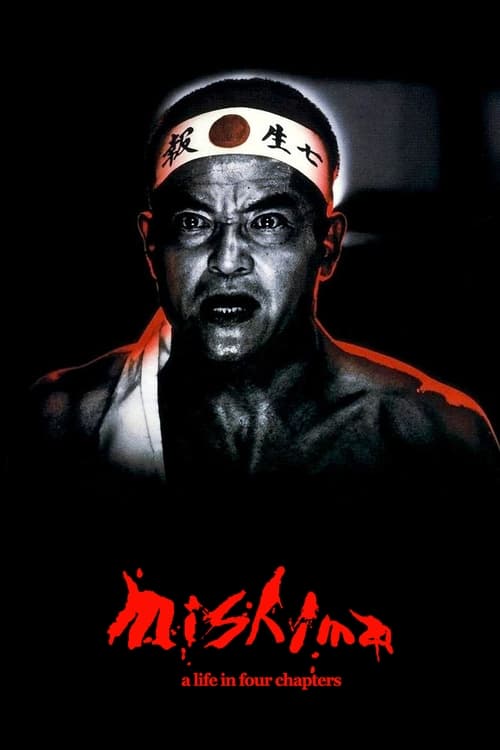
"On November 25, 1970, Japan's most celebrated writer, Yukio Mishima, shocked the world."
Mishima: A Life in Four Chapters - Symbolism & Philosophy
Symbols & Motifs
The Sun
The sun symbolizes purity, Japanese national identity (as on the flag), and the moment of sublime, explosive death. It represents the ultimate aesthetic and spiritual enlightenment that Mishima seeks.
The sun is a recurring visual motif. In the finale, as the protagonist of "Runaway Horses" commits seppuku, the narrator describes "the bright disk of the sun" soaring behind his eyelids. This imagery is cross-cut with Mishima's own suicide, linking his death to this moment of transcendent, fiery beauty and linking him to the very heart of Japan's identity.
Masks
Masks symbolize the various personas Mishima adopted throughout his life: the writer, the bodybuilder, the husband, the nationalist. They represent the idea that life is a performance and that one must wear a mask to navigate a world one cannot change. It also alludes to his autobiographical novel, "Confessions of a Mask."
As Mishima puts on his Tatenokai uniform on his final day, there is a rapid montage of him seeing his reflection wearing different masks, including a Noh mask and a kendo mask. The narration explicitly states, "To survive in this atmosphere, man, like an actor, must wear a mask."
The Golden Pavilion
The Temple of the Golden Pavilion symbolizes absolute, unattainable beauty that can be both intoxicating and oppressive. Its destruction represents a radical act of liberation from the tyranny of this perfect beauty, a theme that resonates with Mishima's own self-destructive path.
In the highly stylized dramatization of his novel, the stuttering acolyte Mizoguchi becomes obsessed with the temple's perfection. He feels that its overwhelming beauty "poisons us" and "blocks out our lives." Ultimately, he burns it to the ground, an act that parallels Mishima's decision to destroy his own beautiful, carefully constructed life.
The Blade (Sword/Dagger)
The blade represents the intersection of pain, beauty, and action. It is both a tool of creation (carving a new reality) and destruction (suicide). It symbolizes the "sword" in his philosophy of the "Harmony of Pen and Sword," representing the tangible, violent action he felt was necessary to complement his art.
The blade is a constant presence, from the seppuku in "Runaway Horses" to the dagger Mishima uses for his own ritual suicide. The film's climax intercuts the fictional suicides with Mishima's, culminating in the narrator stating, "The instant the blade tore open his flesh, the bright disk of the sun soared up behind his eyelids." This act becomes the final, bloody brushstroke of his life's work.
Philosophical Questions
Can life itself be considered a work of art, and what is the role of death in that creation?
The film relentlessly explores this question by framing Mishima's entire existence as a performance. His bodybuilding, his writings, his political activism, and ultimately his suicide are all presented as deliberate aesthetic choices. The film adapts his novels to show how his characters grapple with similar ideas, such as the belief that the body must be sacrificed at its peak beauty to become true art. By intercutting his meticulously planned seppuku with the dramatic deaths of his fictional characters, the film posits that Mishima saw his death not as an end, but as the final, immortalizing act of his greatest artistic creation: himself.
What is the relationship between beauty and destruction?
The film suggests that for Mishima, beauty and destruction were intrinsically linked. This is most vividly explored in the "Temple of the Golden Pavilion" segment, where the protagonist destroys the object of his aesthetic obsession to free himself from its power. The film implies that Mishima viewed his own life, which he had painstakingly molded into a thing of beauty, in the same way. The act of self-destruction becomes the ultimate aesthetic statement, a way of asserting control over beauty and preventing its natural decay, thus preserving it in a moment of violent glory.
Are words sufficient to change the world, or is action necessary?
This question forms the basis of Mishima's "pen vs. sword" dilemma. As a celebrated author, he possessed immense power through words, yet he felt this was a passive, incomplete existence. The film charts his growing conviction that ideas must be backed by physical deeds to have true meaning. His formation of a private army and his eventual coup attempt are portrayed as the logical conclusion of this belief. However, the film leaves the answer ambiguous; his final action fails to inspire the change he desires, suggesting that the harmony he sought between pen and sword may have been a fatal delusion.
Core Meaning
The core meaning of "Mishima: A Life in Four Chapters" revolves around the search for a synthesis between art and life, the pen and the sword. Director Paul Schrader explores the profound internal conflict of a man who felt that words alone were insufficient and that true beauty could only be realized through action, culminating in a beautiful death. The film posits that Mishima's entire life was a performance, a meticulously crafted work of art with his ritual suicide as its final, shocking act.
It delves into the idea that Mishima saw his own body and existence as a canvas for his philosophical and aesthetic ideals. His obsession with physical perfection, his deep-seated nationalism, and his literary creations were all interconnected expressions of his desire to unite the spiritual and the physical. The film suggests that by turning his life into "a line of poetry written with a splash of blood," Mishima sought to achieve a form of transcendence and create an enduring legacy that his art alone could not. Ultimately, the film is a meditation on the complex, often dangerous, relationship between an artist's imagination and their reality.