
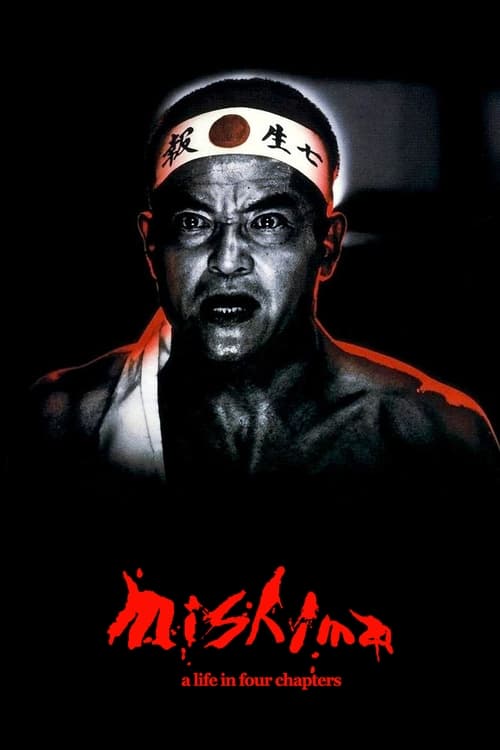
"On November 25, 1970, Japan's most celebrated writer, Yukio Mishima, shocked the world."
Director: Paul Schrader
Cast: Ken Ogata, Kenji Sawada, Bandō Mitsugorō X, Toshiyuki Nagashima, Masayuki Shionoya
Mishima: A Life in Four Chapters — Movie Quotes
Memorable Quotes
In my earliest years, I realized life consisted of two contradictory elements. One was words, which could change the world. The other was the world itself, which had nothing to do with words.
Context
This line is part of the voice-over narration that begins early in the film, setting the philosophical stage for the entire narrative. It is spoken over flashbacks to his childhood, explaining the origins of his lifelong internal struggle.
Meaning
This quote establishes the central conflict of Mishima's life and the film's core theme: the struggle to reconcile thought and action, art and reality. It highlights his feeling of being separated from the physical world by his intellectual and literary nature, a gap he would spend his life trying to bridge.
Beauty is like a rotten tooth. It rubs against your tongue, hurting, insisting on its own importance. Finally you go to a dentist and have it pulled. Then you look at the small bloody tooth in your hand and say, 'Is that all it was?'
Context
This line is spoken by the club-footed character Kashiwagi to the protagonist Mizoguchi in the dramatization of "The Temple of the Golden Pavilion." He is trying to disillusion Mizoguchi about his pure and overwhelming obsession with the temple's beauty.
Meaning
This cynical quote offers a counterpoint to the romantic idealization of beauty. It suggests that beauty can be an obsessive, painful force, and that confronting and destroying it can be a form of liberation, revealing its ultimate insignificance. This reflects the dark side of aesthetic obsession that leads to destruction.
Perfect purity is possible if you turn your life into a line of poetry written with a splash of blood.
Context
This line is narrated during the "Runaway Horses" segment, explaining the ideology of the young, fanatical cadets. The concept is then visually and thematically linked directly to Mishima's own preparation for his seppuku, making it clear that this is his personal philosophy as well.
Meaning
This quote encapsulates the romantic and violent ideal that drives Mishima's final actions. It is the ultimate expression of the 'Harmony of Pen and Sword,' suggesting that life and death can be transformed into a work of art through a sacrificial, aesthetically charged act of violence. It is the philosophical justification for martyrdom.
Somewhere there must be a higher principle that reconciles art and action. That principle... was death.
Context
This chilling realization is voiced by the narrator in the film's final moments, as Mishima prepares for and commits seppuku. It is the philosophical climax of the film, providing the clearest explanation for his suicide as he flies in a jet, feeling a sense of peace in the lifeless upper atmosphere.
Meaning
This is the ultimate conclusion of Mishima's lifelong quest. It explicitly states his belief that only through the act of dying could he finally unite the two contradictory halves of his existence: the creator and the man of action. Death becomes the ultimate artistic and philosophical statement, resolving all contradictions.
Explore More About This Movie
Dive deeper into specific aspects of the movie with our detailed analysis pages