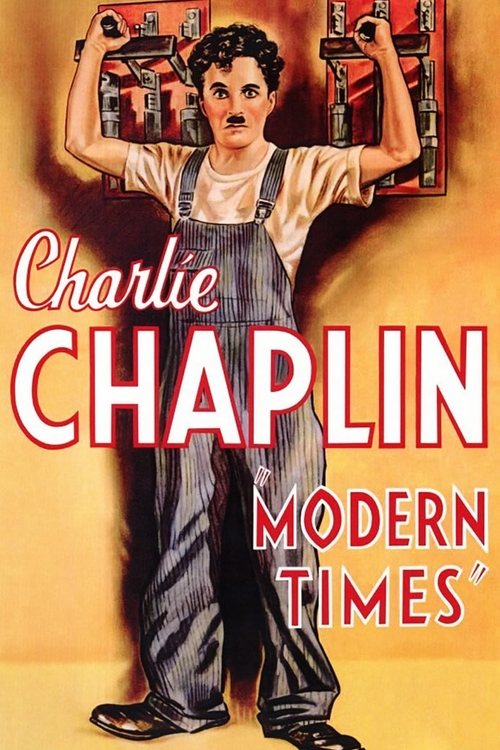
"He stands alone as the greatest entertainer of modern times! No one on earth can make you laugh as heartily or touch your heart as deeply...the whole world laughs, cries and thrills to his priceless genius!"
Modern Times - Ending Explained
⚠️ Spoiler Analysis
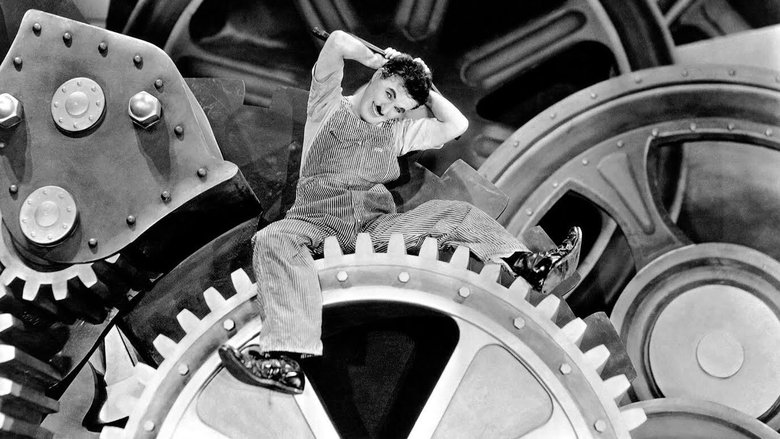
The plot of "Modern Times" follows The Tramp through a series of misfortunes that satirize industrial society. After a frantic nervous breakdown on the assembly line, where he comically tries to tighten bolts on everything in sight, he is sent to a hospital. Upon release, he innocently picks up a red flag that has fallen off a truck, only to find himself at the head of a communist demonstration, leading to his first of several arrests. In jail, he accidentally ingests smuggled cocaine, which leads to a delirious episode where he single-handedly foils a jailbreak, earning him a pardon he doesn't want.
Outside, he meets the Gamin, an orphan fleeing the authorities after stealing bread. They dream of a suburban life together. The Tramp gets a job as a night watchman at a department store but is fired and jailed again after a drunken encounter with burglars who turn out to be his old factory co-workers. Later, he gets a job as a mechanic's assistant, but a strike breaks out, and he is arrested again for accidentally hitting a policeman with a brick.
The climax sees the Gamin get a job as a dancer in a café, and she secures The Tramp a position as a singing waiter. He becomes a sensational hit with an improvised nonsense song after losing his lyrics. Just as they seem to have found stability, juvenile welfare officers arrive to arrest the Gamin. They are forced to flee once more. The hidden meaning that becomes clear is that the system itself is the antagonist; there is no single villain to defeat. Every attempt to join society on its terms—through labor, lawfulness, or art—is ultimately rejected. Their only path to survival is to remain outside of it. The ending, where they walk down the road, is not a resolution but an acceptance of their status as perpetual outsiders, finding solace and strength only in each other.
Alternative Interpretations
While the ending of "Modern Times" is widely seen as optimistic, some interpretations view it with a degree of ambiguity. The hopeful shot of The Tramp and the Gamin walking toward the horizon can be read not as a guarantee of future success, but as the beginning of another cycle of struggle. They are, after all, still homeless, unemployed, and on the run. This reading suggests that their hope is a necessary illusion for survival in a system that will continue to thwart them. Their personal bond is a triumph, but it exists in defiance of a society that has not changed.
Another area of debate concerns the film's political stance. While often read as a critique of capitalism, Chaplin himself was careful to distance the film from overt communist propaganda. The scene where The Tramp accidentally leads a communist protest is played for laughs, which can be interpreted as Chaplin satirizing both the authorities' paranoia and the communists themselves. Some critics argue the film is not a specific political tract but a broader, humanist plea for the individual against any form of oppressive, dehumanizing system, whether capitalist or otherwise.
A darker interpretation suggests that the various institutions The Tramp experiences—the factory, the hospital, the prison—are not distinct entities but different faces of the same monolithic, controlling society. In this view, his "freedom" outside these institutions is just a more chaotic version of confinement, and his desire to return to jail is a rational choice for stability in an irrational world, making the film a bleaker commentary on the illusion of freedom in modern society.