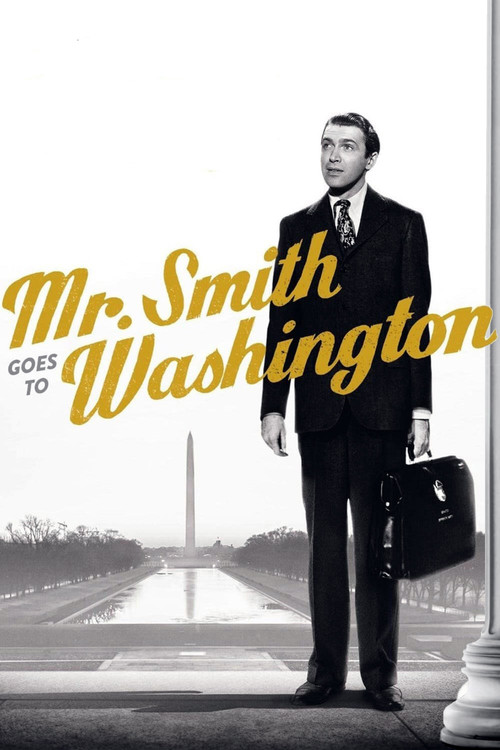
"Romance, drama, laughter and heartbreak... created out of the very heart and soil of America!"
Director: Frank Capra
Cast: James Stewart, Jean Arthur, Claude Rains, Edward Arnold, Guy Kibbee
Mr. Smith Goes to Washington — Characters & Cast
Character Analysis
Jefferson Smith
James Stewart
Motivation
Smith is motivated by a pure and deeply ingrained patriotism and a desire to do good for the nation's youth. His primary goal is to establish a national boys' camp to instill American values. When he discovers the corruption blocking his path, his motivation shifts to exposing the truth and defending his honor, which he sees as synonymous with defending the honor of the country itself.
Character Arc
Jefferson Smith begins as a wide-eyed, naive political appointee, full of reverence for American ideals but utterly ignorant of political realities. His arc is a trial by fire; he is manipulated, publicly humiliated, and framed by the very people he trusts. This ordeal forces him to shed his naivety, but instead of becoming cynical, he transforms into a determined fighter who learns to use the system's own rules to defend his principles. He ends as a tested, resilient champion of the common person.
Clarissa Saunders
Jean Arthur
Motivation
Initially, Saunders is motivated by professional survival and a weary desire to get the job done. Her motivation changes as she witnesses Smith's sincerity and the depth of the corruption he faces. She becomes driven by a newfound belief in his cause and a growing affection for him, ultimately risking her career to help him fight the Taylor machine.
Character Arc
Saunders starts as a jaded, sharp-witted Washington insider who sees Smith as a hopeless "rube." Initially, she is complicit in the political games. However, Smith's genuine idealism gradually breaks through her cynical exterior. She undergoes the most significant transformation in the film, evolving from a disillusioned opportunist to Smith's most crucial ally and a reawakened believer in the "lost causes" he champions. Her arc represents the redemption of a lost faith in democracy.
Senator Joseph Paine
Claude Rains
Motivation
Paine is motivated by a desire to hold onto his power and reputation, which has become dependent on his alliance with Jim Taylor. He rationalizes his compromises by believing he is still serving his state in other ways. His deep-seated, though buried, sense of honor and his past friendship with Smith's father create an internal conflict that ultimately drives him to confess.
Character Arc
Senator Paine is presented as a distinguished and respected statesman who was once an idealistic crusader and a close friend of Smith's late father. His arc is one of moral decay and, ultimately, redemption. Having made compromises with Jim Taylor's corrupt machine to maintain his power, he is forced to betray Smith. Wracked with guilt during Smith's filibuster, he ultimately confesses everything in a dramatic breakdown, choosing to destroy his career rather than his conscience.
Jim Taylor
Edward Arnold
Motivation
Taylor's motivation is simple: greed and the preservation of his power. He orchestrates the dam project as a graft scheme to enrich himself and his cronies. When Smith threatens this scheme, Taylor's sole motivation becomes to crush him by any means necessary, including slander, intimidation, and violence, to protect his political and financial empire.
Character Arc
Jim Taylor is the film's primary antagonist and does not have a developmental arc. He is a static character who represents the absolute corruption of power and wealth. He is ruthless, manipulative, and powerful, controlling the state's governor, its senior senator, and its press. He remains an unrepentant villain throughout the film, embodying the forces that Smith must overcome.
Cast
Explore More About This Movie
Dive deeper into specific aspects of the movie with our detailed analysis pages