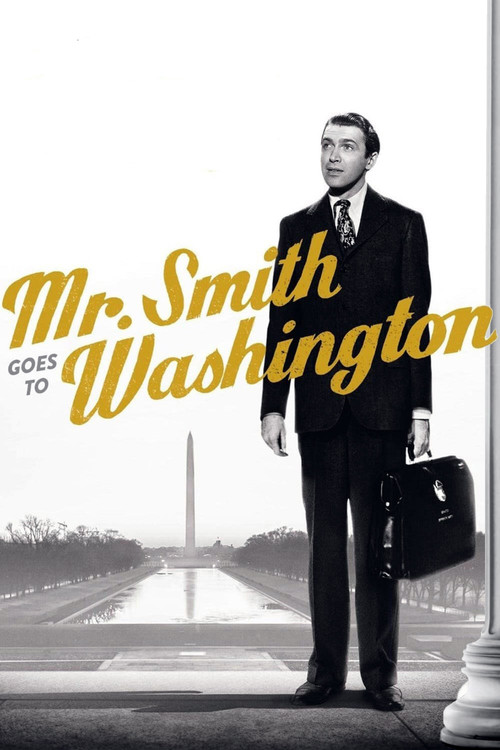
Mr. Smith Goes to Washington
A stirring political drama where earnest idealism collides with entrenched corruption, painting a visually stark portrait of one man's fight for America's soul.
Mr. Smith Goes to Washington

Mr. Smith Goes to Washington

"Romance, drama, laughter and heartbreak... created out of the very heart and soil of America!"

19 October 1939 United States of America 129 min ⭐ 7.8 (1,131)
Director: Frank Capra
Cast: James Stewart, Jean Arthur, Claude Rains, Edward Arnold, Guy Kibbee
Drama Comedy
Idealism vs. Cynicism The Individual Against the System Patriotism and American Ideals The Corruption of Power
Budget: $1,500,000
Box Office: $9,600,000

Overview

"Mr. Smith Goes to Washington" tells the story of Jefferson Smith, a naive and idealistic young man who is unexpectedly appointed to the United States Senate. As the head of the Boy Rangers, he is chosen by his state's corrupt political machine, led by boss Jim Taylor and senior Senator Joseph Paine, precisely because they believe his innocence will make him easy to manipulate.

Upon arriving in Washington D.C., Smith is initially in awe of the monuments and the ideals they represent, particularly the Lincoln Memorial and the Capitol Dome. However, his simple plan to introduce a bill for a national boys' camp clashes with a hidden graft scheme embedded in an appropriations bill, orchestrated by Taylor and Paine, involving the very same piece of land.

When Smith discovers the corruption and refuses to back down, the powerful political machine turns against him, framing him for graft and attempting to expel him from the Senate. Aided by his cynical but ultimately good-hearted secretary, Clarissa Saunders, Smith must decide whether to flee in disgrace or make a final, desperate stand for his beliefs and the principles of American democracy on the floor of the Senate itself.
Core Meaning

The core meaning of "Mr. Smith Goes to Washington" is a powerful assertion that the foundational ideals of a democracy—liberty, integrity, and the power of a single, virtuous individual—can and must triumph over systemic corruption and cynicism. Director Frank Capra aimed to create a film that celebrated American democracy and freedom, particularly in the face of rising fascism in Europe at the time of its release.

The film argues that patriotism is not blind obedience, but an active fight for the country's soul. It suggests that the principles laid down by figures like Lincoln are not just historical artifacts but living truths that must be constantly defended. Smith's journey is a message that even when political systems become poisoned by greed and power, one person's unwavering commitment to what is right can expose the darkness and inspire a return to virtue. Capra makes the battle not one between political parties, which are never mentioned, but a timeless struggle between honesty and corruption.

Thematic DNA

Idealism vs. Cynicism 35%
The Individual Against the System 30%
Patriotism and American Ideals 25%
The Corruption of Power 10%

Idealism vs. Cynicism

The central conflict of the film is the clash between Jefferson Smith's unwavering idealism and the deep-seated cynicism of Washington D.C. Smith arrives with a pure, almost boyish belief in the American system, while characters like his secretary Clarissa Saunders and the press corps have become jaded by the realities of political corruption. Senator Paine embodies the tragic outcome of compromised ideals, having once been an idealist himself before succumbing to the pressures of the political machine. The film explores whether pure idealism can survive in a world of pragmatic corruption, ultimately suggesting that it is not only a virtue but a necessary force for change.

The Individual Against the System

A quintessential "Capraesque" theme, the film champions the power of the common man against a powerful, corrupt system. Jefferson Smith, a seemingly insignificant and naive appointee, finds himself battling the entire political machine of his state, led by the wealthy industrialist Jim Taylor. When the system uses its immense power—controlling the press and manipulating the legislative process—to crush him, Smith's only remaining weapon is his own voice and integrity, symbolized by his dramatic filibuster. The film posits that one person, armed with truth and conviction, can challenge and even defeat entrenched institutional power.

Patriotism and American Ideals

The film is a profound exploration of what true patriotism means. For Smith, it is a deep, emotional connection to the nation's founding principles, symbolized by his awe at the Lincoln Memorial and the Capitol Dome. He believes that liberty is a precious thing that must be actively cherished every day. The film contrasts this genuine, principle-based patriotism with the hollow, flag-waving rhetoric of the corrupt politicians who use patriotic symbols to mask their self-serving schemes. It argues that fighting for the country's integrity is the highest form of patriotism.

The Corruption of Power

"Mr. Smith Goes to Washington" presents a stark portrayal of how power and money can corrupt individuals and institutions. The political boss Jim Taylor wields immense influence, controlling politicians and the media to serve his own financial interests. The character of Senator Paine serves as a tragic example, a once-honorable man who has compromised his integrity over the years to maintain his position. The film serves as a cautionary tale about the ever-present threat of graft and the moral compromises required to navigate a system dominated by powerful special interests.

Character Analysis

Jefferson Smith

James Stewart

Archetype: The Idealist Hero
Key Trait: Unwavering Integrity

Motivation

Smith is motivated by a pure and deeply ingrained patriotism and a desire to do good for the nation's youth. His primary goal is to establish a national boys' camp to instill American values. When he discovers the corruption blocking his path, his motivation shifts to exposing the truth and defending his honor, which he sees as synonymous with defending the honor of the country itself.

Character Arc

Jefferson Smith begins as a wide-eyed, naive political appointee, full of reverence for American ideals but utterly ignorant of political realities. His arc is a trial by fire; he is manipulated, publicly humiliated, and framed by the very people he trusts. This ordeal forces him to shed his naivety, but instead of becoming cynical, he transforms into a determined fighter who learns to use the system's own rules to defend his principles. He ends as a tested, resilient champion of the common person.

Clarissa Saunders

Jean Arthur

Archetype: The Cynic with a Heart of Gold
Key Trait: Pragmatic Intelligence

Motivation

Initially, Saunders is motivated by professional survival and a weary desire to get the job done. Her motivation changes as she witnesses Smith's sincerity and the depth of the corruption he faces. She becomes driven by a newfound belief in his cause and a growing affection for him, ultimately risking her career to help him fight the Taylor machine.

Character Arc

Saunders starts as a jaded, sharp-witted Washington insider who sees Smith as a hopeless "rube." Initially, she is complicit in the political games. However, Smith's genuine idealism gradually breaks through her cynical exterior. She undergoes the most significant transformation in the film, evolving from a disillusioned opportunist to Smith's most crucial ally and a reawakened believer in the "lost causes" he champions. Her arc represents the redemption of a lost faith in democracy.

Senator Joseph Paine

Claude Rains

Archetype: The Fallen Mentor
Key Trait: Compromised Morality

Motivation

Paine is motivated by a desire to hold onto his power and reputation, which has become dependent on his alliance with Jim Taylor. He rationalizes his compromises by believing he is still serving his state in other ways. His deep-seated, though buried, sense of honor and his past friendship with Smith's father create an internal conflict that ultimately drives him to confess.

Character Arc

Senator Paine is presented as a distinguished and respected statesman who was once an idealistic crusader and a close friend of Smith's late father. His arc is one of moral decay and, ultimately, redemption. Having made compromises with Jim Taylor's corrupt machine to maintain his power, he is forced to betray Smith. Wracked with guilt during Smith's filibuster, he ultimately confesses everything in a dramatic breakdown, choosing to destroy his career rather than his conscience.

Jim Taylor

Edward Arnold

Archetype: The Corrupt Tyrant
Key Trait: Ruthless

Motivation

Taylor's motivation is simple: greed and the preservation of his power. He orchestrates the dam project as a graft scheme to enrich himself and his cronies. When Smith threatens this scheme, Taylor's sole motivation becomes to crush him by any means necessary, including slander, intimidation, and violence, to protect his political and financial empire.

Character Arc

Jim Taylor is the film's primary antagonist and does not have a developmental arc. He is a static character who represents the absolute corruption of power and wealth. He is ruthless, manipulative, and powerful, controlling the state's governor, its senior senator, and its press. He remains an unrepentant villain throughout the film, embodying the forces that Smith must overcome.

Symbols & Motifs

The Lincoln Memorial

Meaning:

The Lincoln Memorial symbolizes the core principles of American democracy: integrity, equality, and the enduring spirit of the nation. It represents the "lost causes" and high ideals that Smith believes are worth fighting for.

Context:

Smith visits the memorial upon his arrival in Washington, seeking inspiration. He returns to it at his lowest point, feeling defeated by the corruption he has witnessed. It is there, in the presence of Lincoln's image and words, that Clarissa Saunders convinces him to keep fighting, reigniting his faith in the American dream.

The Capitol Dome

Meaning:

The Capitol Dome symbolizes the promise and majesty of American government and the ideal of liberty. It is a beacon of hope and a physical representation of the democratic process that Smith reveres.

Context:

When Smith first arrives in Washington, he is so captivated by the sight of the illuminated dome that he wanders off from his welcoming party. It represents his initial, unblemished faith in the institution he is about to join. He later tells Saunders he wants to make the ideals it represents, lit up for all to see, real for every boy in the country.

The Boy Rangers Camp Bill

Meaning:

The proposed boys' camp symbolizes Smith's purity, his connection to nature, and his idealistic vision for America's future. It represents a wholesome, grassroots effort to foster citizenship and unity among young boys from all backgrounds, directly contrasting with the greedy, self-serving dam project.

Context:

The bill is the central piece of legislation that Smith introduces. His fight for this seemingly simple project is what brings him into direct conflict with the corrupt Taylor machine, which wants the same land for its graft-ridden dam scheme.

The Filibuster

Meaning:

The filibuster is a powerful symbol of an individual's right to speak truth to power and the democratic principle of free speech in its most dramatic form. It represents Smith's last stand, using the very rules of the institution he is fighting against to expose its corruption.

Context:

In the film's climax, Smith holds the Senate floor for nearly 24 hours, refusing to yield until his voice is heard and the truth is revealed. It is a grueling physical and emotional ordeal that serves as the ultimate test of his endurance and conviction.

Memorable Quotes

I wouldn't give you two cents for all your fancy rules if, behind them, they didn't have a little bit of plain, ordinary, everyday kindness and a little looking out for the other fella, too.

— Jefferson Smith

Context:

Smith says this to Clarissa Saunders in his office as he struggles to understand the complexities of Senate procedure. He is expressing his frustration with the system but also articulating his fundamental belief in what should be the true foundation of government.

Meaning:

This quote encapsulates Smith's core philosophy. He argues that the spirit and humanity behind laws are more important than the technical procedures. It's a powerful statement of Capra's populist ideals, valuing basic human decency over cold, unfeeling bureaucracy.

Lost causes are the only ones worth fighting for.

— Jefferson Smith (quoting his father and Senator Paine)

Context:

This is a sentiment Smith attributes to both his father and a younger, more idealistic Senator Paine. He brings it up during his filibuster as a direct, powerful appeal to Paine's long-buried conscience, reminding him of the man he used to be.

Meaning:

This line serves as the film's moral thesis. It suggests that the most important battles are those fought for principles and ideals, even when victory seems impossible. It speaks to the idea that the struggle for what is right has inherent value, regardless of the outcome.

Liberty is too precious a thing to be buried in books... Men should hold it up in front of them every single day of their lives and say: I'm free to think and to speak. My ancestors couldn't, I can, and my children will.

— Jefferson Smith

Context:

Smith says this to a cynical Clarissa Saunders as he explains his vision for the boys' camp. He wants to create a place that will teach young people to truly understand and appreciate the liberties they have, making his bill about more than just a piece of land; it's about the future of American ideals.

Meaning:

This quote is a passionate definition of active, living patriotism. Smith argues that freedom isn't an abstract concept found in history texts but a tangible, daily responsibility that must be consciously practiced and defended for future generations.

I'm not fit to be a senator! I'm not fit to live! Expel me, not him! Willet Dam is a fraud!

— Senator Joseph Paine

Context:

After attempting suicide in a cloakroom, Senator Paine bursts onto the Senate floor during the chaotic final moments of Smith's filibuster. Overwhelmed by guilt, he shouts this confession to the entire chamber, bringing the film to its dramatic conclusion.

Meaning:

This is the climax of Paine's character arc, a moment of complete moral and emotional collapse leading to redemption. It is the cathartic confession that vindicates Smith and exposes the entire corrupt enterprise, proving that a man's conscience can be a powerful force.

Philosophical Questions

Can an individual's unwavering moral integrity overcome systemic corruption?

The film's central premise is that one good man can, through sheer force of will and principle, defeat a deeply entrenched corrupt system. Jefferson Smith's entire journey is an exploration of this question. The film ultimately answers with a resounding 'yes,' culminating in Senator Paine's guilt-ridden confession. However, it also shows the immense personal cost of such a fight, as Smith is nearly destroyed physically and emotionally, suggesting that while victory is possible, it is a monumental and perhaps rare achievement.

What is the true nature of patriotism?

The film presents two competing versions of patriotism. The first is the hollow, performative patriotism of Senator Paine and the Taylor machine, who use the language of American values to mask their greed. The second is Smith's active, heartfelt patriotism, which involves questioning authority and fighting against the betrayal of the nation's core ideals. The film argues that true patriotism requires civic engagement and the courage to hold power accountable, rather than blind faith in institutions or officials.

Is it possible to retain one's idealism in a cynical world?

This question is explored through the arcs of Jefferson Smith, Clarissa Saunders, and Senator Paine. Smith is the test case, managing to hold onto his ideals despite being subjected to the worst of the cynical world. Saunders represents the possibility of rediscovering lost idealism, as Smith's sincerity rekindles her own. Paine represents the tragedy of abandoning idealism for pragmatism and power, showing the corrosive effect of such compromises on the soul. The film suggests that retaining idealism is a constant struggle, but one that is essential for moral and societal health.

Alternative Interpretations

While widely seen as a celebration of American democracy, some critics offer alternative readings. One interpretation is that the film actually questions the efficacy of representative democracy by showing the entire Senate as either corrupt, indifferent, or powerless until one man stages an extraordinary, near-fatal protest. The happy ending, with Senator Paine's sudden confession, is seen by some as a contrived or "fatuous" 'Capra-corn' finale that sidesteps the grim reality that such systemic corruption would not likely be defeated so easily.

Another perspective examines Frank Capra's own conservative political leanings. While the film's message of the 'little guy' fighting entrenched power appeals across the political spectrum, it can be interpreted as a critique of 'big government' and its susceptibility to corruption, favoring a populist belief in individual morality over systemic regulation. The film's deliberate vagueness—never mentioning political parties or Smith's home state—can be seen as a masterful way to allow any viewer to project their own ideals onto Smith, but also as an evasion of specific political realities and solutions.

Cultural Impact

"Mr. Smith Goes to Washington" was released in 1939, on the eve of World War II, a time of immense global tension. Its powerful defense of democracy resonated deeply with audiences anxious about the rise of totalitarianism in Europe. Despite being controversial among the political establishment for its depiction of government corruption, the film was a box office success and was widely praised by the public for embodying American ideals. It transformed James Stewart into a major star, cementing his persona as the virtuous American everyman.

The film has had an enduring influence on both cinema and politics. Its narrative of an idealistic outsider battling a corrupt system has become a classic cinematic trope. Politically, the movie single-handedly shaped the public's popular image of the filibuster, framing it as a heroic tool for the principled underdog, a perception that continues to influence political discourse to this day. The film's timeless themes of integrity, the power of the individual, and the fight for 'lost causes' have made it a touchstone of American political culture, frequently referenced by politicians and inspiring many to enter public service.

Audience Reception

Audiences at the time of its release and in the decades since have overwhelmingly embraced "Mr. Smith Goes to Washington." It was a significant commercial success, grossing over $9 million on a $1.5 million budget. Viewers praised James Stewart's performance, which is often cited as one of his best and most iconic roles. The film's patriotic and inspiring message resonated strongly, particularly its championing of the common person and the belief that one individual can make a difference.

Points of praise frequently focus on the compelling story, the great characters, and the film's emotional depth and humor. Many viewers find it timelessly relevant, seeing parallels between the film's depiction of political corruption and contemporary issues. Criticism from audiences is less common but sometimes points to the perceived naivete of Smith's character as being somewhat unbelievable, or the ending as being overly sentimental and abrupt. However, the overall verdict is that it is a classic and beloved film that powerfully affirms democratic values.

Interesting Facts

  • The film was intended to be a sequel to Frank Capra's 1936 film "Mr. Deeds Goes to Town," originally titled "Mr. Deeds Goes to Washington" and starring Gary Cooper. When Cooper was unavailable, the project was rewritten for James Stewart.
  • To make his voice sound genuinely hoarse and strained during the 23-hour filibuster scene, James Stewart's throat was swabbed with a mercury chloride solution to irritate his vocal cords.
  • The entire Senate chamber was meticulously recreated on a soundstage at Columbia Studios, as filming in the actual chamber was not permitted.
  • The film was highly controversial upon its release. Many real-life politicians and journalists in Washington D.C. were angered by its depiction of corruption, calling it anti-American. Joseph P. Kennedy, then U.S. ambassador to the U.K., even tried to prevent its release overseas.
  • The film was banned in Nazi Germany, Fascist Italy, and the Soviet Union because of its pro-democracy message. In German-occupied France, it was chosen by some theaters as the last American film to be shown before a ban on them went into effect.
  • The original ending of the film was much longer and included a victory parade for Smith back in his hometown. It was cut after test audiences found it anticlimactic.
  • The Boy Scouts of America refused to allow their name to be used in the film, so Capra created the fictional 'Boy Rangers' instead.
  • Director Frank Capra had a personal say in the script, including adding Senator Paine's suicide attempt, an element that screenwriter Sidney Buchman reportedly disliked.

⚠️ Spoiler Analysis

Click to reveal detailed analysis with spoilers

Frequently Asked Questions

Explore More About This Movie

Dive deeper into specific aspects of the movie with our detailed analysis pages

Comments (0)

Leave a comment

No comments yet. Be the first to share your thoughts!