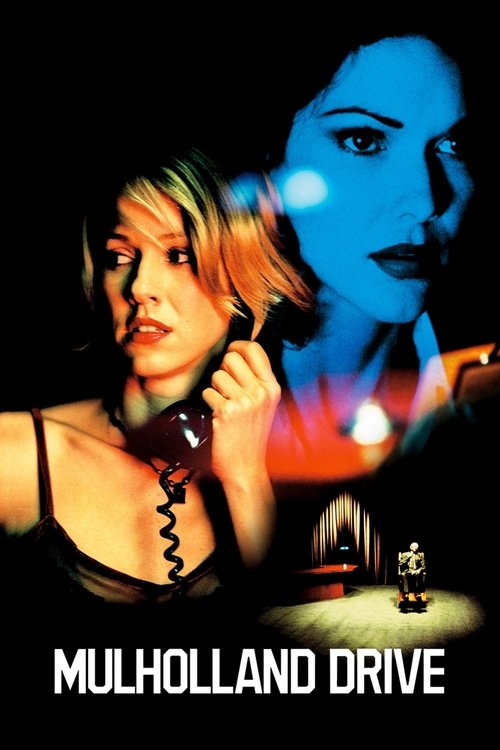
"A love story in the city of dreams."
Mulholland Drive - Symbolism & Philosophy
Symbols & Motifs
The Blue Key and Box
Symbolizes the transition between states of consciousness and the uncovering of a suppressed truth. In the reality of the film, the key is the hitman’s signal that the murder is complete; in the dream, it is the object that 'unlocks' the nightmare.
The key appears in Rita's purse in the dream and is later seen on Diane's coffee table in the reality sequence.
Club Silencio
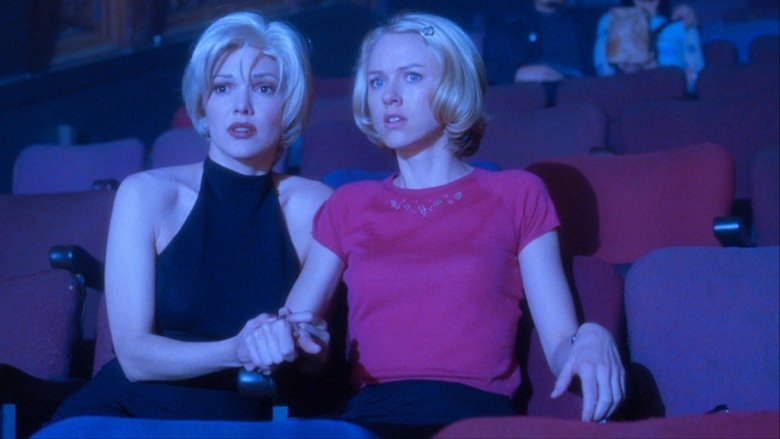
Represents the fundamental artifice of performance and reality. The mantra 'No hay banda' (There is no band) serves as a warning that everything the characters (and the audience) have experienced is a recorded illusion.
Betty and Rita visit the club late at night, where they witness a singer collapse while her voice continues to play.
The Man Behind Winkie's
A manifestation of primal fear and repressed guilt. He represents the 'monster' created by Diane's decision to have Camilla murdered, lurking just beneath the surface of the mundane.
First appearing in a character's dream description at the diner, the figure is later seen holding the blue box.
The Cowboy
Acts as a metaphysical authority figure or a 'reality check.' He serves as the harbinger of awakening, telling the dreamer when it is time to face the truth.
He meets Adam Kesher at a corral and later appears in the doorway of Diane’s bedroom to tell her to wake up.
Philosophical Questions
To what extent is the 'self' merely a performance?
The film shows Betty/Diane literally 'auditioning' for her life and adopting personas. It questions if there is a 'true' self beneath the roles we play for others and ourselves.
Can an illusion be more 'real' than reality?
Lynch explores the power of the dream state. While the dream is 'fake,' the emotions Betty feels—love, hope, fear—are genuine, suggesting that our subjective experience defines our reality regardless of objective truth.
Core Meaning
The core of Mulholland Drive is an exploration of the brutal psychological cost of the 'Hollywood Dream.' David Lynch uses the film to deconstruct the artifice of cinema and the way the industry consumes and discards those who aspire to its heights. At its heart, it is a tragedy about Diane Selwyn, a woman whose professional failure and romantic rejection lead her to retreat into a complex, wish-fulfilling fantasy. The film suggests that the stories we tell ourselves to survive guilt and despair are ultimately as fragile and artificial as a stage performance.