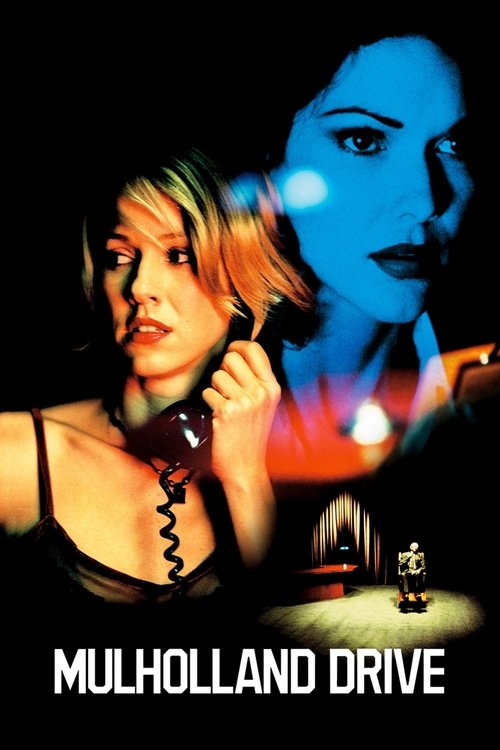
Mulholland Drive
"A love story in the city of dreams."
Overview
Mulholland Drive follows the intertwining lives of several characters in Los Angeles. The narrative begins when a dark-haired woman barely survives a car crash on the titular road, wandering into the city with amnesia. She finds shelter in a luxury apartment belonging to the aunt of Betty Elms, a bright-eyed aspiring actress recently arrived from Deep River, Ontario. Together, the two women embark on a detective-like quest to uncover the amnesiac's identity, adopting the name 'Rita' from a Gilda movie poster found in the apartment.
Parallel to their investigation, a young film director named Adam Kesher finds his latest project hijacked by shadowy, powerful figures who insist he cast a specific actress, 'Camilla Rhodes.' As Betty and Rita’s bond deepens into a romantic connection, their search leads them toward a mysterious blue box and a cryptic nightclub called Club Silencio. The film’s structure famously shifts in its final act, challenging the viewer to distinguish between aspiration and reality, memory and fantasy.
Core Meaning
The core of Mulholland Drive is an exploration of the brutal psychological cost of the 'Hollywood Dream.' David Lynch uses the film to deconstruct the artifice of cinema and the way the industry consumes and discards those who aspire to its heights. At its heart, it is a tragedy about Diane Selwyn, a woman whose professional failure and romantic rejection lead her to retreat into a complex, wish-fulfilling fantasy. The film suggests that the stories we tell ourselves to survive guilt and despair are ultimately as fragile and artificial as a stage performance.
Thematic DNA
The Duality of Identity
The film explores identity as a fluid and often fractured construct. Characters inhabit multiple personas—Betty/Diane and Rita/Camilla—reflecting the split between an idealized self and a degraded reality. This theme is visually reinforced through mirrors and the literal doubling of actors.
Dreams vs. Reality
Lynch blurs the lines between a dream state and waking life. The first two hours are widely interpreted as a wish-fulfilling dream that refashions a tragic reality into a hopeful mystery, only for the 'blue box' to shatter the illusion and return the protagonist to her bleak surroundings.
Hollywood as a Nightmare
The film acts as a scathing critique of the film industry. It portrays Hollywood not as a place of creativity, but as a system of control, exploitation, and 'conspiracy' where artistic integrity is secondary to the whims of unseen power brokers.
Guilt and Repression
The surreal elements of the film—such as the monstrous figure behind the diner—represent the protagonist's repressed guilt over a heinous act. The narrative is a psychological journey of a mind trying to outrun its own conscience.
Character Analysis
Betty Elms / Diane Selwyn
Naomi Watts
Motivation
In the dream, she wants to help Rita and succeed as an actress. In reality, she is driven by a desperate, obsessive love for Camilla and a crushing sense of professional failure.
Character Arc
Starts as the 'Ingénue' Betty, a hopeful and talented actress in a dream world. The arc shatters into the 'Failed Actress' Diane, who is consumed by jealousy, drug use, and suicidal ideation after losing her career and lover.
Rita / Camilla Rhodes
Laura Harring
Motivation
In reality, Camilla is motivated by fame and power, using her sexuality to climb the Hollywood social ladder while discarding Diane.
Character Arc
Transforms from the vulnerable, amnesiac 'Rita' who is dependent on Betty, into the successful, aloof, and manipulative 'Camilla' who has moved on from Diane to marry a director.
Adam Kesher
Justin Theroux
Motivation
Initially seeks creative control and domestic stability, but shifts to survival and compliance as he realizes the magnitude of the forces against him.
Character Arc
A director who loses control of his film and his personal life (finding his wife cheating). He is eventually forced to surrender his artistic integrity to mysterious forces.
Symbols & Motifs
The Blue Key and Box
Symbolizes the transition between states of consciousness and the uncovering of a suppressed truth. In the reality of the film, the key is the hitman’s signal that the murder is complete; in the dream, it is the object that 'unlocks' the nightmare.
The key appears in Rita's purse in the dream and is later seen on Diane's coffee table in the reality sequence.
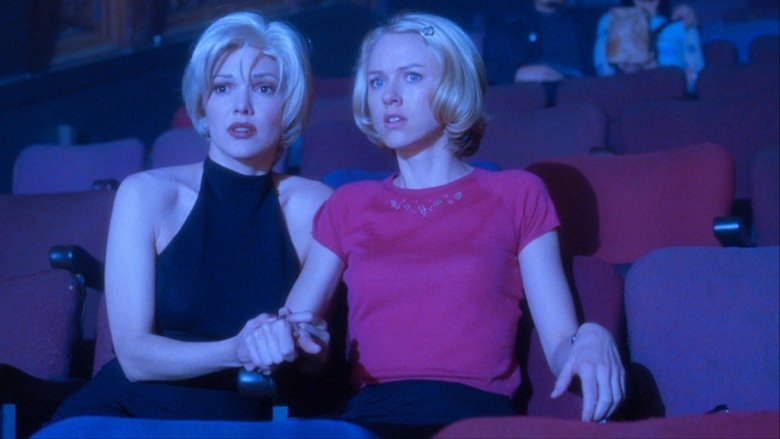
Club Silencio
Represents the fundamental artifice of performance and reality. The mantra 'No hay banda' (There is no band) serves as a warning that everything the characters (and the audience) have experienced is a recorded illusion.
Betty and Rita visit the club late at night, where they witness a singer collapse while her voice continues to play.
The Man Behind Winkie's
A manifestation of primal fear and repressed guilt. He represents the 'monster' created by Diane's decision to have Camilla murdered, lurking just beneath the surface of the mundane.
First appearing in a character's dream description at the diner, the figure is later seen holding the blue box.
The Cowboy
Acts as a metaphysical authority figure or a 'reality check.' He serves as the harbinger of awakening, telling the dreamer when it is time to face the truth.
He meets Adam Kesher at a corral and later appears in the doorway of Diane’s bedroom to tell her to wake up.
Memorable Quotes
Silencio.
— The Blue-Haired Woman
Context:
Whispered in the balcony of Club Silencio after the credits roll.
Meaning:
The final word of the film, signaling the end of the dream, the end of Diane's life, and the return to the void of the theater.
No hay banda! There is no band... it is all an illusion.
— The Emcee at Club Silencio
Context:
The opening speech of the performance at the mysterious nightclub.
Meaning:
A direct address to the audience and the characters that the reality they are witnessing is manufactured and fake.
This is the girl.
— The Castigliane Brothers / Adam Kesher
Context:
Used by the mobsters to force Adam to cast a specific actress, and later echoed by Adam during the audition.
Meaning:
A phrase denoting the loss of agency and the cold, transactional nature of the industry where people are mere commodities.
A man's attitude goes some ways to the way his life will be.
— The Cowboy
Context:
During the meeting with Adam Kesher under the moonlight.
Meaning:
A cryptic warning about the moral consequences of one's choices and the inevitability of facing the 'reality' one has created.
Philosophical Questions
To what extent is the 'self' merely a performance?
The film shows Betty/Diane literally 'auditioning' for her life and adopting personas. It questions if there is a 'true' self beneath the roles we play for others and ourselves.
Can an illusion be more 'real' than reality?
Lynch explores the power of the dream state. While the dream is 'fake,' the emotions Betty feels—love, hope, fear—are genuine, suggesting that our subjective experience defines our reality regardless of objective truth.
Alternative Interpretations
The most widely accepted interpretation is the Dream Theory: the first 110 minutes are Diane's guilt-ridden dream where she is a talented star (Betty) and Camilla is a helpless victim (Rita) who loves her. However, other valid readings exist:
- Parallel Realities: Some suggest the film depicts two diverging timelines or parallel universes that briefly intersect.
- Post-Mortem State: Another theory posits the film is a 'death dream' occurring in the split second as Diane commits suicide, a final reorganization of her life's failures.
- Cinephilic Critique: A more abstract reading suggests the film isn't about a person, but about the 'soul of cinema' itself, moving from the Golden Age (Betty's look) to the cynical, grimy modern era.
Cultural Impact
Mulholland Drive is widely regarded as one of the greatest films of the 21st century, frequently topping lists by the BBC and Sight & Sound. It revitalized the neo-noir genre and solidified David Lynch's reputation as a master of 'dream logic' in cinema. The film’s non-linear structure and ambiguous narrative invited a new level of online discourse and amateur 'detective' work, influencing the way modern audiences engage with complex, 'puzzle' movies. It also launched Naomi Watts into stardom, showcasing a range from innocent optimism to harrowing breakdown that remains a benchmark for film acting.
Audience Reception
Upon its 2001 release, Mulholland Drive was highly acclaimed by critics, earning Lynch the Best Director award at Cannes. Roger Ebert, initially a Lynch skeptic, praised it as a 'rare film that makes you feel its logic.' However, casual audiences were often frustrated by its lack of a linear solution, leading to a polarized initial reaction. Over time, it has achieved massive cult status, with viewers praising its atmospheric intensity, Peter Deming's lush cinematography, and Angelo Badalamenti’s haunting score. It is now considered a 'must-watch' masterpiece of surrealist cinema.
Interesting Facts
- The film was originally shot as a $7 million television pilot for ABC, but the network rejected the open-ended cliffhanger ending.
- Naomi Watts was relatively unknown before this film; Lynch cast her after seeing her headshot and was impressed by her 'wide-eyed' look.
- Ann Miller, a legendary star from Hollywood's Golden Age, makes her final film appearance as Coco, the landlady.
- Lynch included '10 Clues' in the original DVD release to help viewers solve the mystery, though he has never confirmed a single interpretation.
- The jitterbug scene at the beginning was a late addition to transition the pilot footage into a feature-length psychological exploration.
- The scene where Betty auditions for a film was filmed twice—once for the TV pilot and once for the movie to make it more 'charged.'
Easter Eggs
References to Billy Wilder's Sunset Boulevard
The film shares its title with a famous LA road and explores the 'dark side' of Hollywood. There are visual nods to the 1950 classic throughout, emphasizing the cyclical nature of Hollywood tragedies.
Rita Hayworth Poster
The amnesiac woman chooses her name 'Rita' after seeing a poster for Gilda. This highlights how identity in this world is often a 'borrowed' cinematic construct.
The Red Lampshade
A recurring object in Lynch's work. In the reality sequence, it sits next to the telephone, acting as a visual anchor to the moment Diane's life began to unravel.
⚠️ Spoiler Analysis
Click to reveal detailed analysis with spoilers
Frequently Asked Questions
Explore More About This Movie
Dive deeper into specific aspects of the movie with our detailed analysis pages
Comments (0)
No comments yet. Be the first to share your thoughts!