Amici miei
"They played together, they drank together, they whorekistand together and when the semiwattle was in crispation, they had a boobchik of a time!"
My Friends - Symbolism & Philosophy
Symbols & Motifs
La Zingarata (The Gypsy Shenanigan)
The zingarata symbolizes a deliberate and chaotic escape from the routines and responsibilities of adult life. It represents a temporary, self-contained world where the rules of society are suspended, and the friends can revert to an adolescent state of pure, irresponsible fun. It's a "departure without a destination or purpose," a physical manifestation of their desire to evade reality.
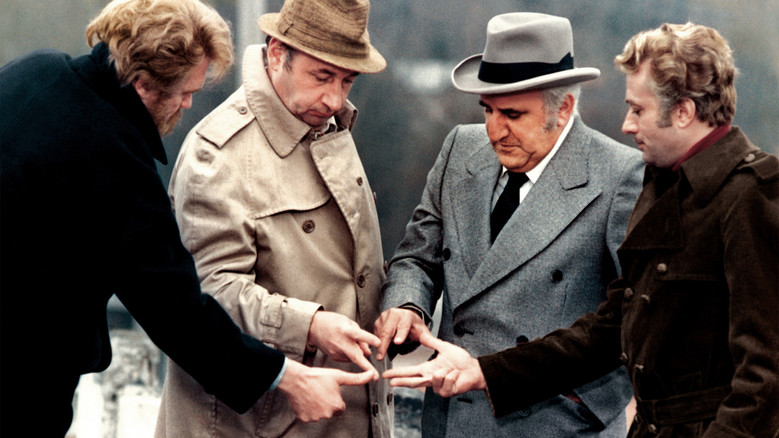
The term is used throughout the film to describe the friends' elaborate pranks. Examples include convincing villagers their town will be destroyed for a highway, slapping departing train passengers, and gatecrashing a Mafioso's family gathering. Each zingarata begins with a spontaneous decision to abandon their daily lives for adventure.
La Supercazzola (The Gobbledygook)
Invented by Count Mascetti, the supercazzola is a stream of nonsensical, pseudo-intellectual gibberish used to confuse and intimidate opponents, typically figures of authority like police officers. It symbolizes the friends' anarchic rebellion against logic, order, and the establishment. It's a verbal weapon that highlights the absurdity of bureaucratic language and the ease with which authority can be baffled by confident nonsense. The term has since entered the Italian lexicon.
The most famous instance is when Mascetti uses it on a traffic warden who has caught them making noise. He unleashes a torrent of meaningless phrases with official-sounding suffixes, completely bewildering the officer and escaping punishment. It is used in various other confrontations as a tool of comic deflection.
Perozzi's Death
The sudden and undignified death of Giorgio Perozzi from a heart attack at the end of the film symbolizes the ultimate, inescapable reality that their games cannot defy. It serves as the film's tragic punchline, reminding the friends and the audience that life's cruelest prank is death itself, which arrives unannounced and cannot be laughed away. It transforms the film from a pure comedy into a profound meditation on mortality.
After a night of revelry, Perozzi suffers a fatal heart attack. His friends gather at his deathbed, initially treating it as another joke. The final scene takes place at his funeral, where his friends, true to form, turn even this solemn occasion into one last prank on the somber attendees, demonstrating that their coping mechanism, even in the face of grief, remains unchanged.
Philosophical Questions
Is perpetual adolescence a valid form of rebellion against a disappointing adult world?
The film constantly explores whether the friends' refusal to grow up is a heroic act of defiance or a pathetic failure of character. It presents their pranks as moments of pure, unadulterated genius and freedom. Yet, it also shows the collateral damage: neglected families, financial ruin, and emotional detachment. The question is left open: is it better to embrace life's absurdities with childish glee, like Perozzi, or to face them with the grim seriousness of his son? The film seems to lean towards the former, but Perozzi's sudden death complicates any easy answer, suggesting that while the game is fun, the end is brutally final.
Can humor truly conquer suffering, or is it merely a temporary distraction?
Laughter is the characters' primary weapon against the pains of life—poverty, loneliness, illness, and boredom. They even turn Perozzi's funeral into a final prank. This raises the question of whether humor is a transcendent force or simply a mask for despair. Monicelli portrays their comedy as both a vital coping mechanism and a profound denial of reality. The final scene is ambiguous: are they heroically laughing in the face of death, or are they tragically incapable of genuine grief? The film suggests that humor doesn't erase pain, but it makes bearing it possible.
Core Meaning
The core meaning of "My Friends" is a profound, tragicomic exploration of friendship as the ultimate, albeit juvenile, rebellion against the disappointments of life, aging, and the inevitability of death. Director Mario Monicelli suggests that the relentless pursuit of gags and pranks is not mere immaturity but a conscious, if desperate, strategy to prolong youth and evade the responsibilities and sorrows of adulthood. The film argues that in the face of personal failure and existential dread, the camaraderie and shared laughter of friendship become a vital coping mechanism. However, it is a bittersweet remedy; the humor is constantly tinged with a deep-seated melancholy, suggesting that such escapes are fleeting and that reality, particularly death, is the one prankster that cannot be outwitted.